In this lesson we cover Amazon Keyspaces — AWS’s managed, Cassandra-compatible database service for high-throughput, low-latency workloads. Amazon Keyspaces (for Apache Cassandra) delivers a serverless Cassandra experience: AWS manages the underlying infrastructure, automatically scales capacity, and provides built-in security, availability, and monitoring. Applications use Cassandra Query Language (CQL) and standard Cassandra drivers to interact with Keyspaces, minimizing migration or tooling changes. Key highlights:
  • Fully managed, Cassandra-compatible service using familiar CQL and Cassandra drivers.
  • Serverless scaling with on-demand billing or provisioned throughput (with auto scaling).
  • High availability across Availability Zones, encryption at rest, IAM integration, and VPC endpoints.
  • Built-in TTL (time-to-live) for automatic expiration of data and managed backups.
  • Support for multi-region (active-active) deployments with storage-based asynchronous replication.
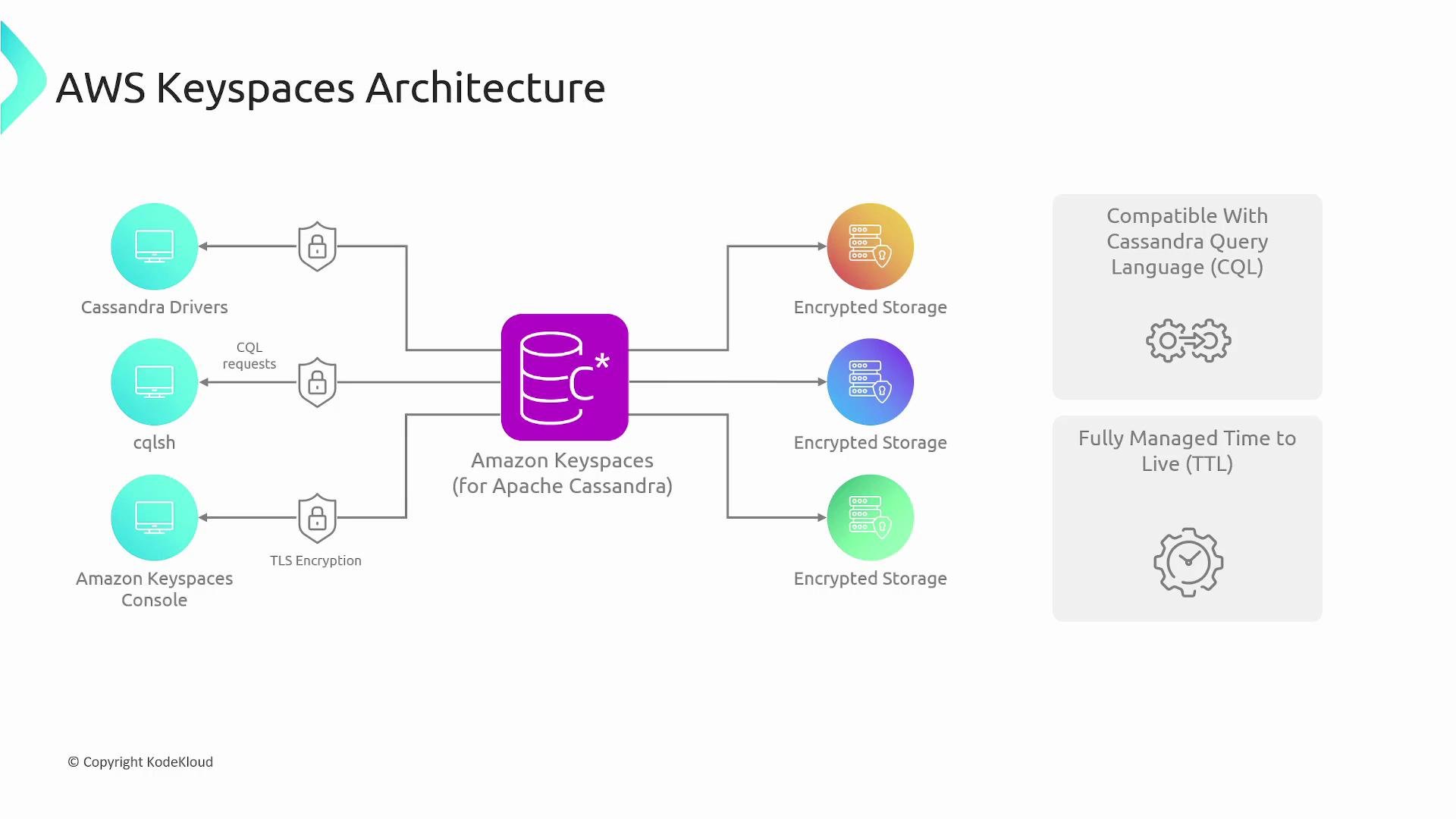
A diagram of AWS Keyspaces architecture showing Amazon Keyspaces (for Apache Cassandra) in the center connecting client interfaces (Cassandra drivers, cqlsh, and the Keyspaces console) on the left via TLS to multiple encrypted storage nodes on the right. Side notes highlight compatibility with Cassandra Query Language (CQL) and fully managed time-to-live (TTL).
What is Amazon Keyspaces Amazon Keyspaces is designed to remove the operational burden of running Apache Cassandra clusters: provisioning, patching, node management, and scaling. Because Keyspaces is compatible with CQL and Cassandra drivers, you can often reuse existing application code with minimal changes. How applications use Keyspaces
  • Use CQL and standard Cassandra drivers (Java, Python, Node.js, etc.) to read and write data.
  • Keyspaces encrypts data at rest and in transit, integrates with AWS IAM for auth, and supports VPC endpoints for private connectivity.
  • TTL (time-to-live) is fully managed by Keyspaces — you don’t provision capacity separately for TTL operations.
Quick CQL examples Create a keyspace (CQL):
Create a table and use it:
Capacity modes Keyspaces supports two throughput capacity modes. Choose the mode that matches your workload characteristics:
Choose on‑demand for unpredictable or bursty workloads and provisioned capacity (with auto scaling) for predictable workloads where cost optimization matters.
You can switch a table’s capacity mode (on‑demand ↔ provisioned) at most once per day. Plan capacity changes accordingly.
Multi-region Keyspaces Keyspaces supports multi-region (global) tables implemented as replica tables — one replica per region — that share a single logical schema. Writes in any region are propagated to other regions using storage-based asynchronous replication. Typical replication lag is low (often under one second), and replication occurs in storage so it has minimal effect on query performance. Benefits of multi-region Keyspaces:
  • Active‑active global reads and writes with low latency for local users.
  • Improved business continuity: if a region fails, traffic can be routed to another active region.
  • Built-in conflict resolution for write conflicts across regions.
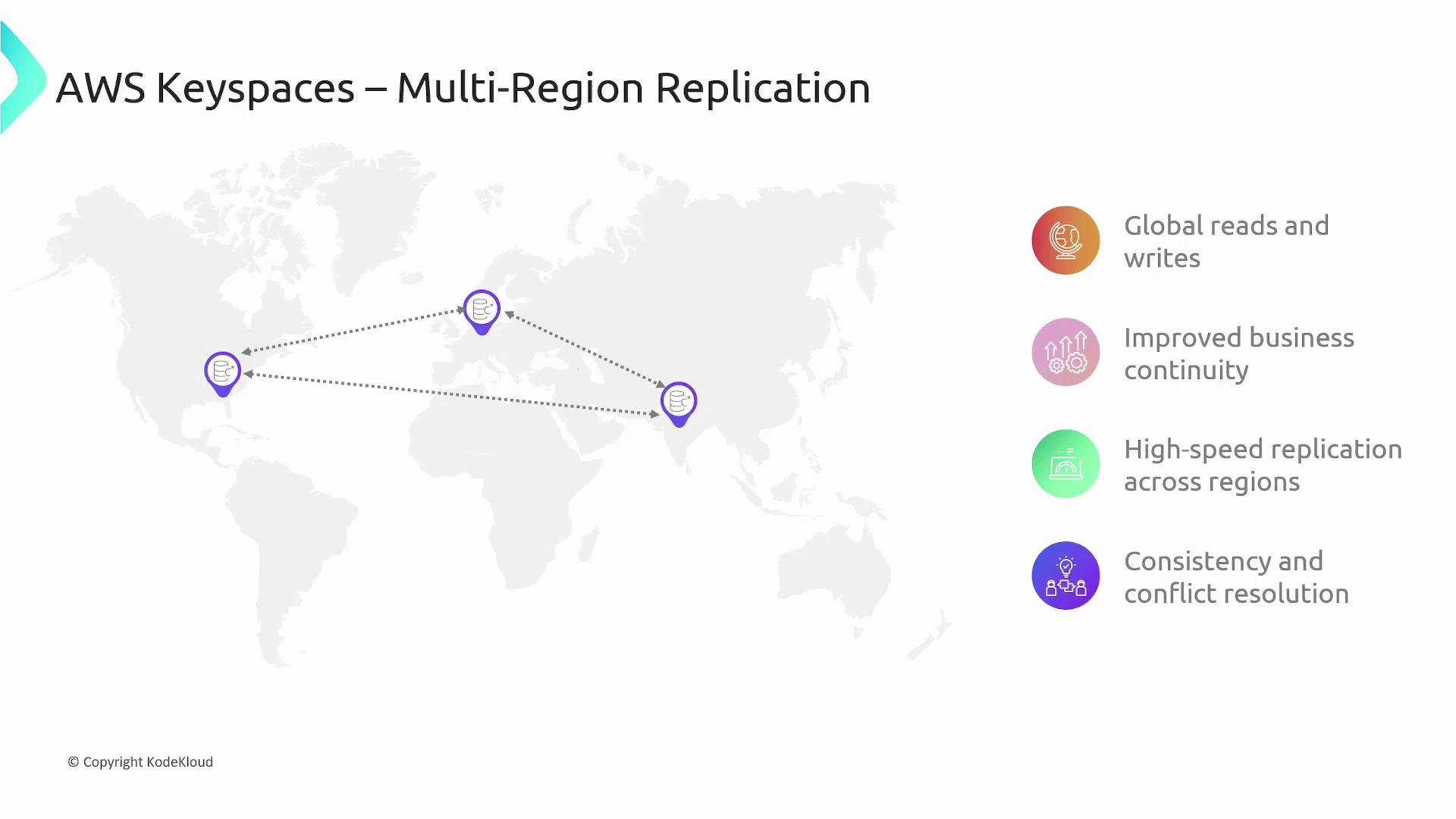
An AWS Keyspaces multi-region replication diagram showing three database nodes on a faint world map connected by dotted arrows. On the right are colored icons listing benefits: global reads and writes, improved business continuity, high-speed replication, and consistency/conflict resolution.
When to use Keyspaces Keyspaces is a strong fit when you need Cassandra compatibility without operational overhead. Typical use cases include:
  • High-volume telemetry and time-series ingestion (industrial IoT).
  • Real-time trading and market monitoring systems.
  • Fleet management, routing, or any system that needs low-latency reads and high write throughput.
Key advantages:
  • No Cassandra cluster management (provisioning, patching, repair).
  • Seamless use of existing CQL-based tools and drivers.
  • Built-in security and monitoring integrations.
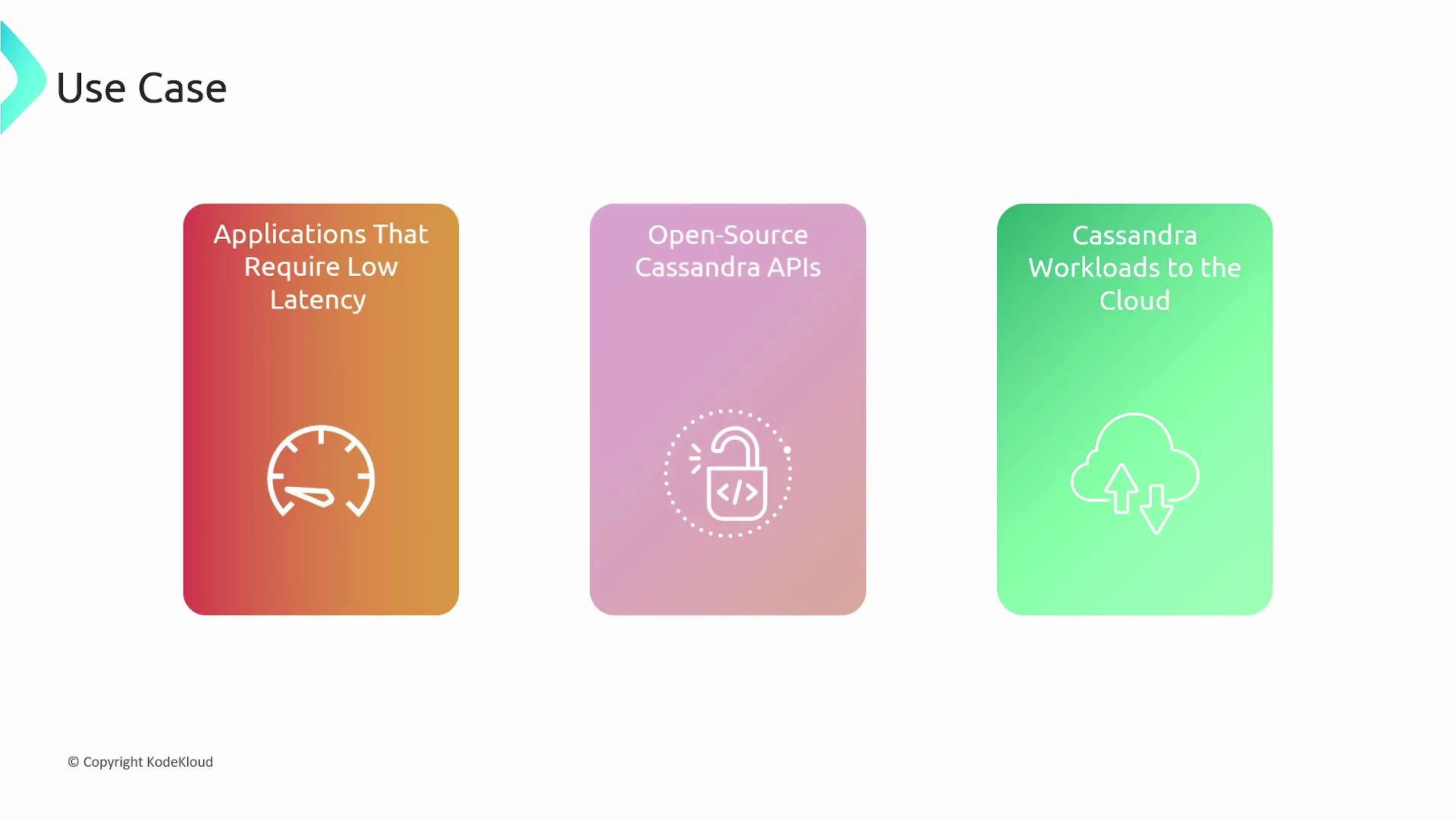
A slide titled "Use Case" showing three colored panels: "Applications That Require Low Latency," "Open-Source Cassandra APIs," and "Cassandra Workloads to the Cloud," each with a matching icon (speedometer, unlocked code padlock, and cloud).
Key features (quick reference) Summary Amazon Keyspaces is a fully managed, Cassandra-compatible, serverless database service that reduces operational complexity while preserving the familiar CQL interface. Choose on-demand capacity for unpredictable traffic and provisioned capacity (with auto scaling) for steady, predictable workloads. Multi-region active-active tables provide global reads and writes with low latency and built-in conflict resolution, while the service handles security, replication, TTL, and monitoring for you.
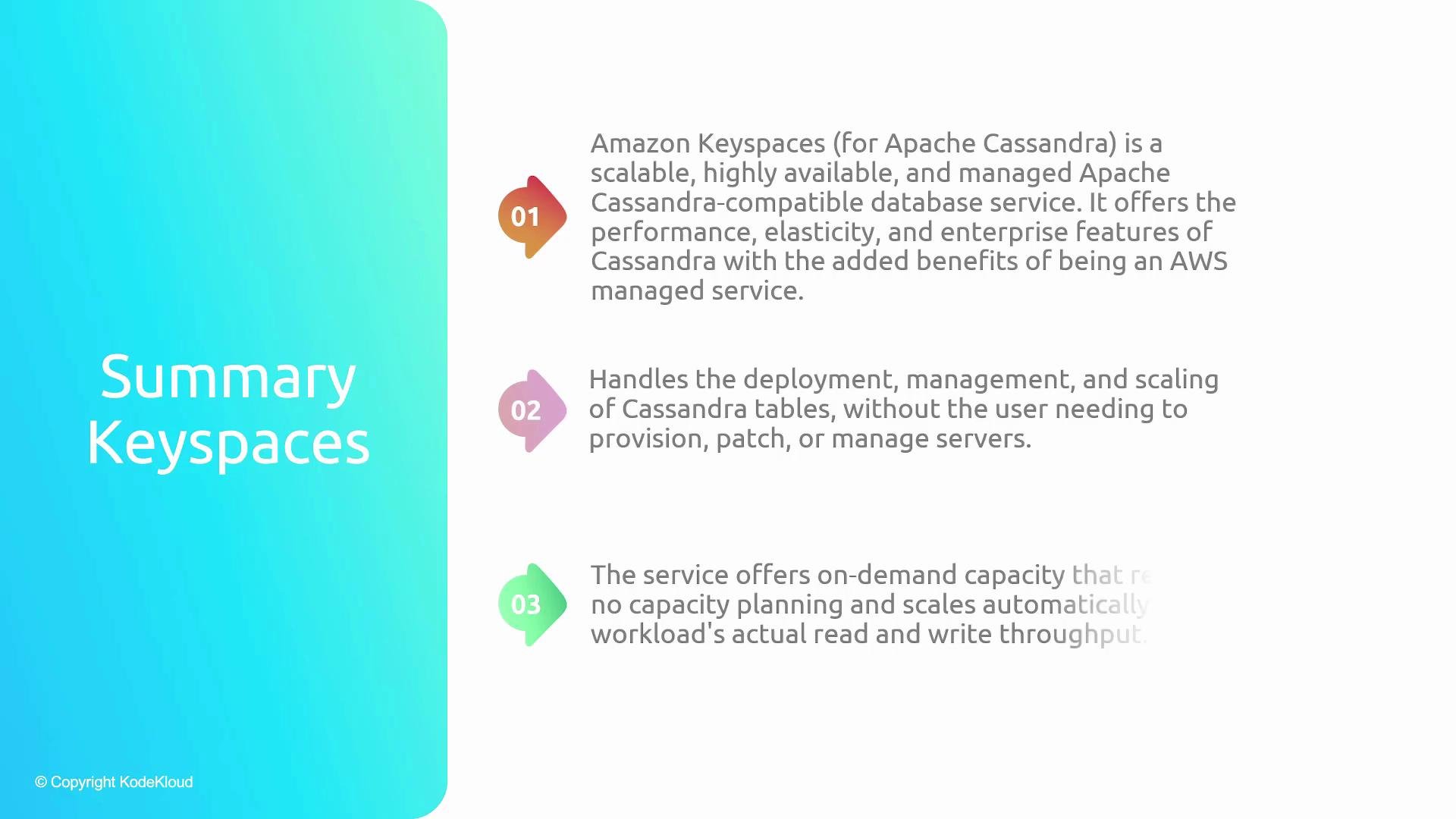
A slide titled "Summary Keyspaces" with a turquoise gradient sidebar and three numbered points summarizing Amazon Keyspaces as a managed, Cassandra-compatible database service. The right side lists brief feature descriptions like scalability, automated management, and on‑demand capacity.
Further reading and references

Watch Video