

DMS architecture and components
DMS is built from several cooperating components that discover source systems, convert schemas when needed, and replicate data from source to target. The sections below walk through each major component and show where it fits in a typical migration workflow.DMS Fleet Advisor
DMS Fleet Advisor performs discovery and metadata collection across database environments to help plan migrations. You deploy a lightweight data collector on database hosts (for example, on-premises MySQL or SQL Server). The collector inventories schemas, objects, and configurations and sends metadata to DMS for analysis. You can export results (CSV) for offline planning and effort estimation.
Schema Conversion Tool (SCT)
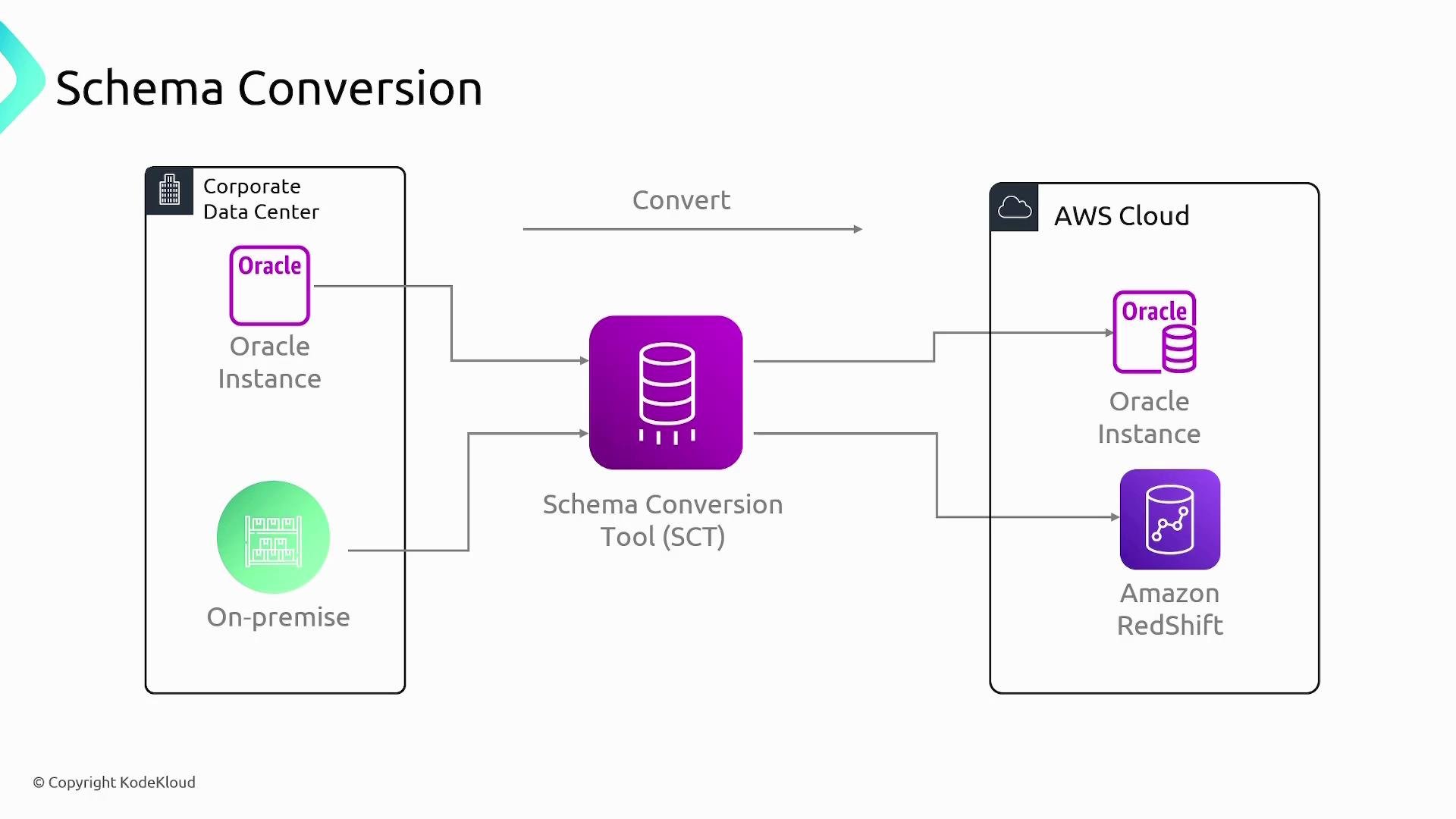
The AWS Schema Conversion Tool (SCT) analyzes your source database and flags schema objects, stored procedures, and other constructs that require conversion for a heterogeneous migration. SCT can automate many conversions and generates a report of items needing manual intervention. It also supports data type mappings and can generate a migration plan for use with DMS. SCT is especially useful for heterogeneous migrations (for example, Oracle → PostgreSQL or an enterprise data warehouse → Amazon Redshift), where database constructs and data types differ.Replication instance and endpoints
The replication instance is the managed compute resource that runs DMS replication tasks. It reads data from source endpoints, applies any configured transformations, and writes to target endpoints. Choose replication instance capacity based on expected throughput and latency requirements. An endpoint is a configuration that describes a source or target data store. Endpoint settings include:- Endpoint type:
sourceortarget - Engine type: e.g., MySQL, PostgreSQL, Oracle
- Server host/IP and port
- Encryption configuration (TLS certificates, if required)
- Authentication credentials

When configuring endpoints, verify network access (VPC, routing, security groups) and confirm credentials and any required certificates. Missing network routes or incorrect authentication are common causes of connection failures.
Replication tasks and migration modes
A replication task is the job that moves and/or replicates data between a source endpoint and a target endpoint. When creating a task you select:- The replication instance
- Source and target endpoints
- A migration type (mode)
- Table mappings and optional transformation rules
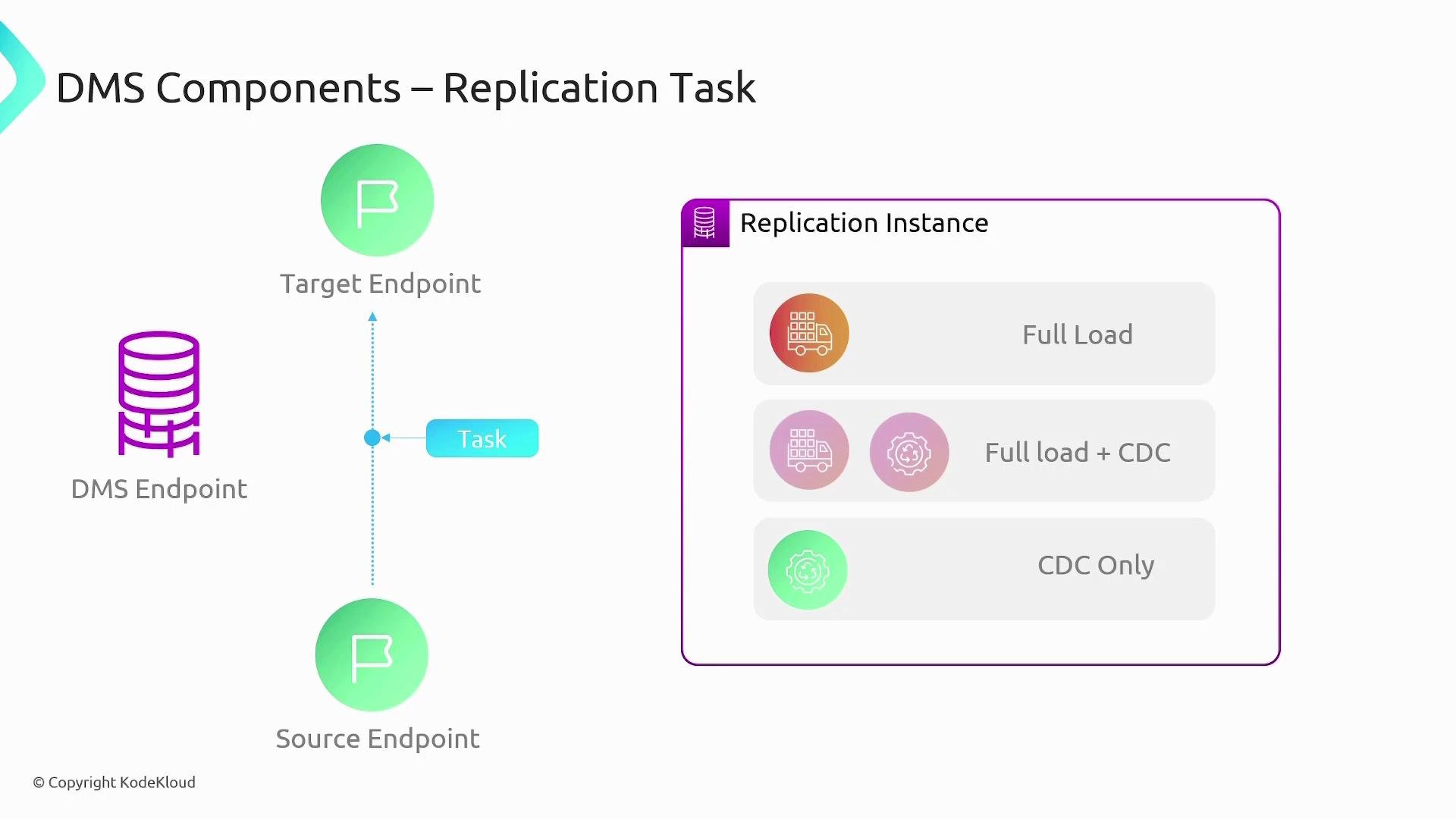
Always validate data consistency and plan for cutover testing. Network latency, LOBs/large objects, and unsupported data types can introduce replication delays or require manual reconciliation.
Automatic schema conversion and mappings
For heterogeneous migrations, pair DMS with SCT. SCT converts schema objects and helps define mappings (for example, mapping OracleVARCHAR2 to PostgreSQL VARCHAR). SCT attempts automated conversions and flags objects that need manual work. DMS focuses on data movement and CDC — SCT handles the schema and code translation.
Key terminology (recap)
- Endpoint: A source or destination database configuration used by DMS.
- Replication instance: The compute resource that runs replication tasks.
- Task: The migration job that moves data and/or applies ongoing changes between endpoints.
- CDC (Change Data Capture): The mechanism that captures and applies ongoing changes from the source to the target.
Common use cases
DMS is used for a variety of migration and replication scenarios:
Putting it all together
DMS, Fleet Advisor, and SCT form a complementary toolkit:- Fleet Advisor discovers and inventories your database estate so you can estimate migration effort.
- SCT converts schemas and application code for heterogeneous targets.
- DMS performs data movement and CDC to keep source and target synchronized with minimal downtime.
Links and references
- AWS Database Migration Service documentation
- AWS Schema Conversion Tool documentation
- AWS DMS Fleet Advisor overview
- Amazon Redshift
- Amazon S3