

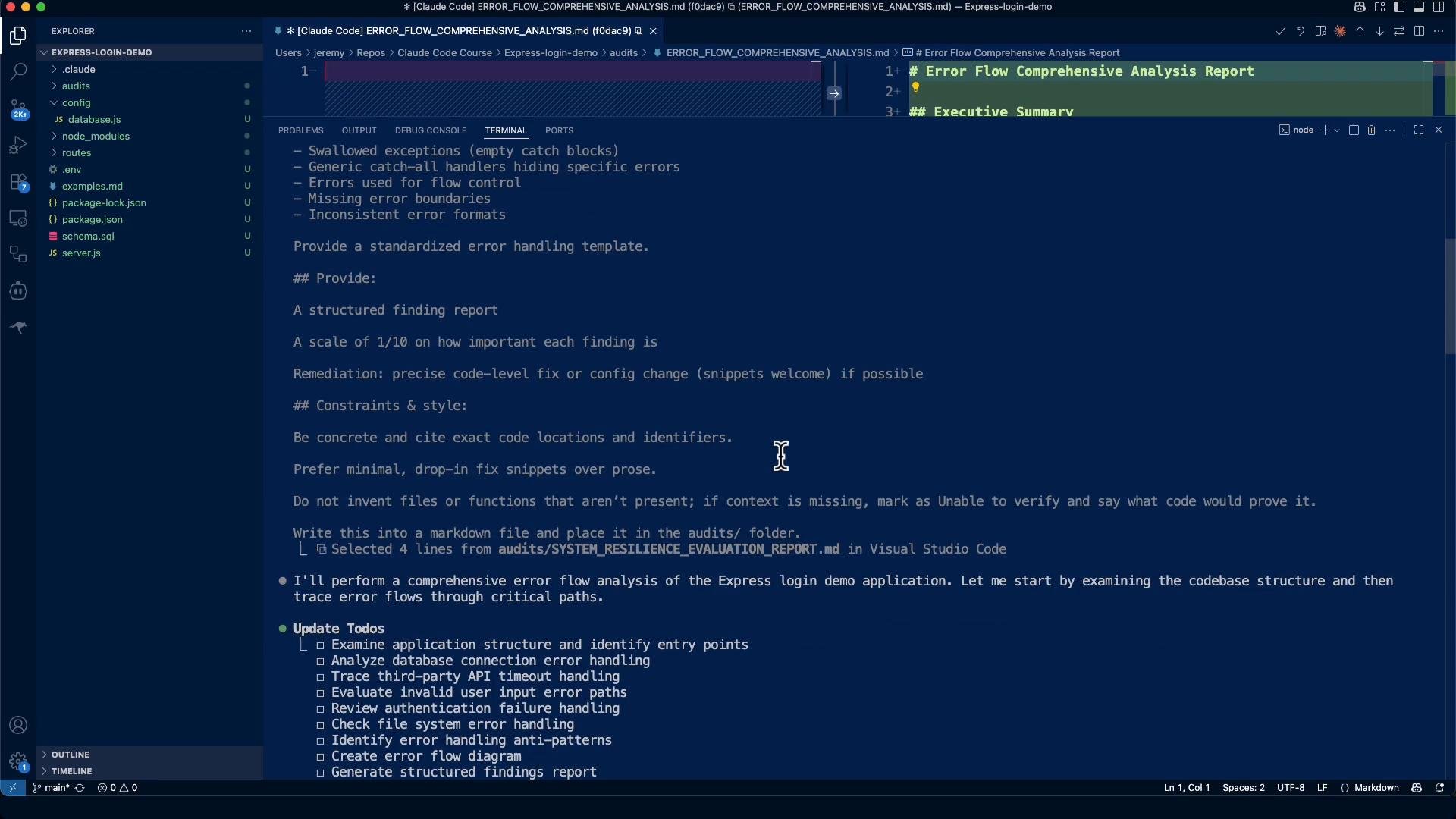
- Map where errors are caught and how they’re transformed
- Determine what is logged versus what the user sees
- Verify system-state consistency after failures
- Provide a prioritized remediation plan with code-level fixes
Executive summary
This audit inspects error handling in a small Express login demo. Key findings show several high-impact gaps that make the service susceptible to outages, information leakage, and inconsistent system state. The highest-priority fixes are adding a global error handler, validating critical runtime configuration, and protecting database interactions with timeouts and pool limits. Top recommendations (high-level):- Add a global Express error handler + process-level rejection handlers
- Harden database usage: connection pool limits, connection timeouts, and per-query timeouts
- Standardize error JSON responses and switch to structured logging (no console-only logs)
- Harden JWT usage (validate presence of secrets and specify algorithms)
- Add rate limiting to auth endpoints and consider circuit-breaker/retry for transient dependencies
Application entry points and observed state
- Main server entry point: server is started but lacks a global error-handling middleware and request-level timeouts.
- Authentication route: single POST
/api/auth/loginendpoint implements validation, bcrypt compare, JWT signing. - Database: PostgreSQL
pgPool exists but is missing explicitmax,connectionTimeoutMillis, and per-query timeouts. - Core dependencies observed: Express 4.x,
jsonwebtoken,bcrypt,express-validator. - Not found in the codebase: external HTTP clients and file system operations (
fsnot detected).
Critical path analyses
For each critical path we show: origin points, observed flow, key gaps, and minimal remediation snippets.1) Database connection / query failures — Severity: 9/10
Origin points- Pool creation and configuration (missing connection timeouts / max clients)
- Route-level DB queries in auth flow (no per-query timeout)
- DB connection error or long-running query →
pool.query()or client usage → route-levelcatch→ generic error mapping to 503 or 500 - Potentially sensitive error messages are logged or returned depending on environment
- No per-query timeouts → hung queries can block resources
- No pool max configuration → possible connection exhaustion under load
- No retry/circuit-breaker for transient failures
- Logging may include raw DB error objects (sensitive)
- Set pool limits / timeouts (database config):
- Per-query timeout wrapper:
- Circuit-breaker sketch (use to guard DB calls):
opossum) and instrument metrics.
2) Third-party API timeout — Severity: N/A (Not present / Unable to verify)
Finding: No external HTTP clients detected in repository. Future integrations must:- Set per-request timeouts (axios/fetch/timeouts)
- Implement retries with backoff and circuit breakers
- Surface standardized errors to the client
3) Invalid user input — Severity: 6/10
Origin points- Validation middleware applied on
/api/auth/login(express-validator chains andvalidationResult)
- Email normalization and format checks present
- Password minimum length check exists
- Missing: explicit max lengths, sanitization to prevent XSS vectors, and strict error messaging to avoid information leakage
- No size limits on input fields (risk of DoS with large payloads)
- Validation error responses can disclose too much detail
4) Authentication failures — Severity: 7/10
Origin points- User-not-found branch
- Invalid password path using
bcrypt.compare - JWT signing usage
- Consistent client-facing message for invalid credentials (prevents enumeration)
- Use of
bcrypt.comparefor password verification
- No startup validation that
JWT_SECRETexists; no explicit signing algorithm specified injwt.sign - No rate limiting or account lockouts
- JWT expiry read from env without validation
- Validate critical config at startup:
- Enforce JWT algorithm when signing:
- Apply rate limiting to login endpoint:
5) File system errors — Severity: N/A (Not present / Unable to verify)
Finding: No file system usage found. If future code addsfs operations:
- Wrap I/O in try/catch and map errors to safe client responses
- Log errors with context but avoid exposing file paths or internals to users
Error handling anti-patterns observed
- Generic catch-all handlers that swallow specific errors (e.g., returning 500 without context or remediation)
- Console-only logging (insufficient structured logs for production)
- Missing global error middleware and process-level handlers
- Inconsistent error response formats across code paths (validation vs auth vs DB errors)
- Missing global handler: 9/10
- Generic swallowed errors: 8/10
- No circuit-breaker/retry: 8/10
- Console-only logging: 7/10
- Inconsistent response formats: 5/10
Error flow diagram (simplified)
[ HTTP Request ] → [ Express App ] → [ Auth Route ] ↓ ↓ ↓ ERROR ORIGIN POINTS: Input Validation | Authentication | Database | JWT ↓ TRANSFORMATION LAYER: Validation formatting | Auth normalization | DB error code switch ↓ FINAL HANDLING: HTTP status + standardized error JSON + structured log (avoid console-only) ↓ RECOVERY: Retry / Circuit Breaker / Rate limit / Graceful degradation (NONE present in current app)Structured findings (selected)
Concrete remediations (minimal, prioritized snippets)
Priority 1 (Immediate, low-effort)- Add global Express error middleware (place after all routes):
- Process-level rejection / exception handlers (startup):
- Validate critical config at startup:
- Database pool and per-query timeout (see Database section above).
- Rate limiting for login (see Authentication section above).
- Replace console logging with structured logger:
logger.error(...) / logger.info(...) instead of console.*.
Priority 3 (Medium-term)
- Standardize error responses:
- Enforce JWT signing options (see Authentication section).
- Implement resilient patterns: circuit-breaker and retries for transient dependencies.
Testing suggestions (local/manual)
Run these to validate behavior changes:Summary & recommended next steps
Short-term (days)- Add global error middleware and process-level handlers.
- Validate critical environment variables at startup (
JWT_SECRET). - Swap
consolecalls for a structured logger (winston or similar).
- Enforce DB pool limits and per-query timeouts.
- Add rate limiting to auth endpoints.
- Explicitly set JWT signing algorithm and validate expiry config.
- Implement circuit-breaker/retry patterns around DB/external calls.
- Standardize error payloads across routes.
- Harden input sanitization and size limits.
- Add account lockout and monitoring/alerts on error rates.
Start by adding the global error middleware and config validation — they are low-effort, high-impact fixes that prevent many common failure modes.