

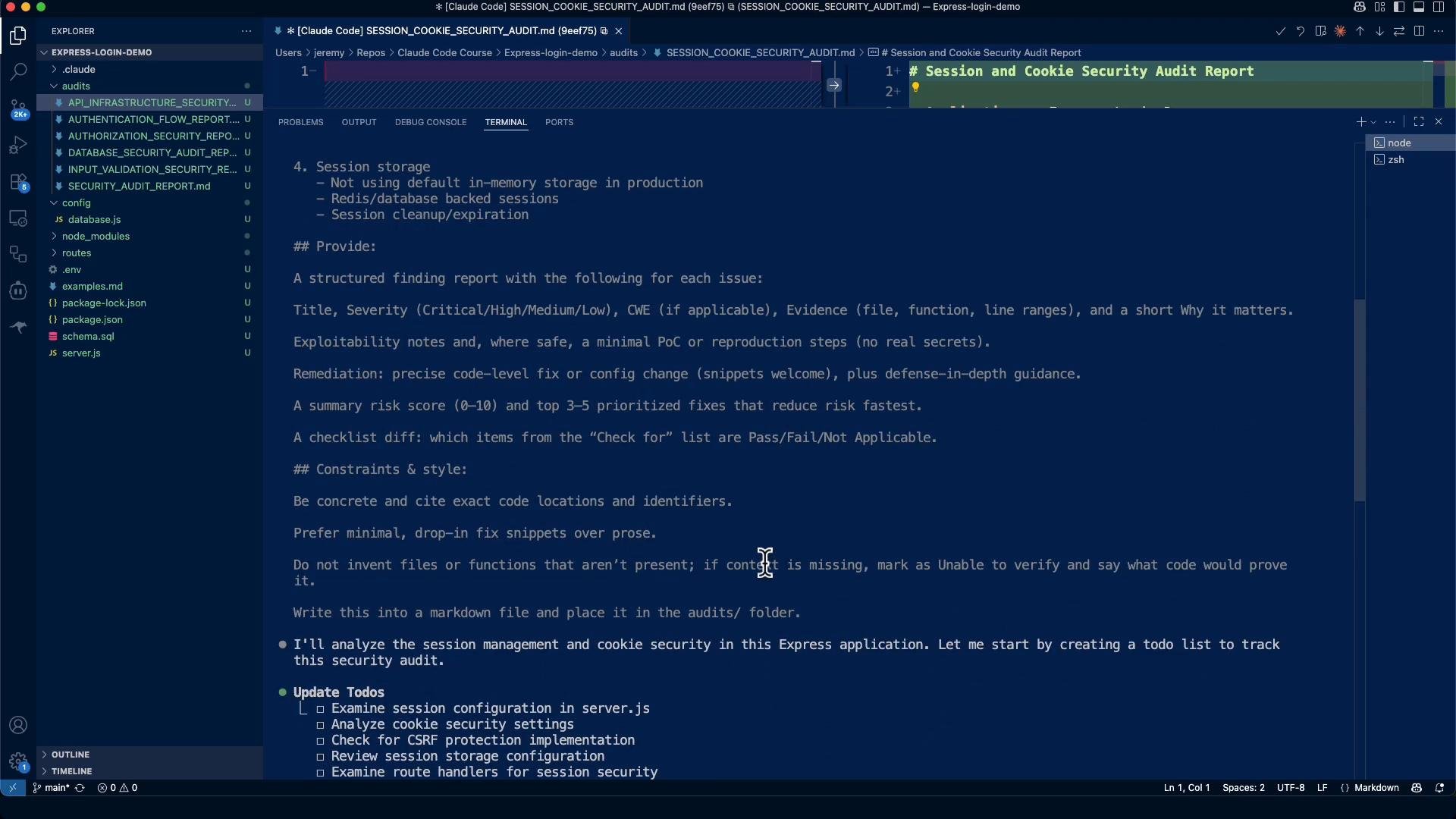
- Inspect session configuration: secure flag, HttpOnly, SameSite, session timeout, and session regeneration.
- Validate cookie usage: flags, absence of sensitive data, domain/path scoping, and encryption of sensitive cookies.
- Check for CSRF protections: token-based or double-submit cookie patterns, or origin/header checks.
- Review session storage: avoid default in-memory stores in production; prefer Redis or DB-backed stores and ensure cleanup/expiration.
- Produce a structured findings report: title, severity, CWE mapping, evidence, impact, exploitability, PoC (when safe), and code-level remediation.
Executive summary (condensed)
- Authentication design: JWTs are used via Authorization headers — no traditional cookie-based session store is present.
- Risk score: 8.5 / 10 (High) — main issues are lack of token revocation, absence of refresh token rotation, and limited guidance for secure token storage.
- High-level remediation: introduce token revocation (blacklist), rotate and shorten JWT lifetimes, add refresh tokens stored securely (prefer httpOnly cookies), validate/enforce a strong JWT secret, and add CSRF protections if cookies are introduced.
- No session management / token revocation (Critical — CWE-613)
- Evidence:
server.js:1-19,routes/auth.js:1-98— JWTs are issued and there is no blacklist or revocation layer. - Impact: Stolen tokens remain valid until expiry; no immediate revocation path.
- Exploitability: High — attackers with tokens can access resources until expiry.
- Missing refresh token implementation and long-lived access tokens (High — CWE-613)
- Evidence:
routes/auth.js:48-57— only access tokens are issued; no refresh tokens are present. - Impact: Long-lived access tokens increase exposure windows. Refresh tokens allow shorter access token lifetimes and controlled re-authentication.
- No CSRF protection for cookie usage (Medium — CWE-352)
- Evidence:
server.js:1-19— no CSRF middleware detected. Currently, JWTs in Authorization headers are not vulnerable to CSRF, but storing refresh tokens in cookies would require CSRF mitigation. - Impact: Cookies are automatically sent by browsers; without CSRF protections, state-changing endpoints can be abused.
- Insecure or weak JWT secret handling (High)
- Evidence:
.envor code contains default or short JWT secret. - Impact: Weak or known JWT secrets let attackers forge tokens.
- Exploitability: High if a default/short secret is used.
kid) strategy so older tokens can be validated during a transition period.
- No session/store configuration (Medium/High)
- Evidence: no session store configured. If you adopt express-session for other parts, do not use MemoryStore in production.
- Impact: MemoryStore leaks memory and lacks persistence and centralized invalidation.
- Token storage guidance missing (Medium)
- Evidence: no client-side guidance or documentation. Storing JWTs in
localStorageorsessionStorageis vulnerable to XSS. - Impact: JavaScript-accessible tokens can be exfiltrated via XSS.
- Recommendation: Prefer storing refresh tokens in
httpOnlycookies; keep access tokens short-lived and in memory. Provide client guidance for native and SPA clients.
- Implement logout endpoints to:
- Blacklist access tokens (as applicable), and/or
- Delete/expire refresh tokens in the DB and clear refresh cookie.
- Example logout handler:
Top priority fixes (recommended)
- Replace any weak/default JWT secret with a strong, randomly generated secret and enforce minimal length checks.
- Implement token blacklisting/invalidations (Redis or DB-backed) to support immediate revocation.
- Adopt a refresh-token architecture with short-lived access tokens and rotated refresh tokens stored as secure httpOnly cookies.
- Add logout endpoints that invalidate refresh tokens and optionally blacklist access tokens.
- If cookies are used, enable CSRF protection (e.g.,
csurfor double-submit) and ensuresecure,httpOnly, andsameSiteflags are set.
- Check for missing logout endpoint:
- Confirm token remains valid after intended revocation (demonstrates lack of revocation):
- Break audits into focused checks (cookie flags, CSRF, token management, secret handling) rather than issuing a single large prompt. Focused prompts reduce hallucinations and improve coverage.
- Repeated findings across different, independent checks indicate a higher-confidence issue that needs remediation.
- Immediate: Replace weak JWT secret, add logout and token blacklist, shorten access token lifetime.
- Week 1: Implement refresh-token rotation, persist refresh tokens in a DB, and set refresh cookie flags (
httpOnly,secure,sameSite). - Week 2: Add CSRF protection for cookie-based flows, add session monitoring and adaptive timeouts.
- Month 1: Harden secrets management, implement auditing and alerting for session anomalies, and map controls to compliance frameworks (OWASP Top 10, PCI-DSS, SOC 2, NIST).
If you adopt cookies for refresh tokens: always set
httpOnly, secure (in production), and sameSite: 'strict', and pair this with CSRF protections for state-changing endpoints.