Overview
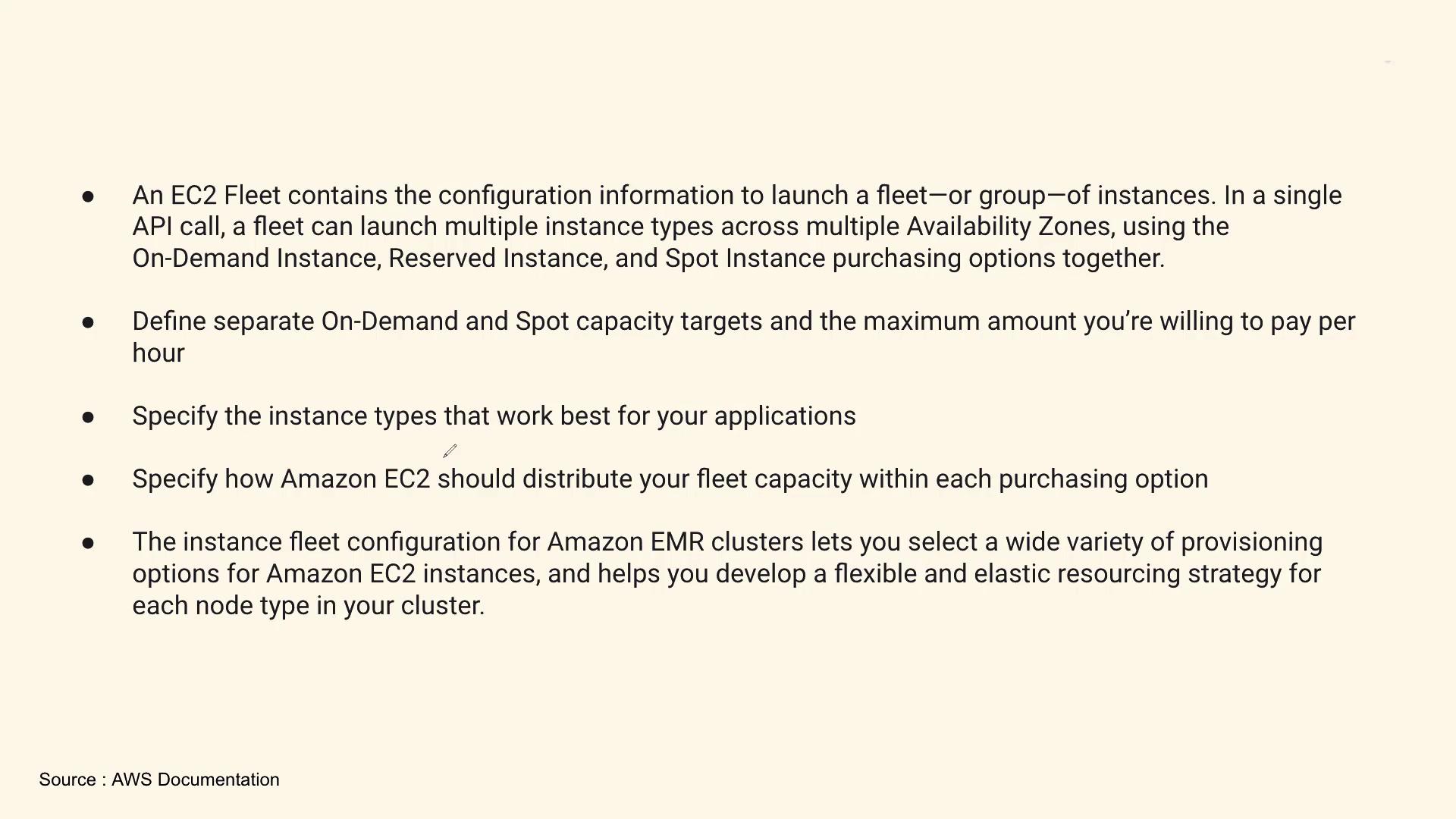
An instance fleet is a configuration that enables you to launch a group of EC2 instances with a variety of instance types. Unlike autoscaling groups that usually deploy similar instance types (for example, multiple T2_micro instances), an instance fleet offers the flexibility to mix different types—such as T2_micro, T3_medium, or M-series—to match your application’s needs.An instance fleet not only allows the use of multiple instance types but also supports integrating different purchasing options (spot, reserved, and on-demand) in one unified configuration.
How Instance Fleets Work
Think of an instance fleet as a military fleet where a primary ship is supported by smaller vessels. Similarly, AWS instance fleets allow you to mix and match various EC2 instances. This setup lets you define separate capacity targets for on-demand and spot instances, ensuring that you can fine-tune your infrastructure based on both performance requirements and cost-effectiveness.