

Understanding NoSQL
Both SQL and NoSQL databases are built to store information, yet they differ significantly in how they manage data structure:- In SQL databases, you must define a strict table schema—such as columns for ID, name, or age—before inserting any data. Any deviation from this structure (for example, attempting to add a “city” or “country” column) typically triggers an error.
- In NoSQL databases, on the other hand, there is no mandatory schema. This schema-less design allows you to store data with varying structures. For instance, one JSON or YAML record may contain the fields “name,” “age,” and “gender,” while another might also include “city” or “country.” The only requirement is that each record includes a unique identifier (UID).
NoSQL databases are particularly valuable when dealing with applications in which data formats can evolve over time or include unpredictable fields.
Visual Comparison: NoSQL vs. SQL
The diagram below presents a clear comparison between NoSQL and SQL database approaches, emphasizing how each manages data structure and use cases: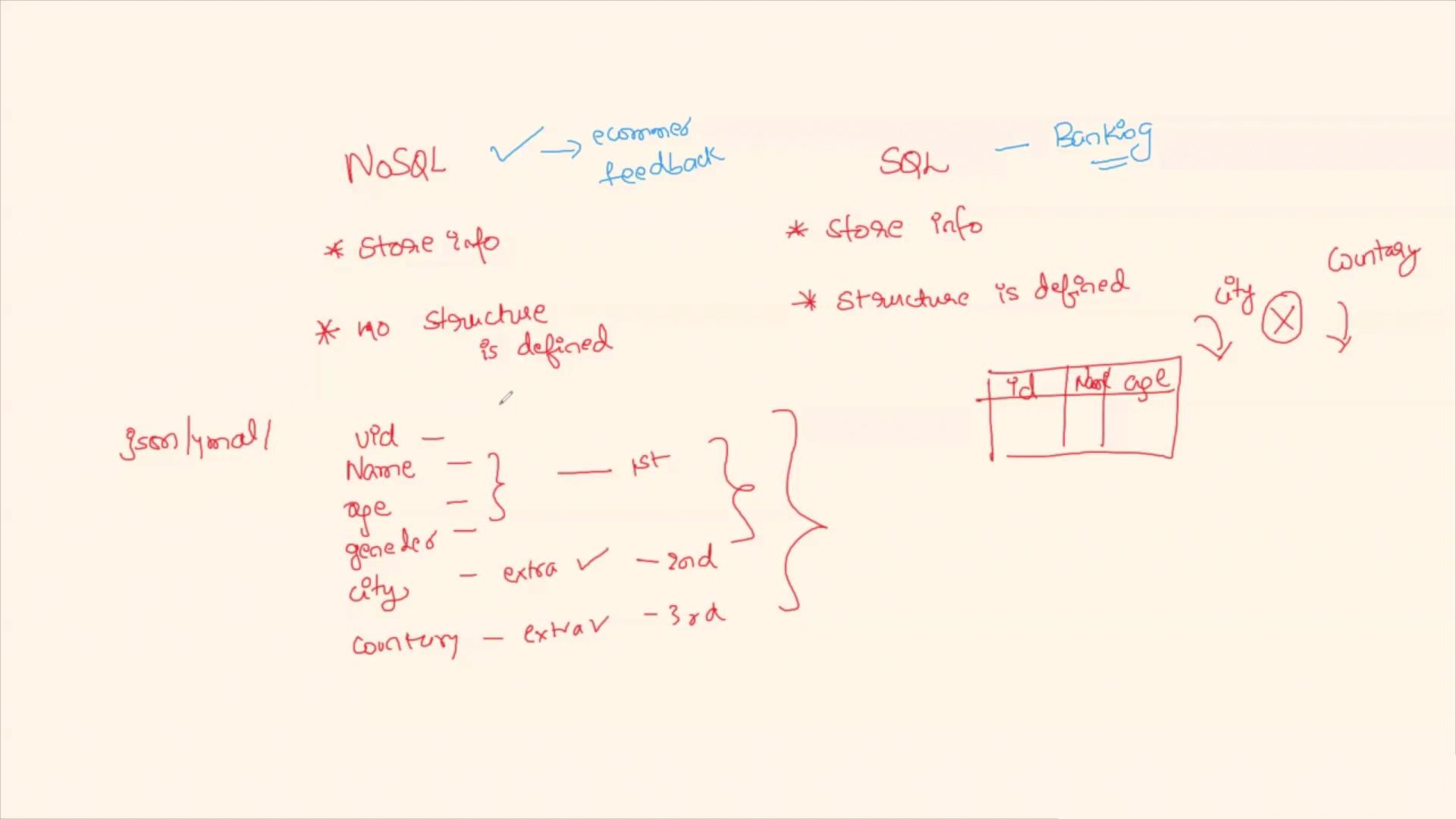
Interview Insights: Explaining NoSQL
When responding to an interview question about NoSQL, consider the following points:- Emphasize that NoSQL databases do not require a predefined schema.
- Highlight that they can store diverse data formats without modifications to an underlying structure.
- Explain that, unlike SQL databases with fixed schemas, NoSQL systems offer the flexibility necessary to accommodate dynamic and evolving data needs.
AWS and NoSQL: DynamoDB
When discussing AWS services, it’s important to mention DynamoDB. AWS DynamoDB is a serverless NoSQL database that scales automatically to handle high-traffic and variable workloads. This service allows you to store and retrieve data without the overhead of managing database servers, making it ideal for modern, flexible applications.AWS DynamoDB is a great choice when you require a scalable and managed NoSQL solution. It supports high performance and low-latency responses in diverse application scenarios.