

- Goal: Deepen your understanding of stakeholders and adapt your communication to their priorities.
- Daily task (5 days): Each day pick one different stakeholder. Spend 5–15 minutes either asking about their priorities or inferring them from past interactions (emails, meeting notes, or earlier conversations).
- Practice: Use active listening in one conversation per day. After listening, deliberately reframe one sentence to reflect the stakeholder’s priorities or concerns.
- Reflection prompts:
- Who was the stakeholder?
- What are their top priorities and constraints?
- How did you adapt your language, data, or emphasis?
- Did the response or outcome change?
- Choose five stakeholders (one per day).
- Use one active-listening technique per conversation (paraphrase, ask a clarifying question, or summarize).
- Record one short reflection after each interaction.
- Goal: Practice simplifying one technical idea so a non-technical person can understand it.
- Weekly plan:
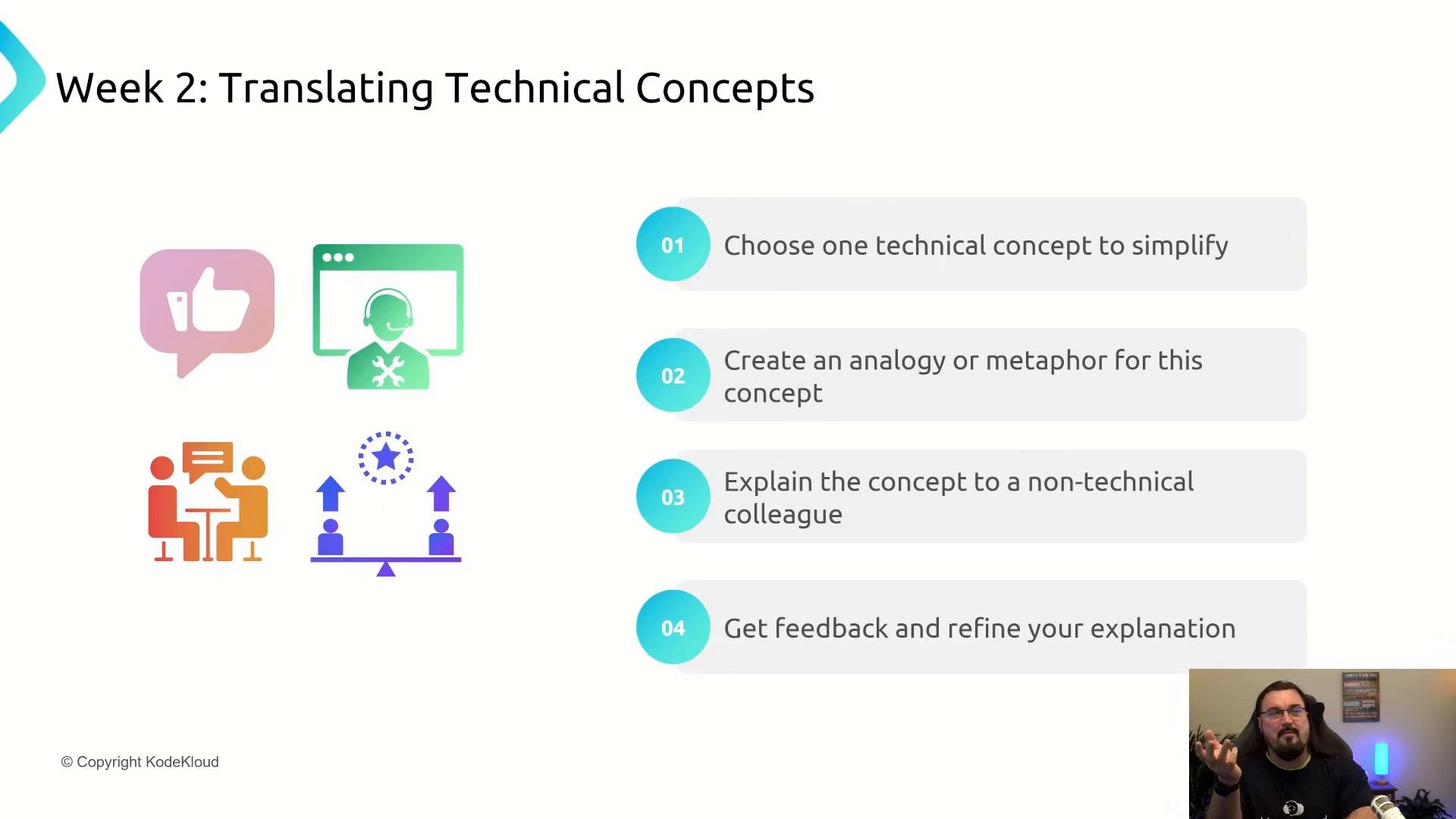
- Choose one technical concept to simplify (example: “CI/CD pipeline,” “cloud computing,” or “service mesh”).
- Create a single, clear analogy or metaphor that captures the core idea.
- Explain the concept to a non-technical person — a friend, family member, or colleague.
- Collect feedback and refine your explanation.
- Keep the analogy focused on one main benefit or risk.
- Avoid jargon; when you must use a term, define it in one sentence and link it to the analogy.
- Measure success by whether the listener can paraphrase the idea back to you.
- Goal: Turn a technical success or challenge into a concise, memorable story.
- Weekly plan:
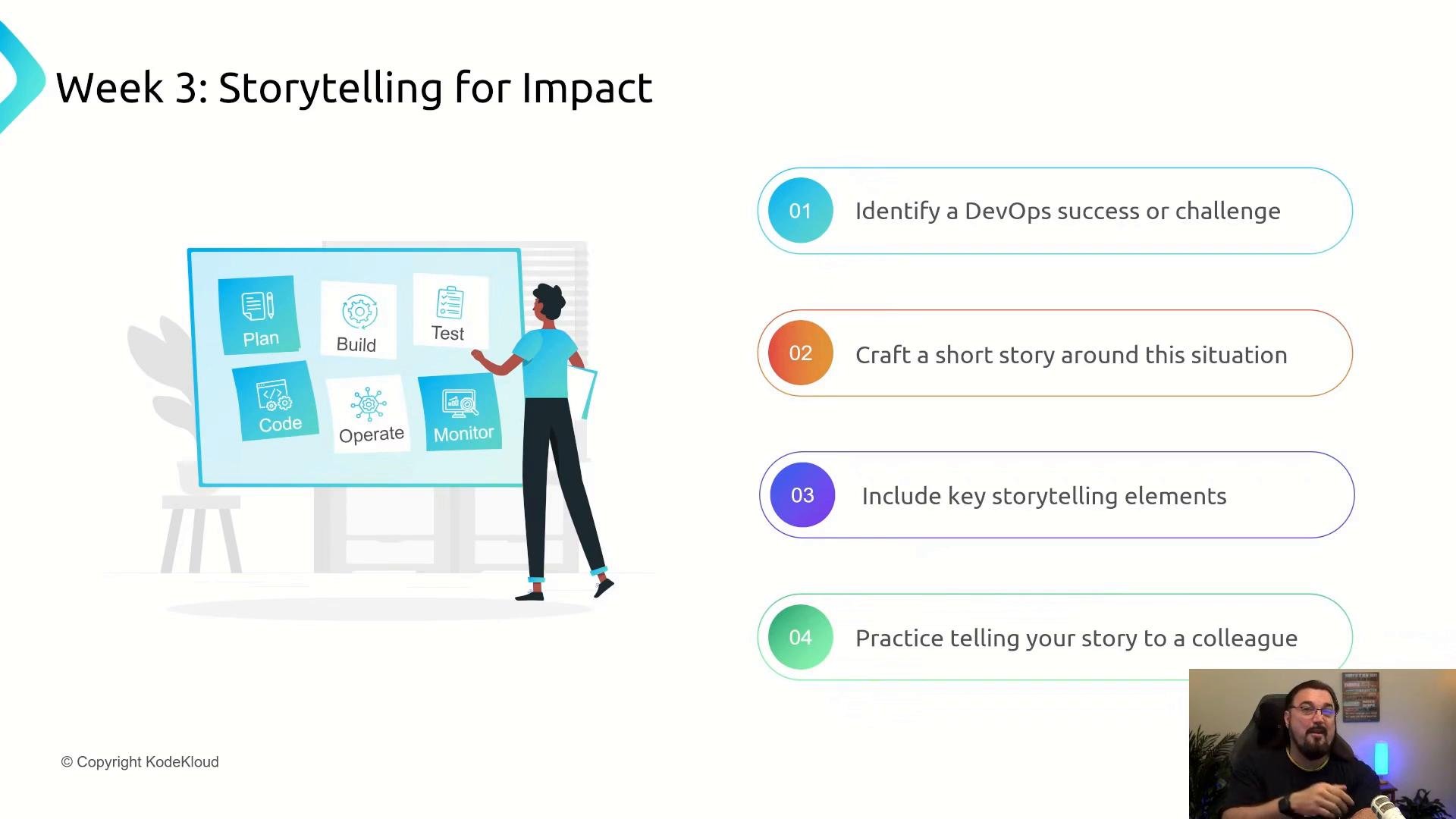
- Identify a technical success or challenge with a clear beginning, middle, and end.
- Craft a short story with context (why it mattered), the problem, the action taken, and the outcome.
- Optionally, extend Week 2: tell the story to a non-technical person using your analogy for clarity.
- Get feedback and refine the story, focusing on clarity, emotional impact, and a single key takeaway.
- Keep it under 60–90 seconds for an elevator-style delivery.
- Highlight stakes and impact (cost saved, downtime avoided, performance improved).
- End with a one-sentence takeaway or lesson.
- Goal: Anticipate and respond effectively to objections about value, cost, or feasibility.
- Weekly plan:
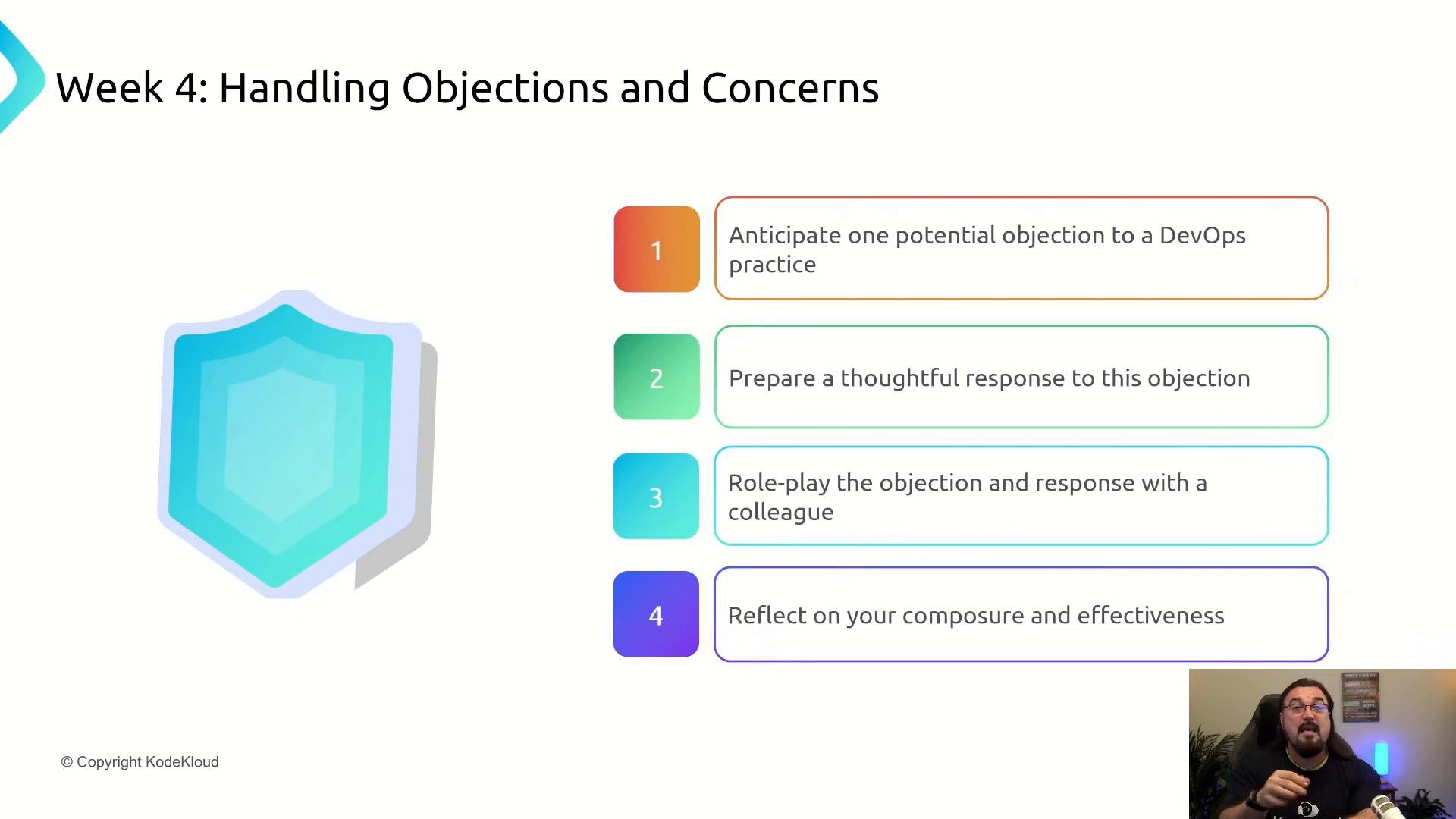
- Identify one likely objection relevant to your current project (e.g., “Too expensive,” “Too risky,” “Not our priority”).
- Prepare a concise response that acknowledges the concern and explains the value or trade-offs.
- Role-play the objection and your response with a colleague (they don’t need to be technical).
- Ask them to throw curveballs; reflect on your composure, clarity, and how persuasive your response was.
- Start by validating the concern, then present a trade-off or evidence-based counterpoint.
- Use one statistic, one brief example, or a visual to support your response.
- Practice staying calm and curious; ask follow-up questions when appropriate.
- Goal: Turn reflection and feedback into one specific, measurable improvement goal.
- Weekly plan:
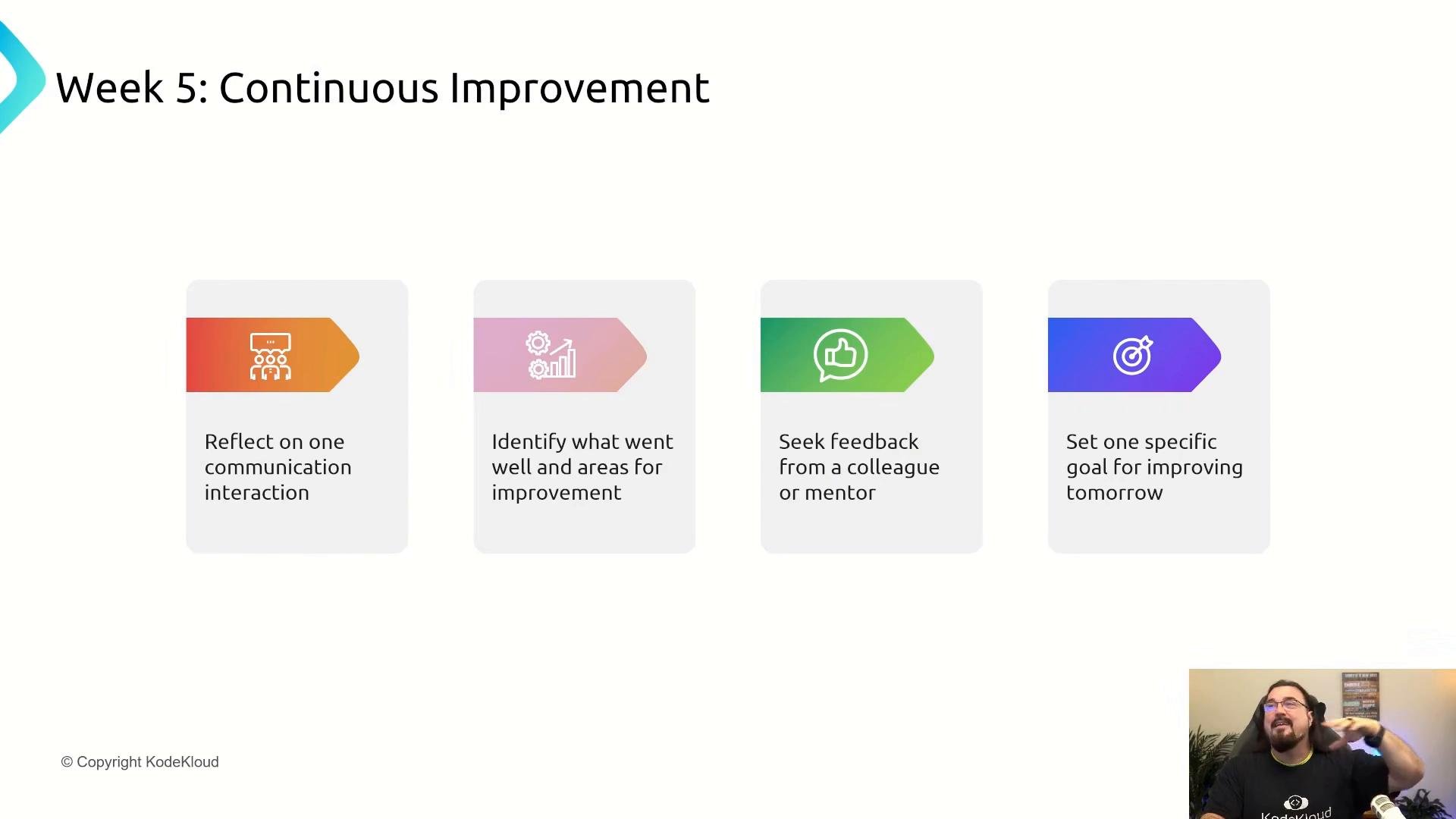
- Pick a recent communication interaction to review (meeting, email thread, or demo).
- Identify what went well and what could improve.
- Seek feedback from someone who was present or from a transcript/recording.
- Set one specific, measurable goal for the following week (e.g., “use one analogy in my next stakeholder meeting” or “pause twice before answering to improve listening”).
- Make the goal specific, measurable, and time-bound (use the SMART framework).
- Focus on one behavior change at a time to avoid spreading effort too thin.
- Keep a simple log of daily practice activities in a plain text file, a Slack/Discord channel, a note app, or a dedicated notebook.
- Each entry should capture: date, stakeholder or topic, action taken, a one-line result, and a quick self-rating of confidence (1–5).
- At the end of each week, review patterns:
- Which exercises produced noticeable improvements?
- Which areas need more practice or a different approach?
- Use the weekly review to adjust the next week’s focus and set small, achievable goals.
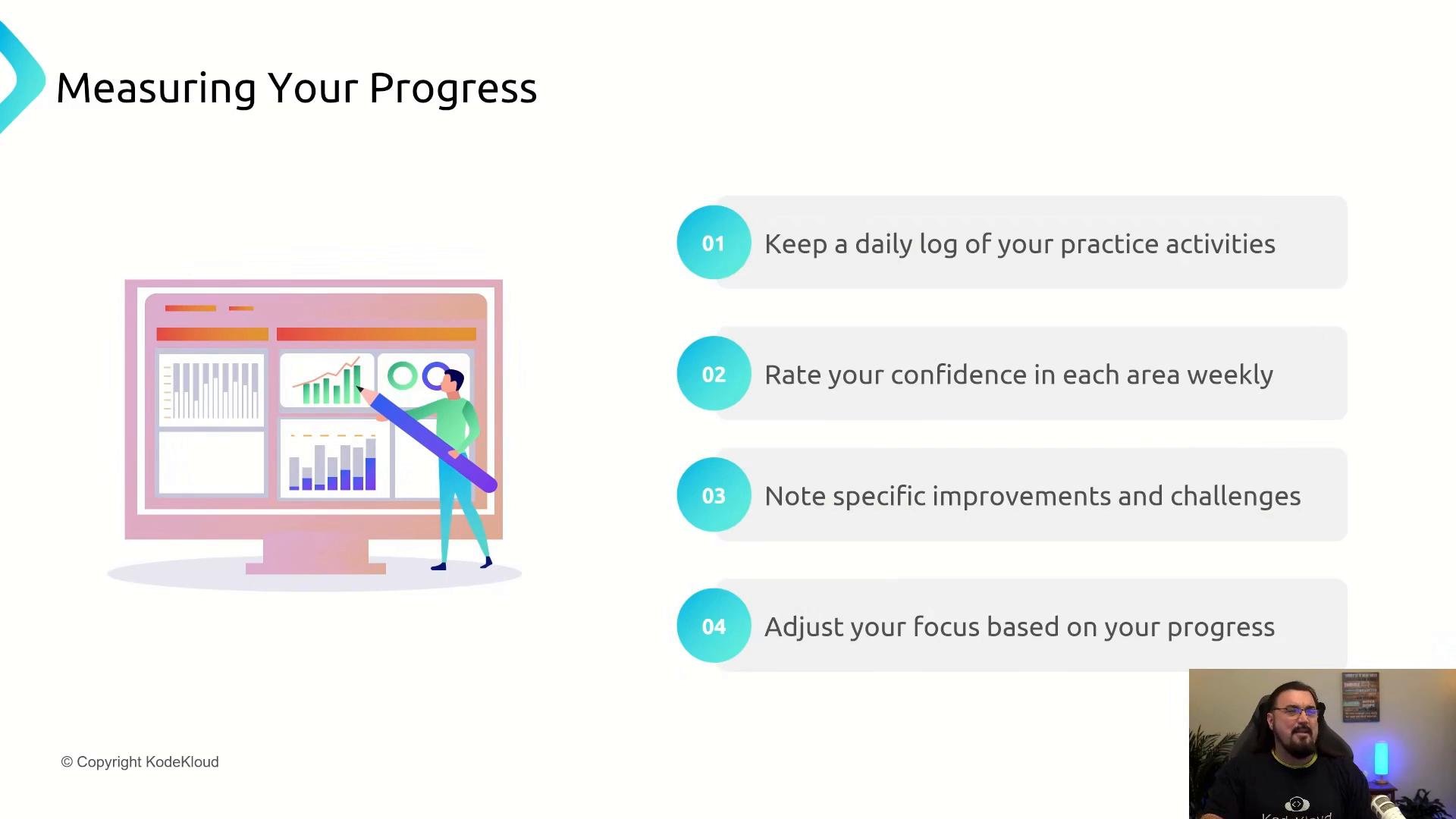
Weekly review checklist:
- Compare confidence scores across exercises.
- Identify one repeatable habit that improved outcomes (e.g., pausing before responding).
- Choose one focused goal to practice next week.
Keep it simple and consistent: a short daily log plus one weekly reflection is usually enough to see steady improvement.
- Rotate your focus: repeat the five-week cycle but swap in new stakeholders, different technical concepts, or fresh story topics.
- Raise the challenge: present to larger or more diverse audiences, lead a cross-functional demo, or mentor a junior colleague.
- Form a communications peer-review group or find a mentor for ongoing feedback and accountability.
- Teach or document what you’ve learned—mentoring others accelerates your own mastery.
- Active listening techniques: https://www.mindtools.com/CommSkll/ActiveListening.htm
- Short storytelling guide: https://hbr.org/2014/03/the-irresistible-power-of-storytelling-as-a-strategic-business-tool
- Feedback best practices: https://www.coursera.org/lecture/leading-teams/giving-and-receiving-feedback-Y2T4z