

- Revealing blind spots and areas for improvement.
- Increasing your awareness of how you come across.
- Strengthening relationships through clearer, collaborative exchanges.
- Driving skill growth and adaptability over time.
Types of feedback
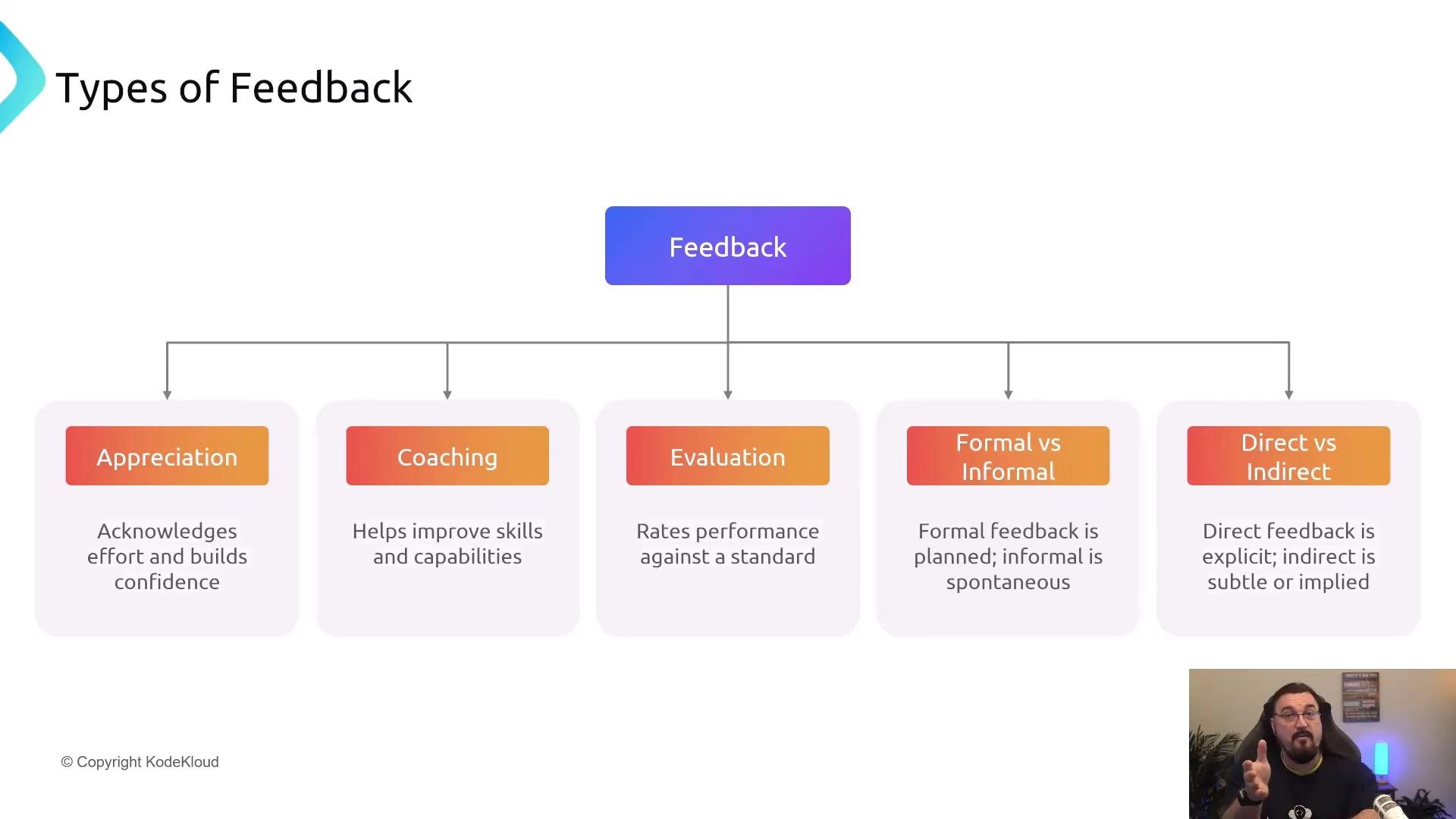
Feedback comes in several common forms. Knowing the type helps you interpret comments and decide how to act.- Appreciation: Positive reinforcement for things you did well.
- Coaching: Actionable suggestions to improve specific skills or techniques.
- Evaluation: Judgments against a standard or benchmark (for example, how a talk compares to a model like a TED Talk).
- Formal vs. Informal: Structured sources (surveys, performance reviews) versus casual, on-the-spot comments.
- Direct vs. Indirect: Explicit, face-to-face feedback versus subtler, implied signals.
How to solicit effective feedback
When asking for feedback, frame the request so responses are actionable and focused.- Be specific about what you want feedback on (clarity, slide flow, energy, pacing).
- Pick an appropriate time and place — avoid interrupting or asking in unsuitable contexts.
- Ask open-ended questions to invite useful detail (for example, “What worked best?”, “What could I improve?”, “Can you give an example of where I lost focus?”).
- Encourage honesty and make it clear you value constructive comments.
- When feedback is vague, probe with clarifying questions: “You said my style was meandering — which section felt that way and why?”
When you request feedback, set the scope and context up front (what you want reviewed, by whom, and when). This helps reviewers focus and increases the likelihood of actionable responses.
The ASK model for receiving feedback
Use the ASK model to turn comments into usable improvements:- Ask: Request specific feedback about an aspect of your communication.
- Seek: Probe to fully understand the feedback; ask for examples and clarifications.
- Keep: Keep an open mind and avoid defensiveness so you can turn feedback into action.
Adapting your communication style
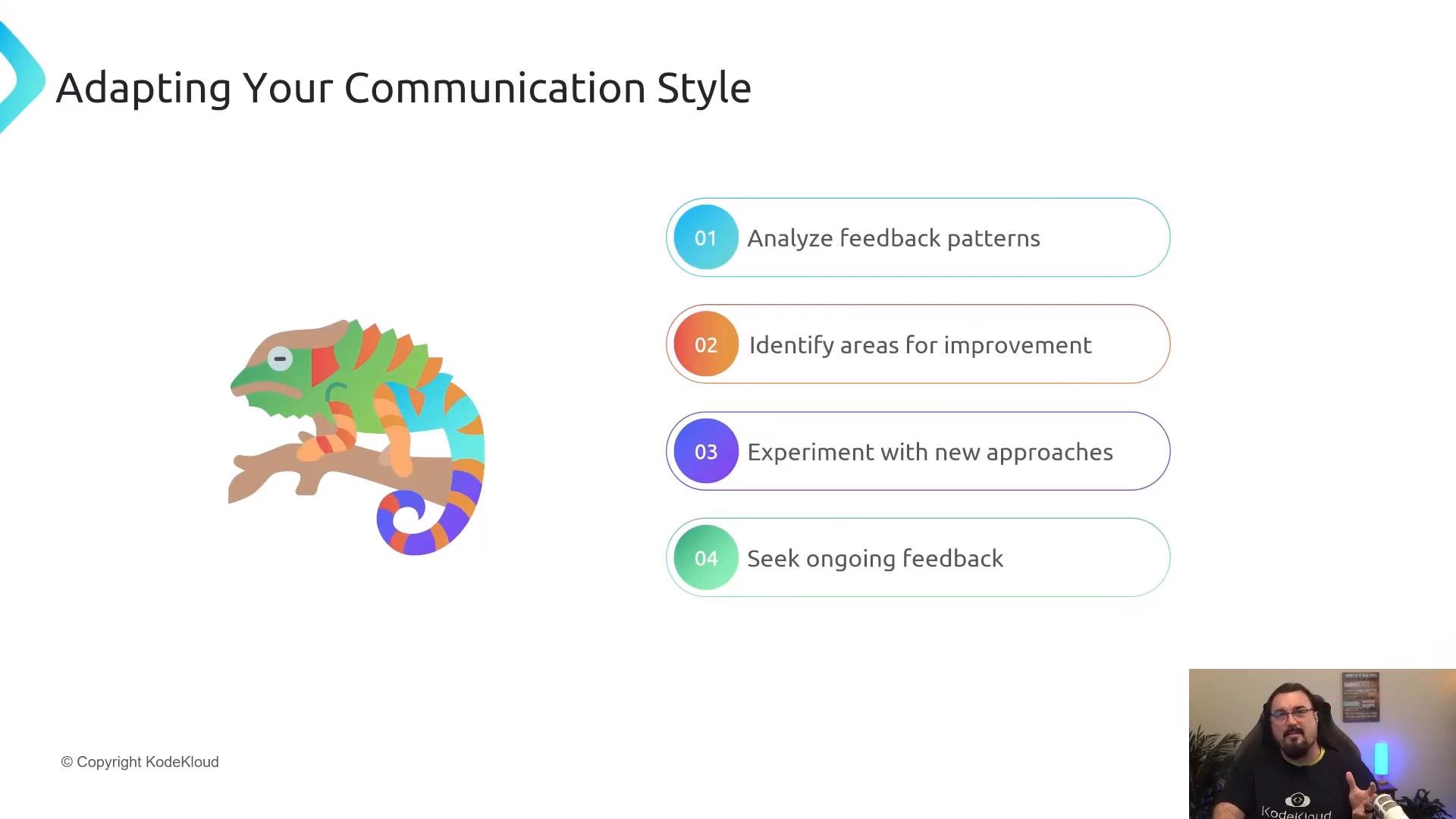
Turn feedback into iterative improvements by following a feedback loop:- Analyze feedback patterns — look for recurring themes rather than isolated comments.
- Identify priority areas for change based on those patterns.
- Experiment with new techniques or behaviors (try different openings, tighter transitions, or clearer summaries).
- Seek ongoing feedback to measure the impact of those experiments and iterate.
The ADKAR model for sustained change
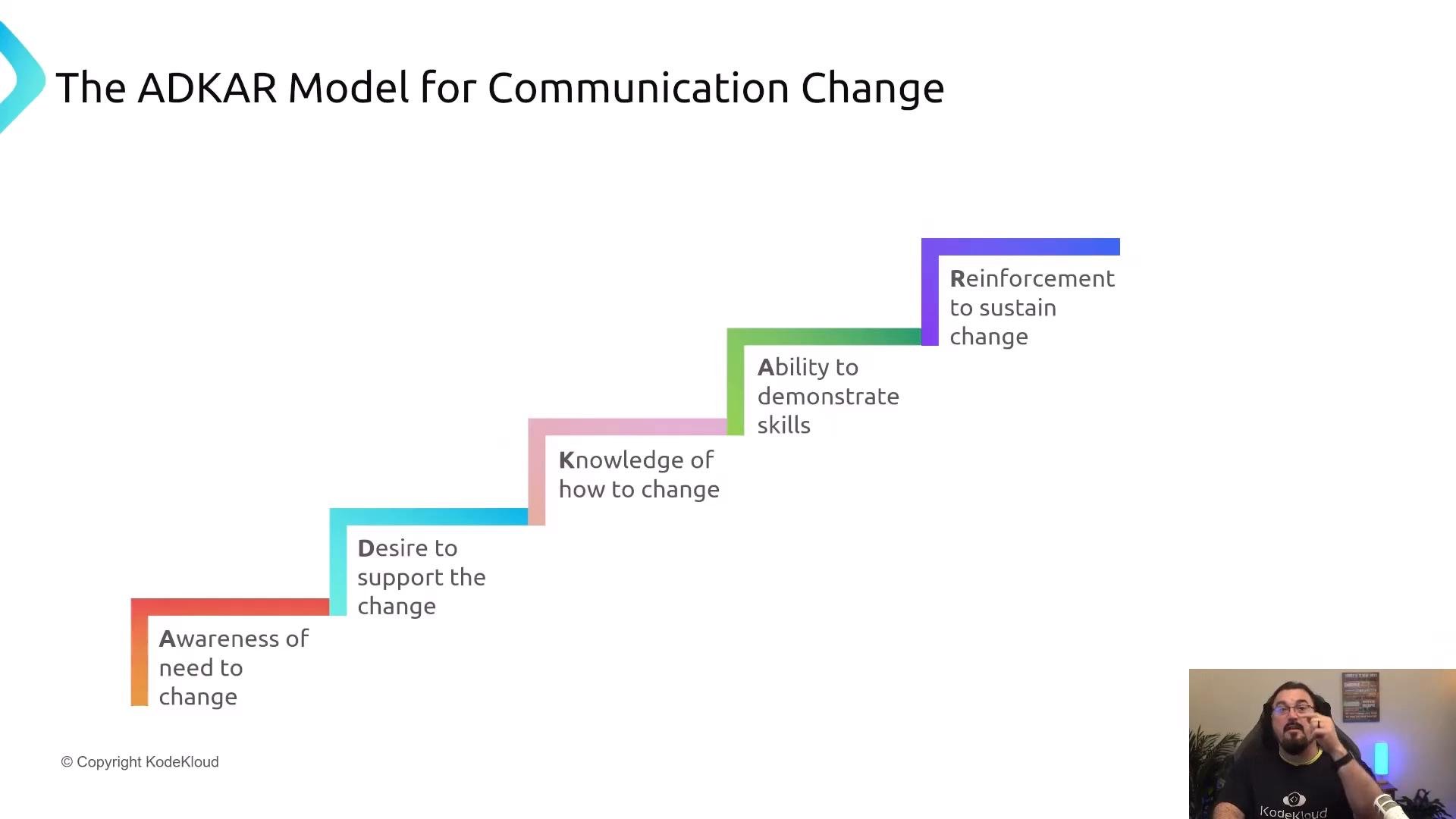
ADKAR is a proven change-management framework that maps well to communication improvement. Use it to move feedback from a single insight into a lasting habit.
Applying ADKAR helps you convert feedback into repeatable improvements rather than one-off fixes.
Avoid defensiveness when receiving feedback. Immediate self-justification closes the conversation and reduces the likelihood of actionable input. Pause, acknowledge, and ask for specifics instead.
Key takeaways
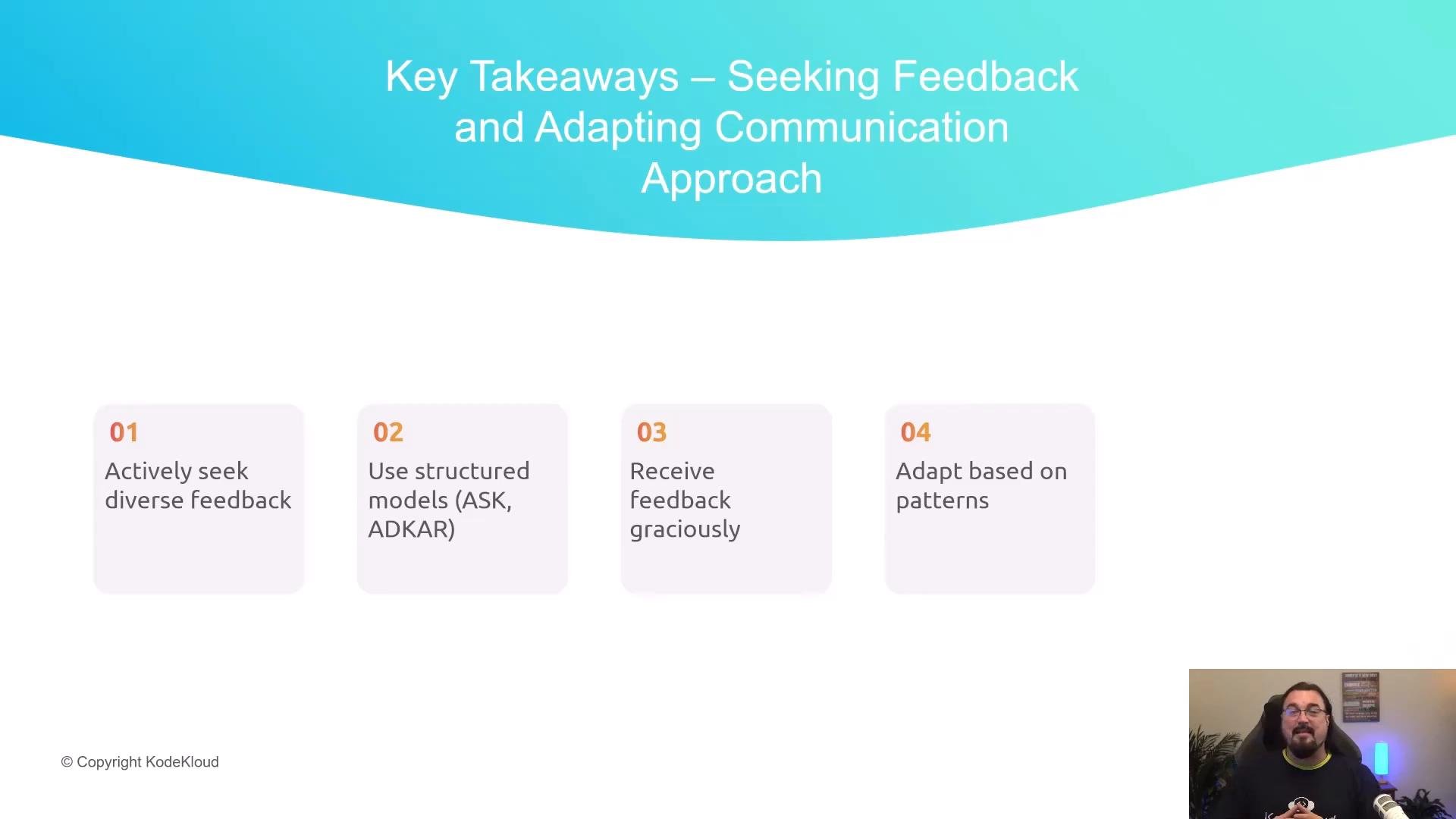
- Actively seek diverse feedback (peers, mentors, audience members) to gather multiple perspectives.
- Use structured approaches like ASK and ADKAR to make feedback actionable and sustainable.
- Receive feedback graciously and without defensiveness — people are helping you improve.
- Focus on recurring patterns in feedback and iterate: small, measurable experiments and continued evaluation lead to meaningful change.
Further reading and references
- ADKAR overview — Prosci: https://www.prosci.com/resources/adkar
- How to give and receive feedback effectively — search for evidence-based guides and coaching resources for practical exercises and templates.