

- Understanding your audience
- Identify primary stakeholders, their goals, and the decisions they must make.
- Tailor your message: match the level of technical detail to the audience (executive, product, engineering, operations).
- Apply empathy and active listening to surface real concerns, align expectations, and build trust. For a refresher on active listening techniques, see MindTools: https://www.mindtools.com/CommSkll/ActiveListening.htm.
- Translating technical concepts for non-technical audiences
- Simplify without losing accuracy: prioritize the business outcome, risks, and trade-offs over low-level implementation details.
- Use analogies and metaphors to make abstract concepts relatable (e.g., “microservices are like modular appliances in a kitchen”).
- Emphasize value: show how the technical approach impacts revenue, cost, speed, reliability, or user experience.
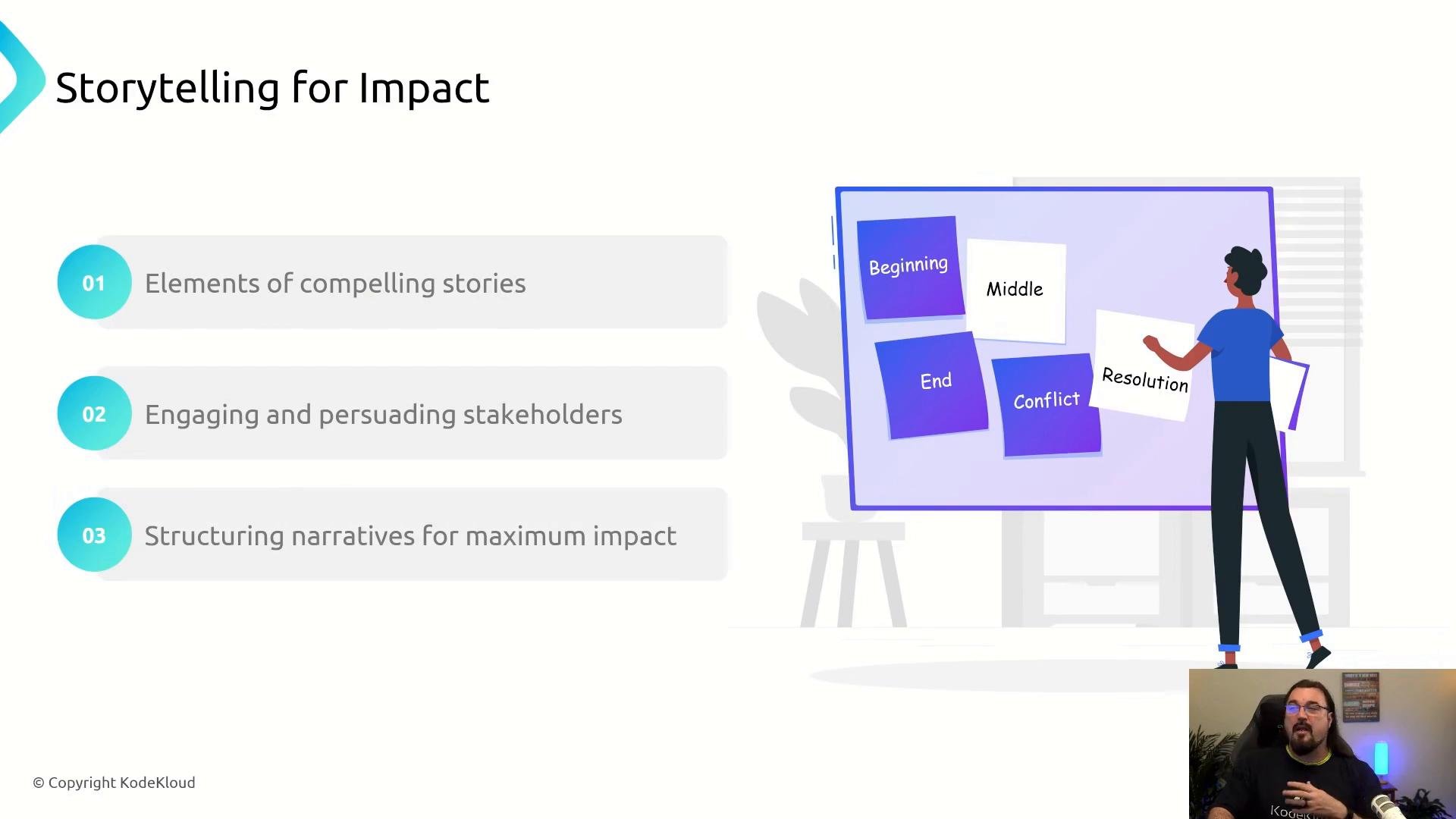
- Storytelling for impact
- Structure narratives with clear elements: character (stakeholder), problem (pain point), evolution (approach and trade-offs), resolution (solution), and benefits (outcomes and metrics).
- Use story-driven examples or mini-case studies to engage and persuade technical and non-technical stakeholders alike.
- Organize your story for clarity and momentum so the audience can follow the technical rationale and outcomes.
- Handling objections and concerns
- Anticipate common objections and prepare concise, evidence-based responses (data, benchmarks, small experiments).
- Use clarifying questions, reframe the concern, and present alternatives or mitigations.
- Maintain professionalism: acknowledge the concern, explain the rationale, and propose next steps or a plan to test assumptions.
- Continuous improvement
- Treat communication as iterative: collect feedback after meetings or presentations and measure small, actionable signals.
- Track simple metrics such as stakeholder alignment, decision velocity, and number of follow-up questions to gauge progress.
- Iterate on your messaging, slide format, and supporting data based on outcomes and feedback.
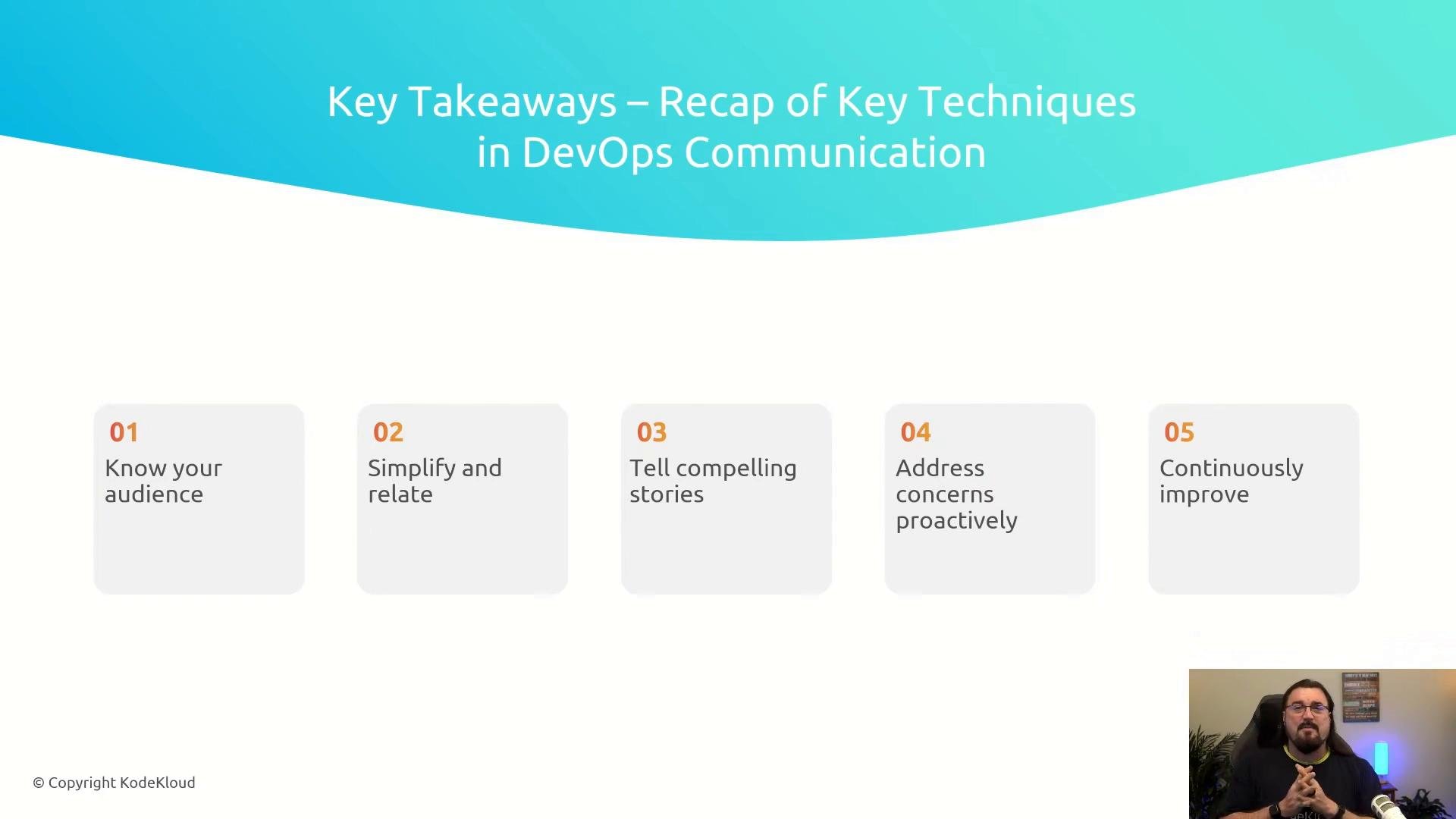
- Know your audience.
- Simplify and relate technical content to stakeholder needs.
- Tell compelling stories that show the problem and the resolution.
- Address concerns proactively and professionally.
- Continuously improve through feedback and measurable metrics.
Next steps: practice these techniques through exercises or role-plays. After that, review feedback, refine your approach, and iterate on messaging based on real stakeholder interactions.