

This lesson (presented by Michael Forrester) explains two closely related collaboration practices used widely in DevOps and engineering teams: co-creating and mobbing. You’ll learn clear definitions, how they differ, when to choose each, and the trade-offs so you can apply them to improve code quality, incident response, onboarding, and team knowledge sharing. Co-creating and mobbing both emphasize joint action and shared responsibility for a single problem, goal, or artefact. Teams that adopt these practices increase cross-functional knowledge, reduce defects, and create more predictable long-term velocity by standardizing approaches and spreading institutional memory.
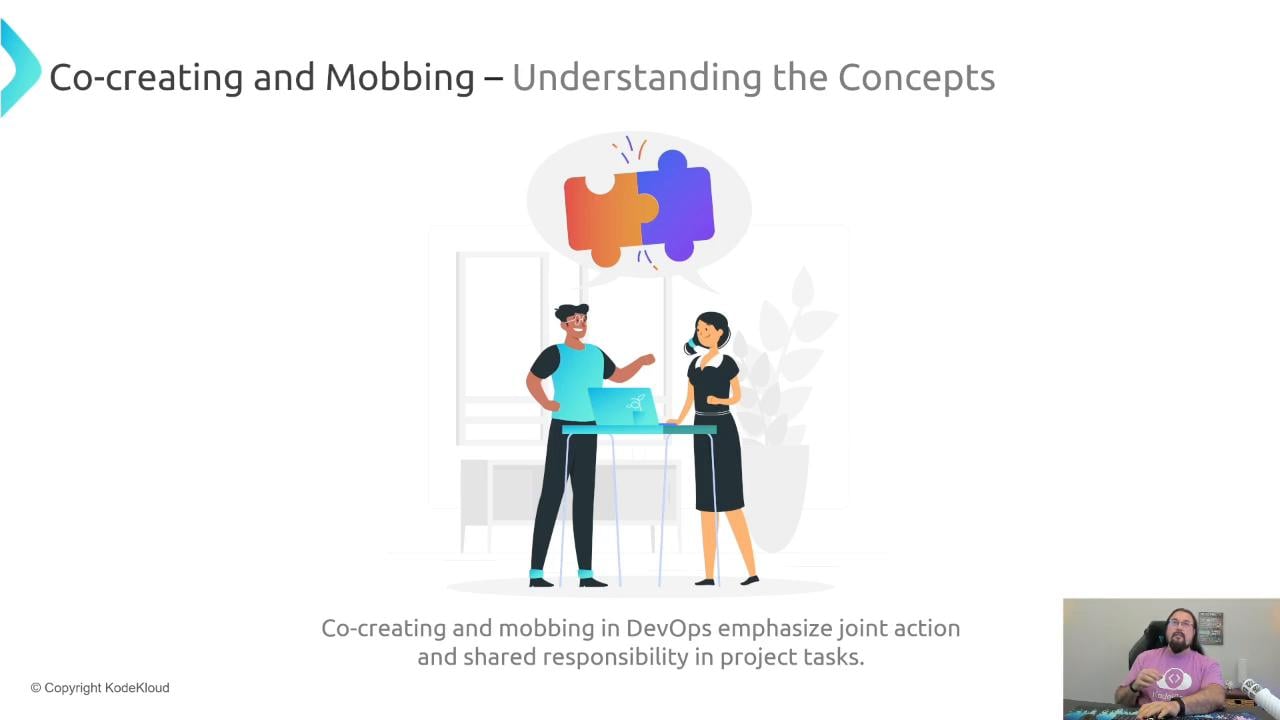
Definitions and key differences
-
Co-creating
- A collaborative process where multiple team members actively contribute to the same artefact (code, documentation, design, runbook) at the same time.
- Contributors often work from their own workstations, adding ideas, code, or edits to a shared space in real time.
- Emphasizes distributed, parallel contribution and iterative refinement by many actors.
-
Mobbing (mob programming / mobbing in troubleshooting)
- One person typically “drives” at a single workstation while the rest of the group observes, suggests, reviews, and proposes alternatives.
- Especially useful for debugging, scripting, incident response, or complex problem-solving where focused collective attention accelerates results.
- The group collectively owns the outcome even though inputs are often sequenced through a driver and assisting observers.
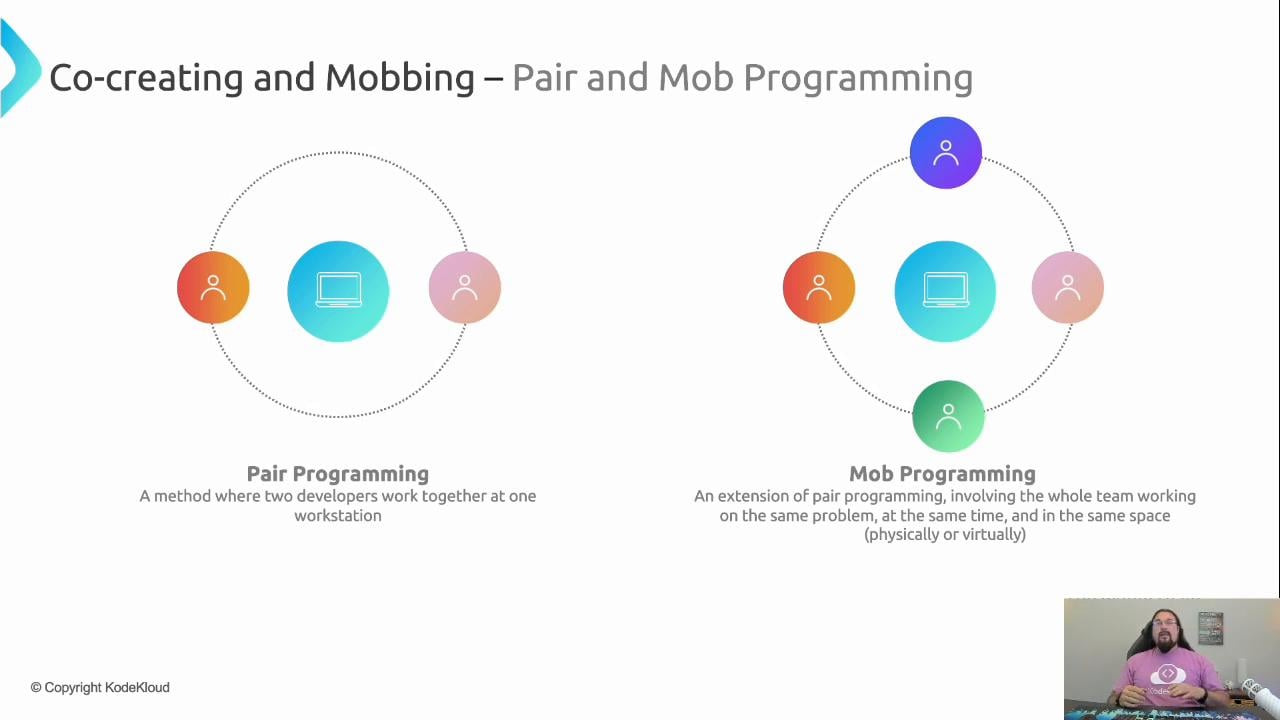
Pair programming vs mob programming
-
Pair programming
- Two people collaborate at one workstation; roles of driver and navigator rotate frequently.
- Commonly used for mentoring, focused development of a feature, or when two perspectives produce faster, higher-quality output.
-
Mob programming
- The entire team works on the same problem at the same time. One person drives while others act as navigators or commentators.
- Valuable for complex architecture decisions, onboarding in-context, or when you need rapid consensus and shared understanding.
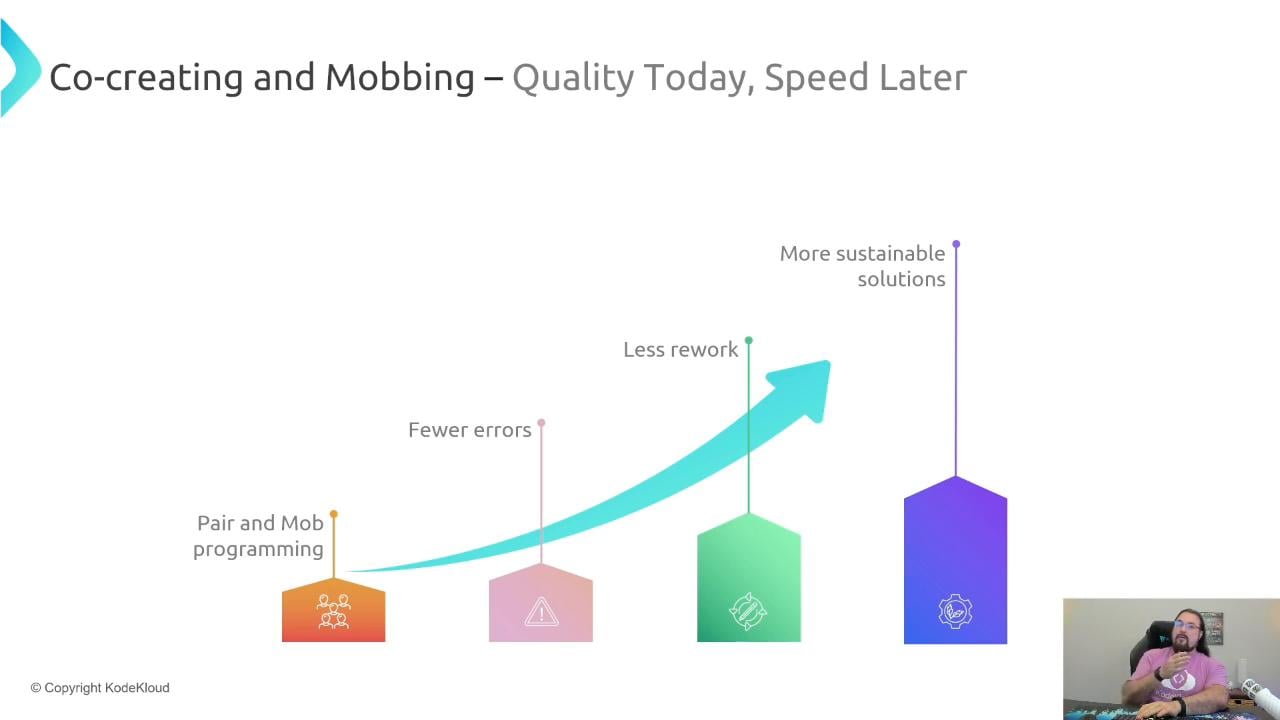
Benefits and trade-offs
Use co-creating for collaborative design and living documentation; use mobbing when concentrated attention on a single system or problem will accelerate resolution or learning (for example: incident response, debugging sessions, or hands-on onboarding).
When to choose which approach
-
Use co-creating when:
- Multiple team members need to make parallel contributions to a shared artefact (e.g., documentation, design work, or working in a shared repo).
- You want rapid idea generation with distributed ownership.
-
Use mobbing when:
- You need concentrated team focus to solve a tough bug, script an automation, run through an incident postmortem, or onboard someone with live walkthroughs.
- Fast consensus, shared situational awareness, or immediate knowledge transfer is critical.
- Define roles and rotate the driver frequently to avoid bottlenecks.
- Timebox sessions and agree the goals up-front.
- For remote teams, ensure good audio/video and a shared cursor or screen tool so everyone can follow and contribute.
- Capture decisions and action items in a shared place (PR, issue, or runbook) to preserve outcomes.
Summary
Co-creating and mobbing are complementary, group-centered practices that increase long-term quality, institutional knowledge, and team collaboration. Co-creating distributes contribution across participants working in parallel on a shared artefact; mobbing concentrates hands-on work while leveraging collective observation and guidance. Both trade short-term speed for higher immediate quality and yield faster long-term velocity by reducing defects and spreading knowledge.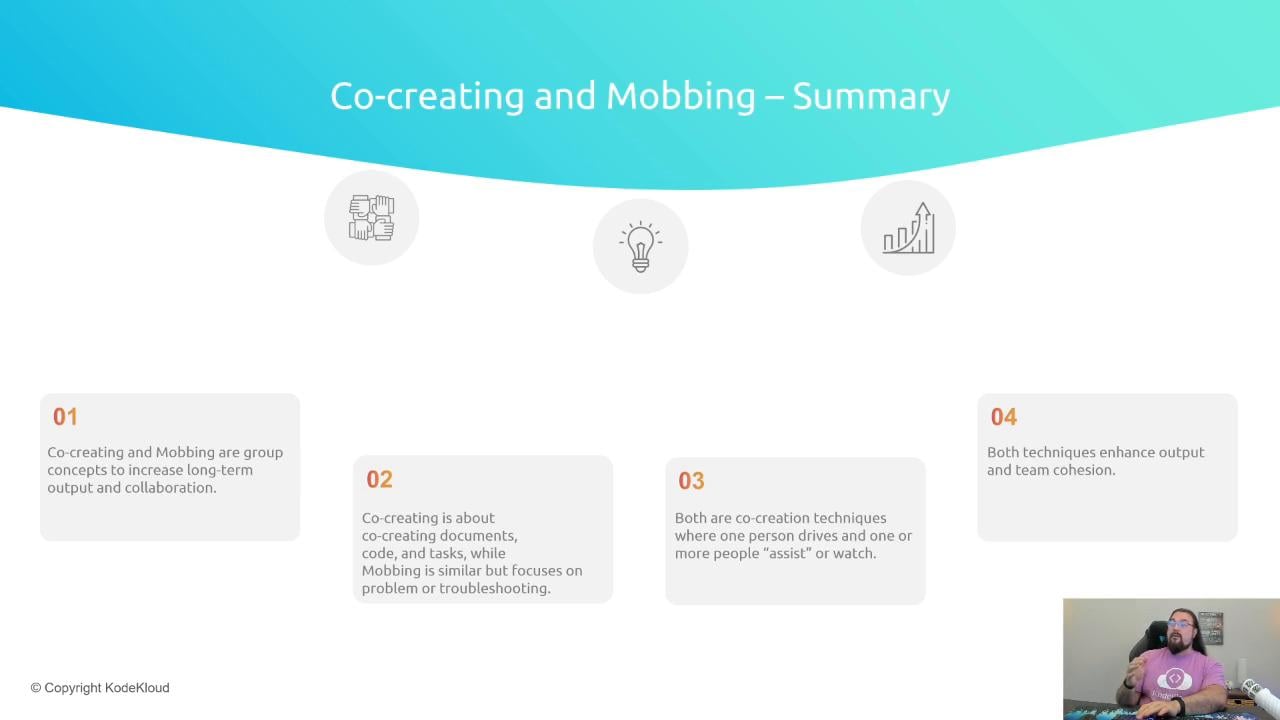
Links and references
- Mob programming overview — https://www.mobprogramming.org/
- Pair programming (Agile Alliance) — https://www.agilealliance.org/glossary/pair-programming/
- DevOps collaboration patterns — https://devops.com/category/collaboration/