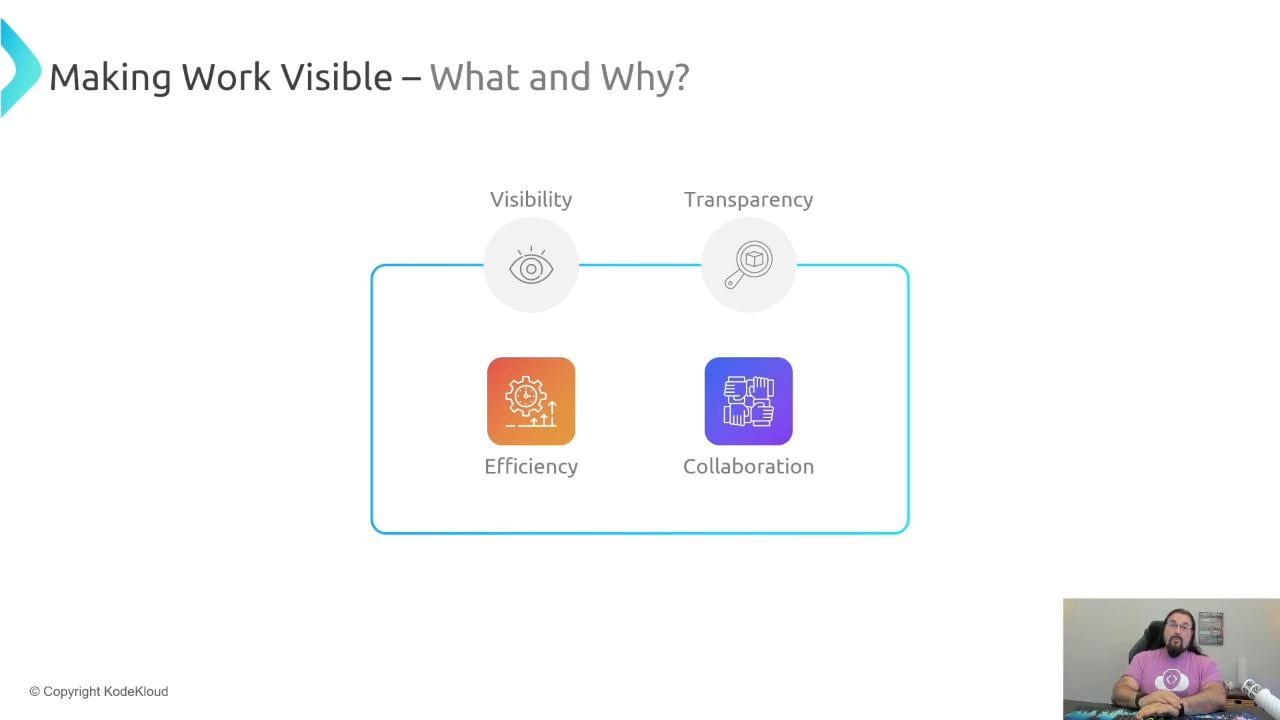
Welcome, Soft Skills students. This is Michael Forrester. In this lesson we’ll cover making work visible: what it means, why it matters in a DevOps culture, and practical techniques you can use to increase transparency and improve collaboration across teams. Making work visible increases transparency and helps everyone — teammates and stakeholders alike — understand what is happening. When work is visible it can be measured, managed, and improved. Without visibility, both problems and opportunities remain hidden.
A presentation slide titled "Making Work Visible — What and Why?" showing icons for Visibility and Transparency at the top and Efficiency and Collaboration below, connected by a rounded outline. A small video thumbnail of a presenter appears in the bottom-right corner.
Why show work early?
  • People often hesitate to show unfinished work because of fear of criticism. However, if you’re building a product or service for someone else, early and frequent feedback keeps you aligned to their needs.
  • Sharing incremental progress gives stakeholders the opportunity to change scope or priorities while the cost to adapt is still low, reducing late rework and wasted effort.
  • Visibility provides practical benefits: clearer project status, better coordination across teams, and improved prioritization because everyone can see what’s being worked on.
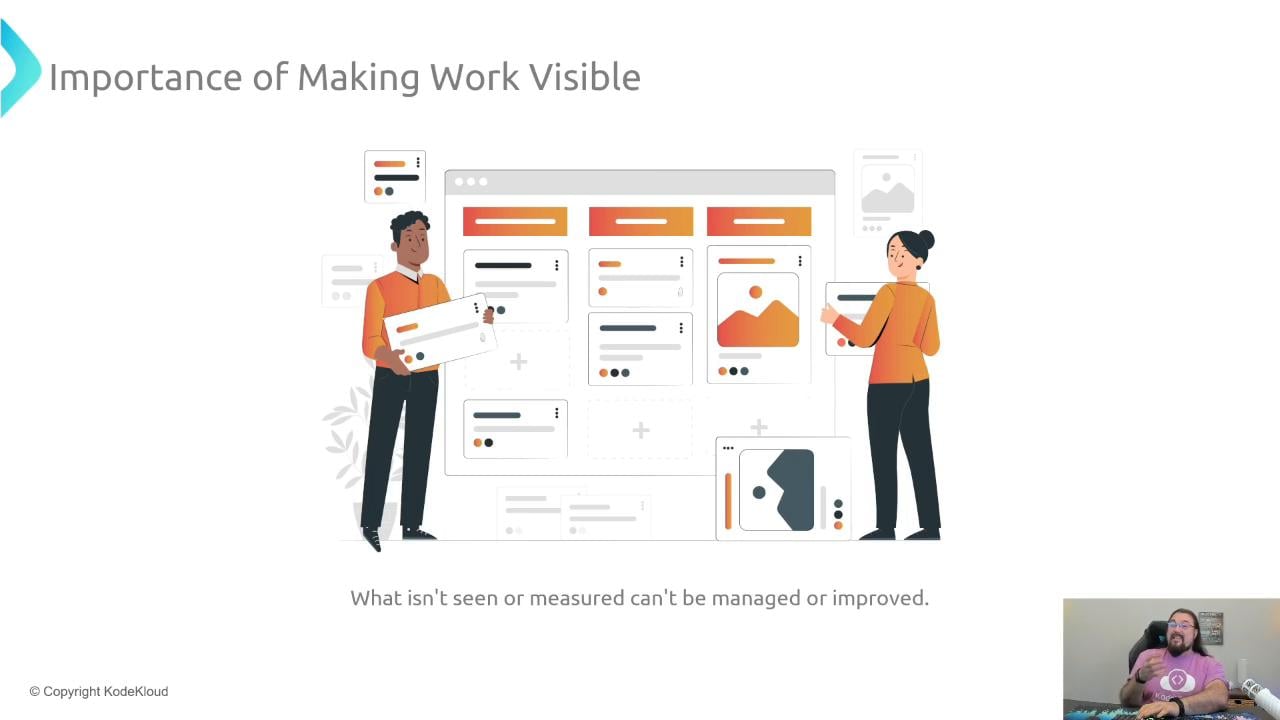
A presentation slide titled "Importance of Making Work Visible" showing an illustration of two people arranging cards on a large Kanban-style board, with the caption "What isn't seen or measured can't be managed or improved." There's also a small webcam photo of a person in the lower-right corner.
Common frameworks and how they help Techniques that enhance transparency take many forms. Two widely adopted approaches are Scrum and Kanban:
  • Scrum uses three core pillars—transparency, inspection, and adaptation—and relies on timeboxed sprints, sprint reviews, and retrospectives to create frequent feedback loops around small batches of work.
  • Kanban emphasizes visualizing workflow and limiting work in progress (WIP), which is especially effective for interruption-driven teams and for tracking individual tasks through to completion.
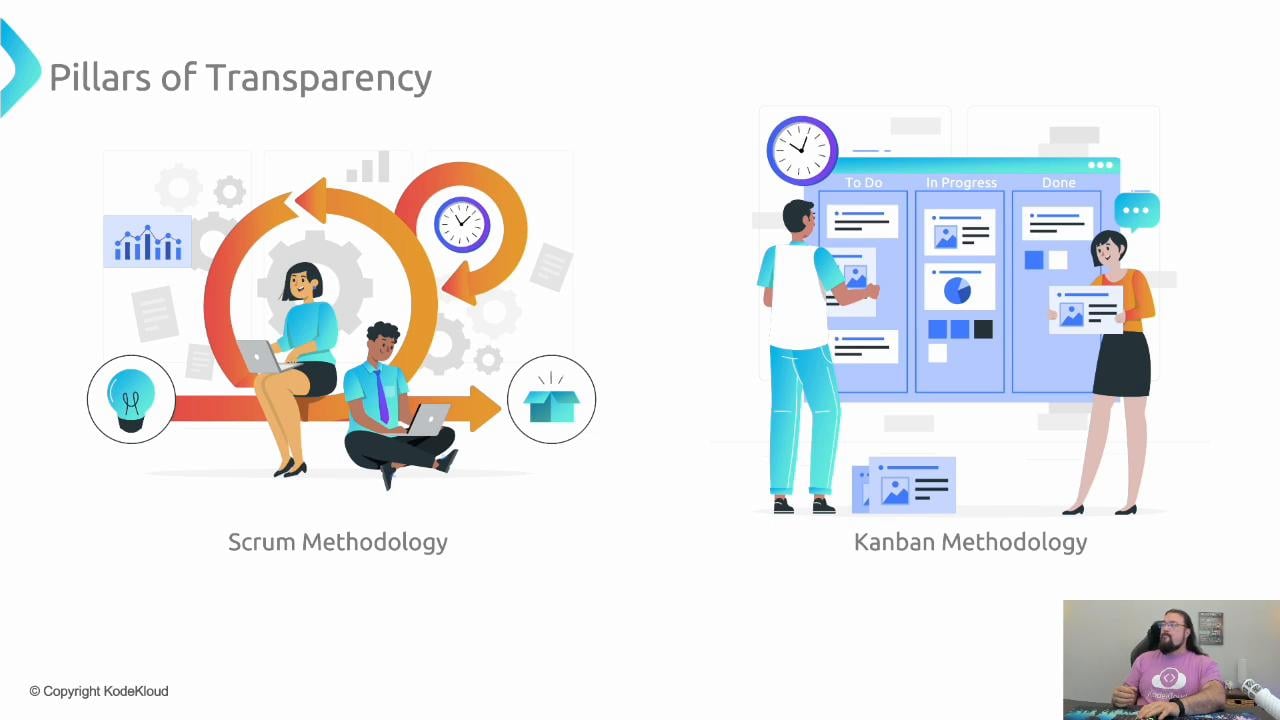
Both frameworks make progress visible, surface impediments, and enable rapid adaptation.
A presentation slide titled "Pillars of Transparency" showing illustrative graphics for Scrum Methodology (left) and Kanban Methodology (right). The left image features people with circular arrows and clocks, while the right shows people arranging cards on a Kanban board, plus a small webcam video feed of a person in the bottom-right.
Quick comparison: Scrum vs Kanban Visibility across the delivery lifecycle Making work visible means tracking items as they move through development → testing → deployment (and back again if needed). At each stage, make explicit:
  • Status (what stage is the item in)
  • Ownership (who is responsible now)
  • Feedback (how the item is being received or validated)
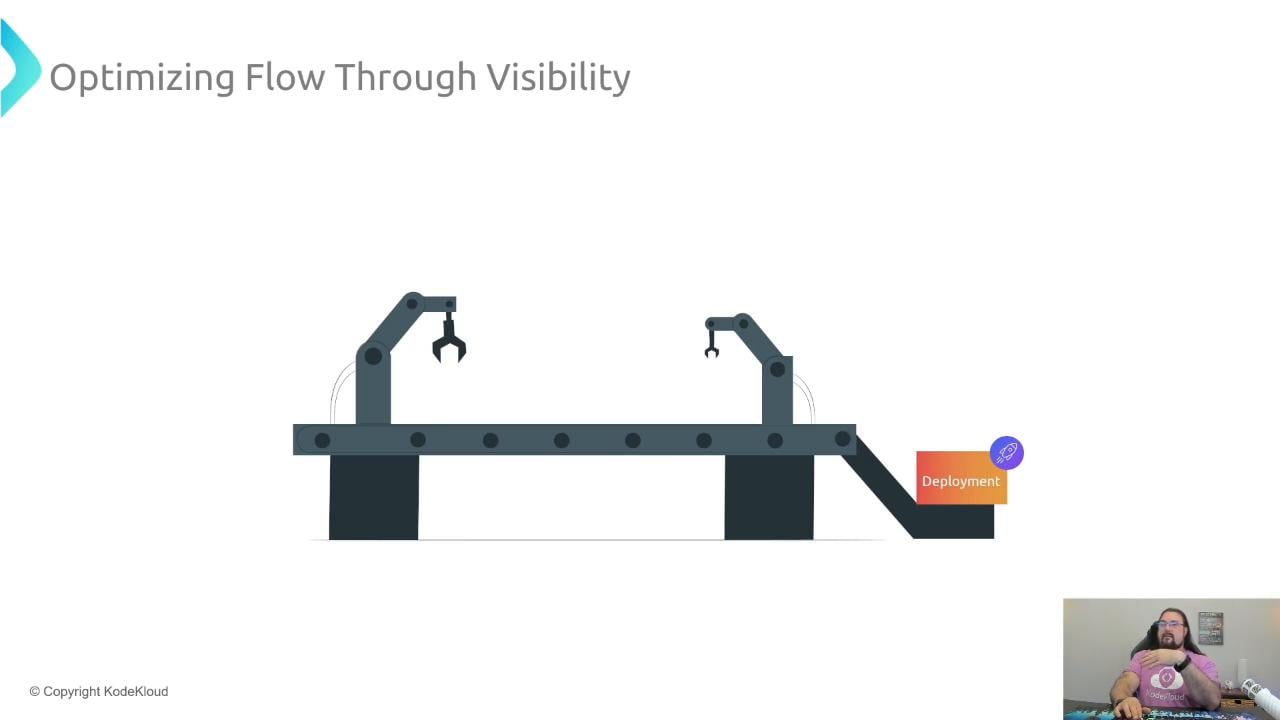
This makes bottlenecks, handoffs, and delays visible so teams can optimize flow.
A presentation slide titled "Optimizing Flow Through Visibility" showing a simplified conveyor with robotic arms and a box labeled "Deployment" at the end. A small video overlay in the bottom-right shows a speaker gesturing.
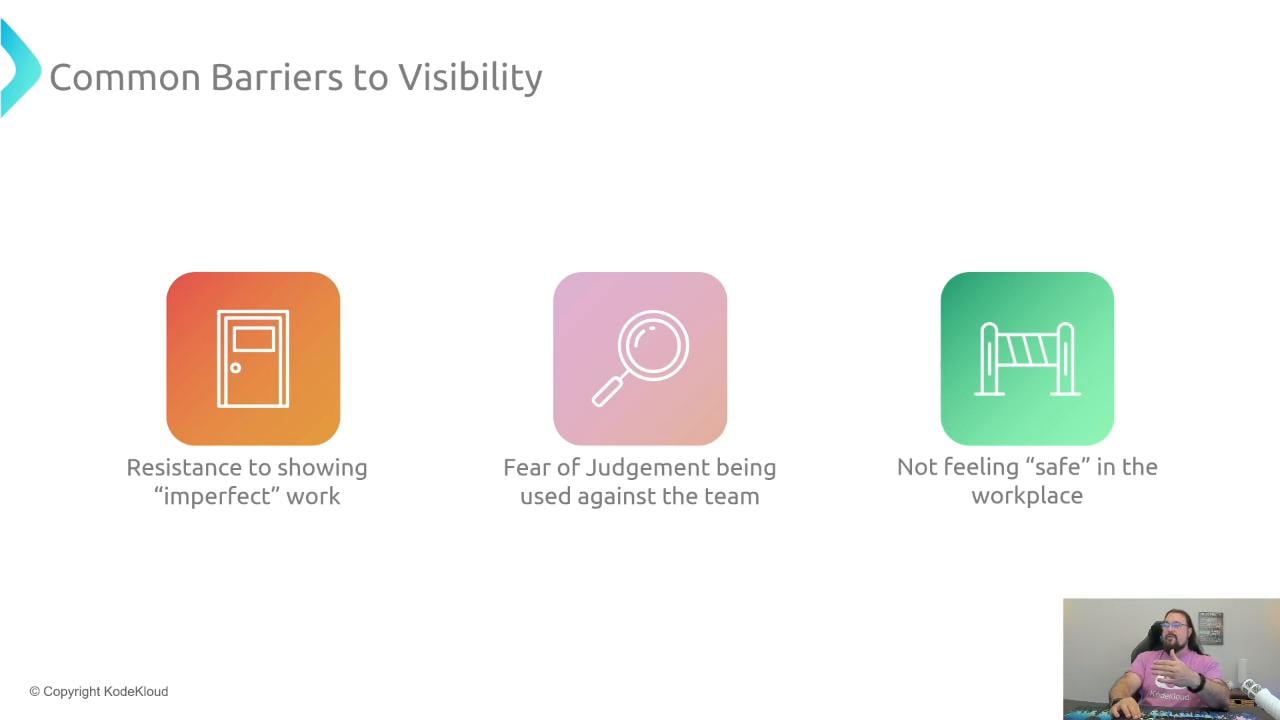
Barriers to visibility Common obstacles include resistance to exposing imperfect work, fear of judgment, and lack of psychological safety. Perfection should not be the target—aim for excellence through rapid feedback and iteration. When people don’t feel safe, they hide work and problems, which prevents course corrections and increases the risk of delivering something that misses the mark.
A presentation slide titled "Common Barriers to Visibility" with three colorful icons and captions: "Resistance to showing 'imperfect' work," "Fear of Judgement being used against the team," and "Not feeling 'safe' in the workplace." A small video thumbnail of a person presenting appears in the bottom-right corner.
Psychological safety is a prerequisite for real visibility. Teams that feel safe share progress, raise issues early, and accept feedback without fear of retaliation. Prioritize creating a culture where honest communication is rewarded, not punished.
Practical strategies to increase visibility
  • Talk about the work frequently — use standups, demos, written updates, and informal check-ins to share progress and decisions.
  • Use a framework or tool (Scrum, Kanban, or visual boards) to show work in progress and transitions between teams.
  • Make dependencies explicit so teams know when their work depends on or impacts others.
  • Run regular retrospectives to surface hidden issues and improve your process.
  • Ask for feedback from users, consumers, and teammates to validate direction and priorities.
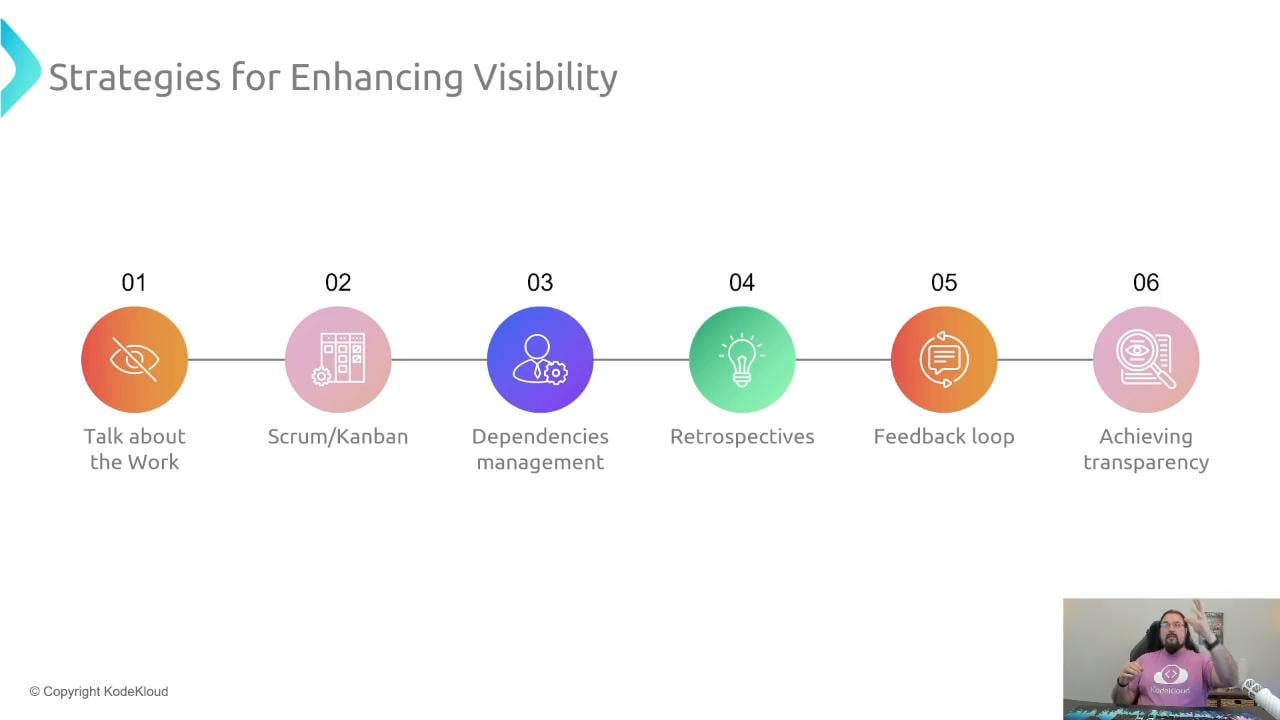
These actions not only show what’s being built but also reveal the systems and processes that produce it, enabling continuous improvement.
A slide titled "Strategies for Enhancing Visibility" showing a six-step horizontal timeline of colored icons: Talk about the Work, Scrum/Kanban, Dependencies management, Retrospectives, Feedback loop, and Achieving transparency. A small inset video in the bottom-right shows a person presenting.
Dealing with resistance and common personas Expect some resistance. Four common personas you may encounter are:
  • Skeptics — require data and clear examples of benefit.
  • Passive followers — can become engaged by increasing involvement and ownership.
  • Die-hards — experienced practitioners resistant to change; show how visibility complements expertise.
  • Saboteurs/covert dissenters — give counterfeit agreement; include them in execution and set clear, empathetic boundaries.
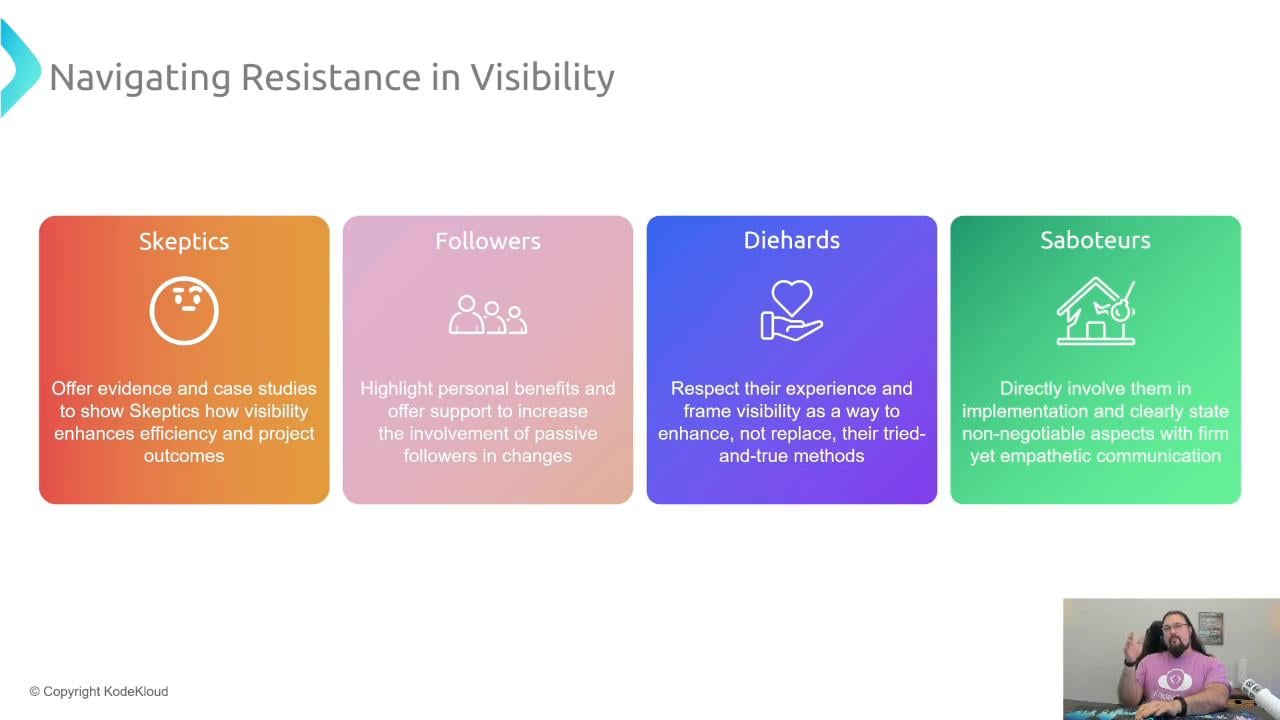
Effective approaches include presenting evidence, increasing participation, respecting experience while demonstrating improvements, and using empathy and clear communication to bring reluctant participants on board.
A slide titled "Navigating Resistance in Visibility" shows four colored boxes labeled Skeptics, Followers, Diehards, and Saboteurs with short strategies for engaging each group. A small video feed of a presenter appears in the bottom-right corner.
Summary
  • Making work visible enables feedback, confirmation, and timely course corrections.
  • Scrum and Kanban are common frameworks that help surface and manage work in progress.
  • Visibility supports DevOps principles of flow and feedback and is essential before meaningful experimentation can occur.
  • Address barriers and personality-driven resistance with data, inclusion, and a focus on psychological safety.
Thanks for reading. Links and References

Watch Video