All right — welcome to Soft Skills, students.
A blue presentation slide reading "Enhancing Soft Skills for DevOps Engineers — Teaching and Learning." A small webcam inset in the bottom-right shows a person speaking at a desk.
This is Michael Forrester. In this lesson we cover teaching and learning as essential practices for building effective teams. The emphasis is on collaboration and shared learning — how teams gain alignment, increase throughput, and become more resilient when knowledge is distributed intentionally. Why teaching and learning matter to teams Teams that receive the same inputs and learn together — whether a concept is introduced by a single person or discovered collaboratively — maintain stronger alignment and make higher-quality decisions. In fast-moving technical environments, keeping skills current matters; coordinating that learning multiplies the benefit by creating shared mental models, surfacing complementary strengths, and reducing single points of failure. Key team-level benefits:
  • Faster onboarding and ramp-up for new members.
  • Consistent approaches to architecture, tooling, and operations.
  • Better decision-making through shared context and background.
  • Higher team resilience when knowledge is distributed.
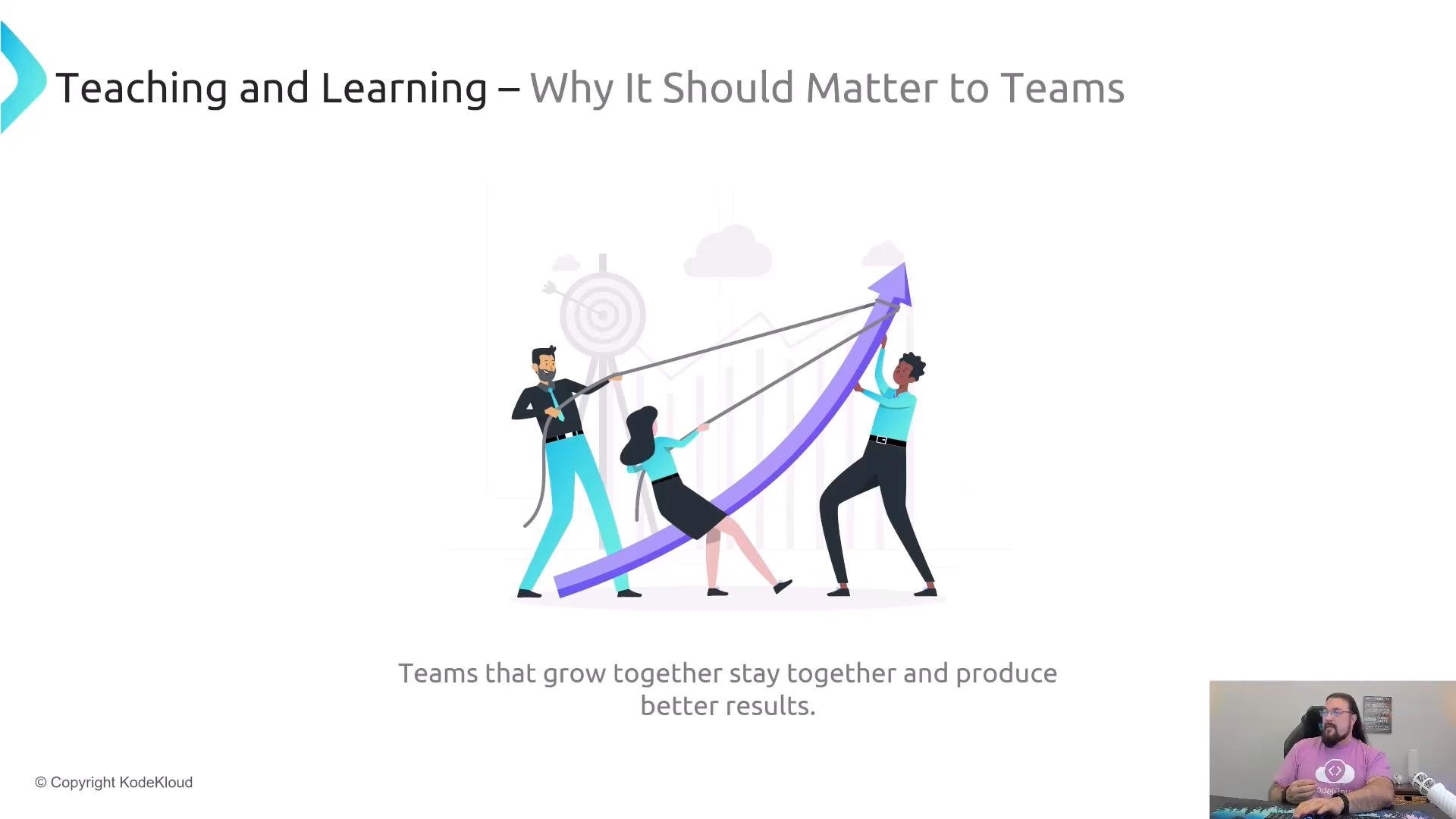
A presentation slide titled "Teaching and Learning — Why It Should Matter to Teams" with an illustration of three team members pulling up a rising purple arrow to represent growth. A small video thumbnail of a person at a desk appears in the bottom-right corner.
Learning together strengthens team bonds because the group acquires the same relevant skills and experiences at roughly the same time. This shared experience reduces friction, clarifies expectations, and improves collaboration across tasks and decisions. Forms that shared learning can take Teams can embed learning in day-to-day work or run dedicated learning events. Common formats include:
  • Workshops and instructor-led classes.
  • Online courses and self-paced training.
  • Proof-of-concept (POC) development and pair programming.
  • Collaborative problem-solving sessions and war rooms.
  • Demos, “show me” sessions, and internal showcases.
  • Mentorship programs: senior-to-junior, peer mentoring, and role-swaps.
  • External teaching: conference talks, blog posts, and community talks.
  • Teach-backs, lunch-and-learns, and internal lightning talks.
Use the table below to match a format to when to use it and the typical benefit.
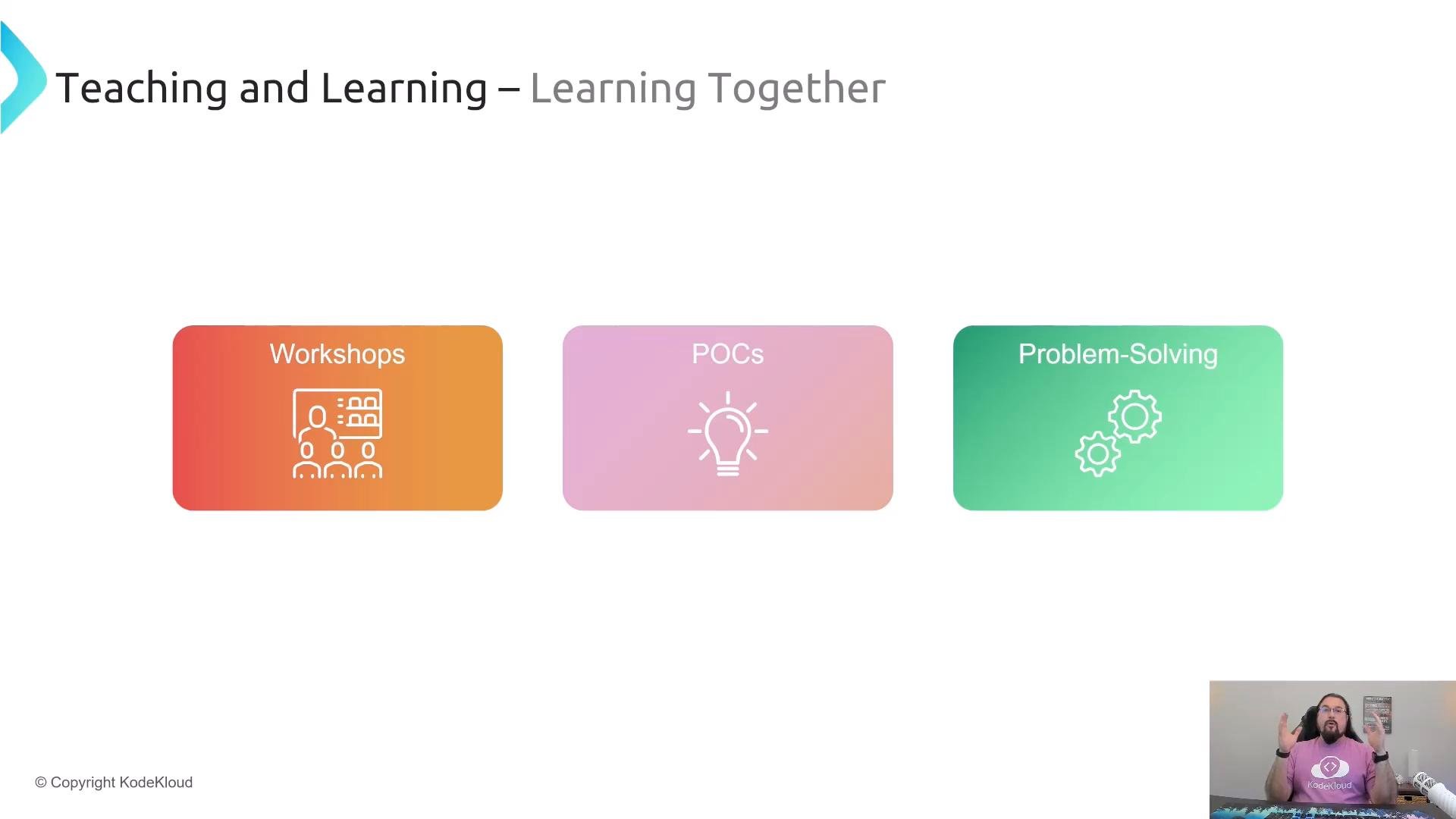
A presentation slide titled "Teaching and Learning — Learning Together" showing three colored boxes labeled Workshops, POCs, and Problem‑Solving with icons (people, lightbulb, gears). A small webcam feed of a presenter appears in the bottom-right corner.
Demos, teach-backs, and mentoring are particularly effective for DevOps teams because they combine practical, contextual learning with visibility across the team. These formats encourage faster adoption of techniques and make tacit knowledge explicit.
Why this matters for organizations When organizations prioritize shared learning, they build a culture of continuous improvement and knowledge sharing. This improves team performance and helps the organization adapt to change quickly. Making learning a repeatable, supported activity (budget, time, recognition) turns individual growth into organizational capability. Benefits at the organizational level:
  • Increased throughput and fewer handoffs caused by knowledge gaps.
  • Better retention and career development pathways.
  • External visibility that attracts talent and partners when teams present or publish.
  • Stronger security and reliability through consistent practices.
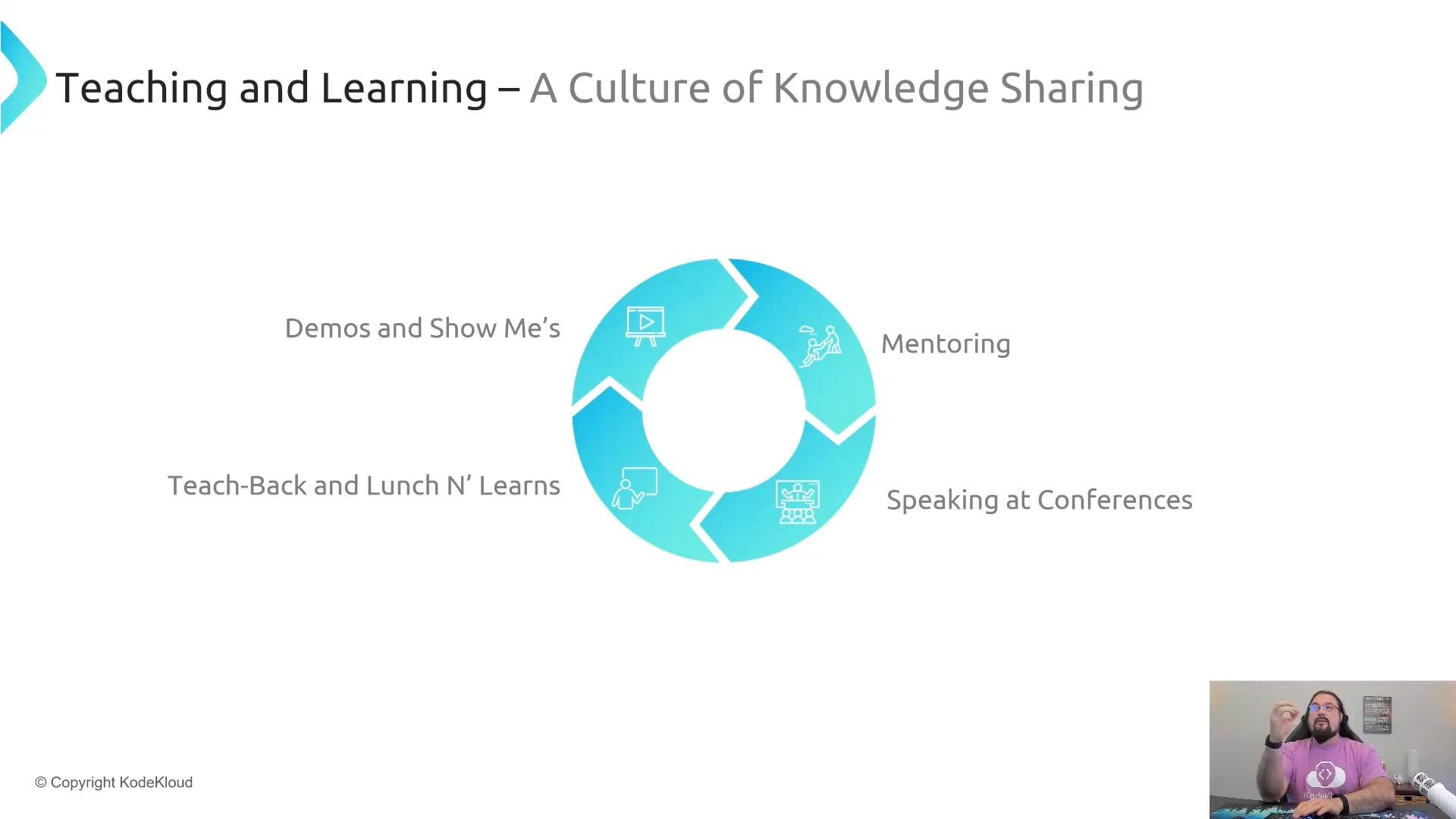
A presentation slide titled "Teaching and Learning – A Culture of Knowledge Sharing" featuring a circular infographic listing Demos and Show Me's, Mentoring, Teach-Back and Lunch N' Learns, and Speaking at Conferences. A small video inset in the bottom-right shows a person gesturing while speaking.
Practical tips to embed teaching and learning
  • Schedule regular short sessions (e.g., biweekly demos or monthly teach-backs) rather than one-off events.
  • Tie learning goals to team objectives and measure impact (time to onboard, incident resolution time, number of shared docs).
  • Encourage multiple formats: hands-on pairing, async write-ups, recorded demos.
  • Recognize contributors who teach externally — it benefits recruiting and credibility.
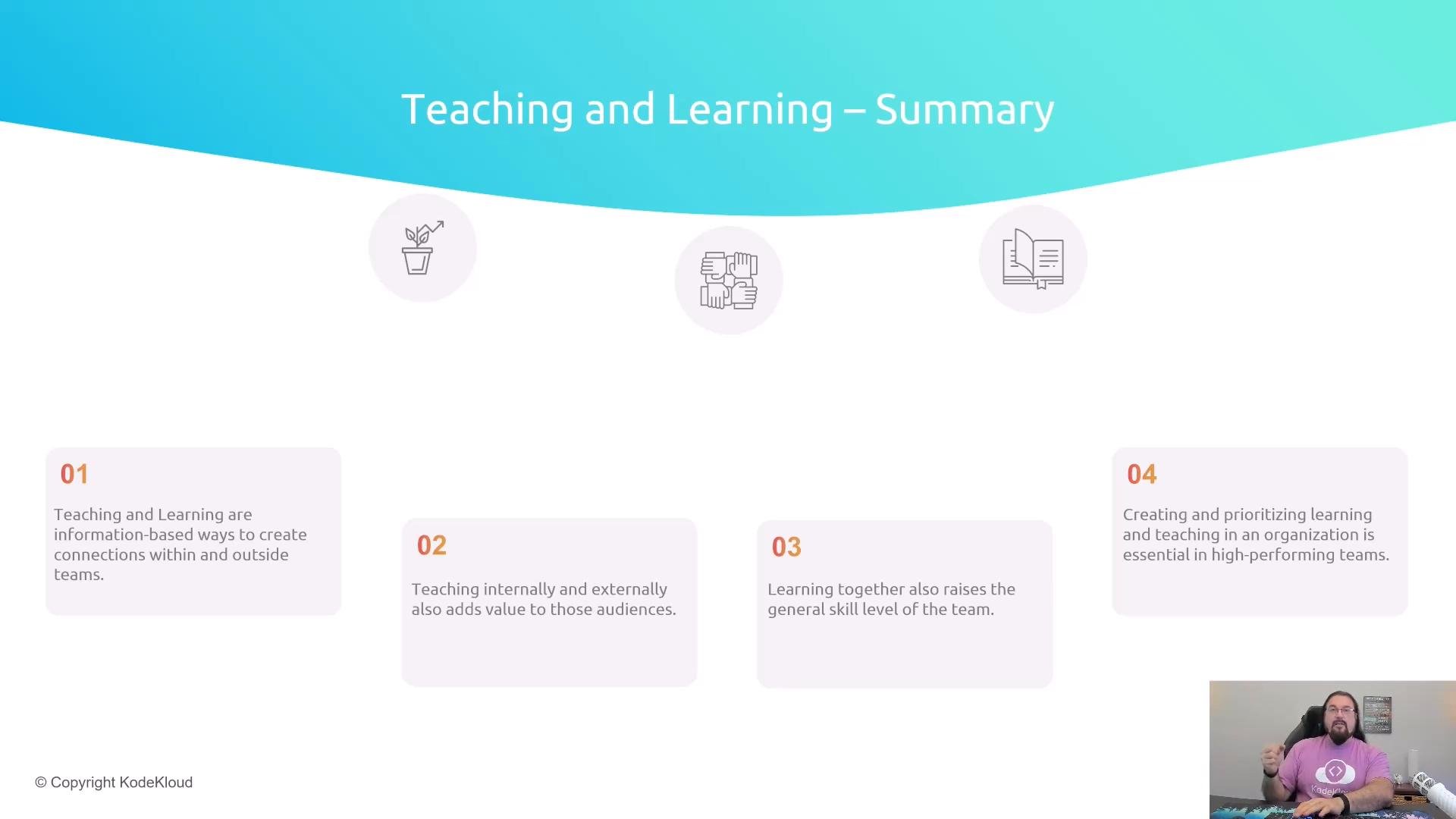
In short: empower teams through shared knowledge, skills, and experience. Teams that learn together are more likely to become high-performing, adaptable groups.
A presentation slide titled "Teaching and Learning – Summary" with icons and four numbered summary boxes across the page. A small video window in the bottom-right shows a person speaking.
Thanks for listening. Links and references
Make learning a habit, not a checkbox. Without follow-through (documentation, practice, and policy), one-off sessions will not produce lasting team capability.

Watch Video