

OpenClaw is optimized for self-hosted, private deployments and supports pluggable model providers. You can run it on a local server, a small cloud VM, or an edge device like a Raspberry Pi for low-cost always-on access.
Agent configuration (example)
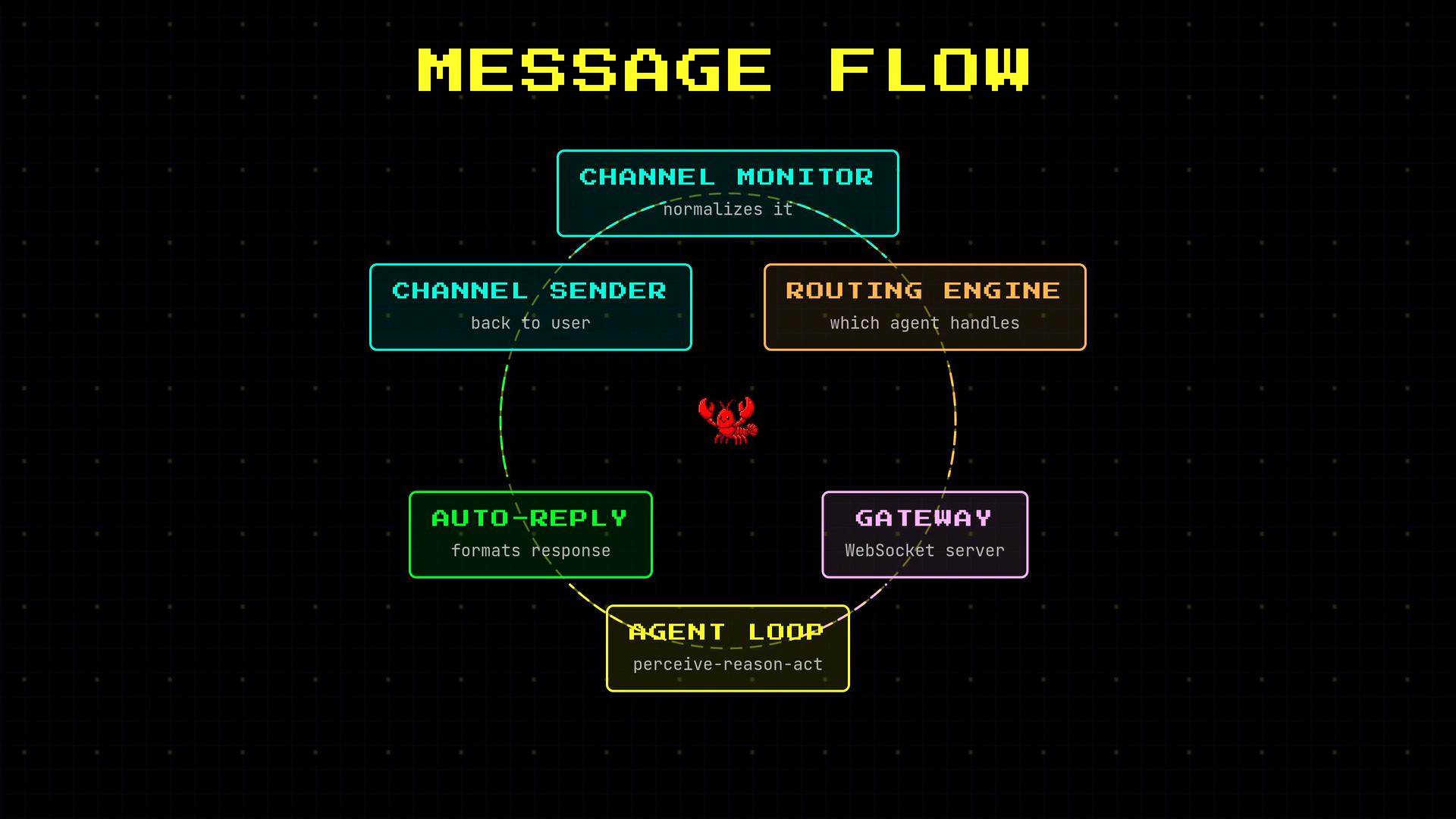
- Channel Monitor normalizes the incoming payload (unifying formats from WhatsApp, Telegram, Discord, etc.).
- Routing Engine selects the correct agent or agent instance based on channel, session, or metadata.
- Gateway (a WebSocket coordinator) handles authentication, concurrency, and connection lifecycle, then forwards the request to the agent system.
- Agent Loop executes the Perceive–Reason–Act cycle: perceive input, reason (including tool use and memory retrieval), act (invoke tools or craft a response), and decide whether follow-up steps are needed.
- Auto-reply Engine formats the agent’s response to the originating channel’s required payload structure.
- Channel Sender dispatches the formatted response back to the user.
Patterns and safety
OpenClaw applies established architectural and safety patterns commonly used in agent systems:
- Augmented LLMs with first-class tool integration and persistent memory (embeddings + vector stores).
- Policy-driven tool access: tools can be allowed, restricted, or require explicit human approval.
- Routing by channel and session to ensure conversation continuity per agent instance.
- Context window compression and model fallback to handle provider rate limits or outages.
- Human-in-the-loop for risky, destructive, or safety-sensitive operations.
- Robust error handling: credential rotation, rate-limit backoff, and retries.
Tools that perform destructive operations (e.g., file deletion or remote shell access) must be protected by strict policies and human approval workflows. Test policies in a safe environment before enabling them in production.
- Run-time environments: Node.js LTS on macOS, Linux, and Windows.
- Edge deployment: lightweight agent builds and trimmed toolsets for Raspberry Pi.
- Scaling: multiple gateway instances and routing allow horizontal scaling; session affinity ensures conversation continuity.
- Configuration: store sensitive keys and secrets securely (e.g., environment variables, secret stores) and use validated
JSON5for runtime configuration.
- Node.js — https://nodejs.org/
- OpenAI — https://openai.com/
- Anthropic Claude — https://www.anthropic.com/
- Google Gemini — https://cloud.google.com/gemini
- AWS Bedrock — https://aws.amazon.com/bedrock/