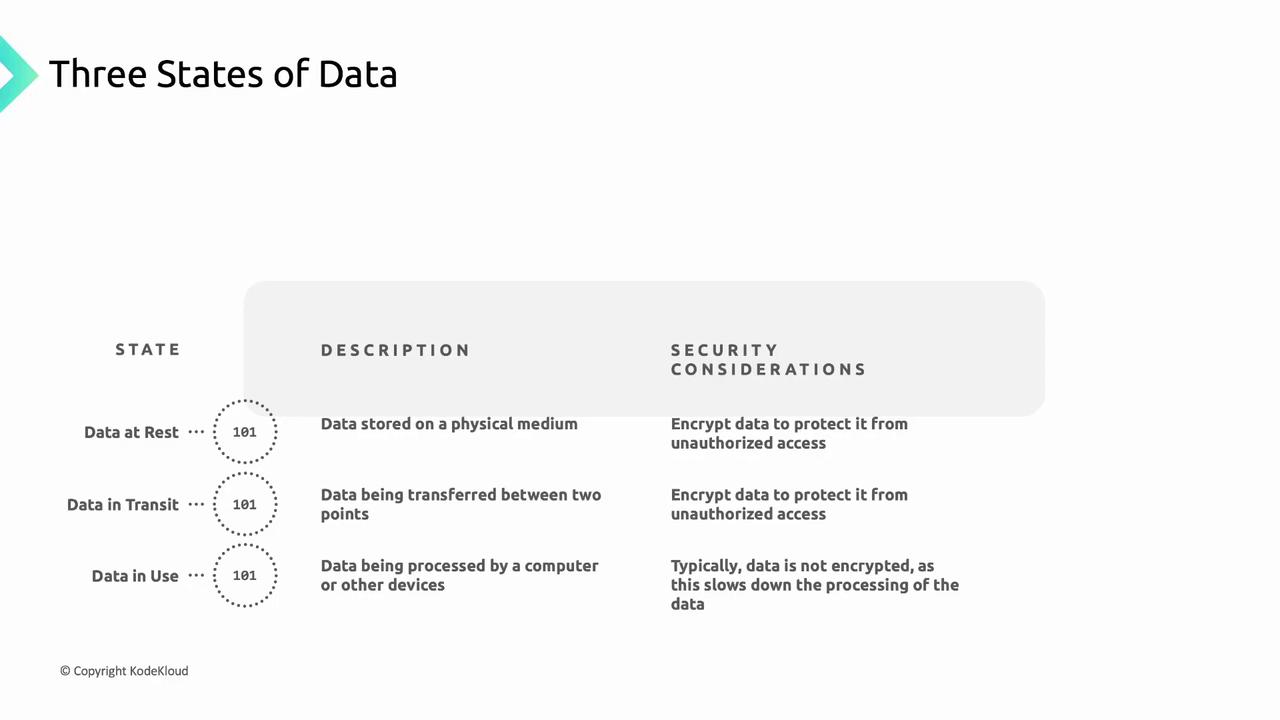
Data States Overview
GKE applies encryption by default across all three states to ensure confidentiality, integrity, and compliance.
Encryption at Rest
Google Cloud automatically encrypts all customer data at rest using the Advanced Encryption Standard (AES-256). To meet compliance or key ownership requirements, you can use Cloud Key Management Service (Cloud KMS):- Create, rotate, and manage your own cryptographic keys.
- Implement envelope encryption for layered security.
- Audit and control key usage with IAM policies.

Customer-managed encryption keys (CMEK) let you maintain full control over key rotation, access policies, and audit logs.
Encryption in Transit
All data exchanged between clients and Google Cloud services is protected by HTTPS (TLS). Key features include:- TLS handshake powered by BoringSSL.
- Default support for strong cipher suites and forward secrecy.
- Encryption for both user-facing traffic and internal API calls.
Ensure your clients and services support TLS 1.2 or higher to comply with Google’s security requirements.
Encryption in Use
GKE’s Confidential Nodes leverage Compute Engine Confidential VMs to encrypt VM memory, protecting data during processing.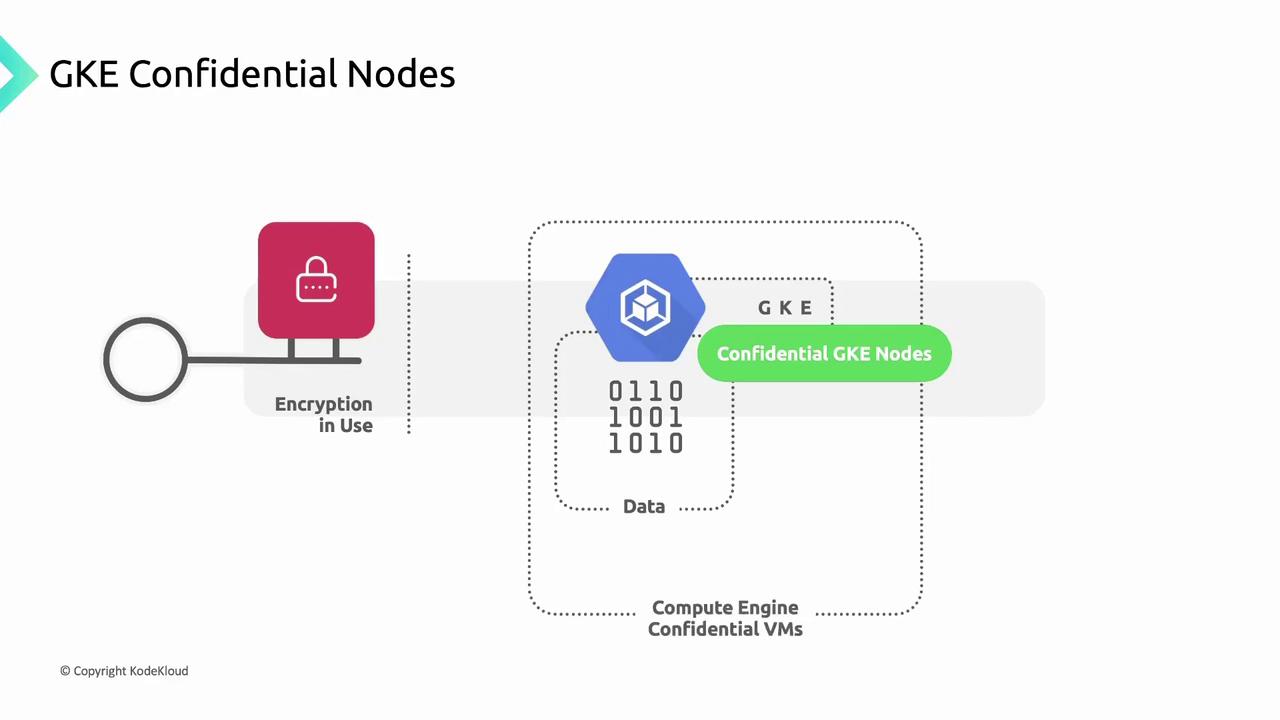
Enabling Confidential Nodes
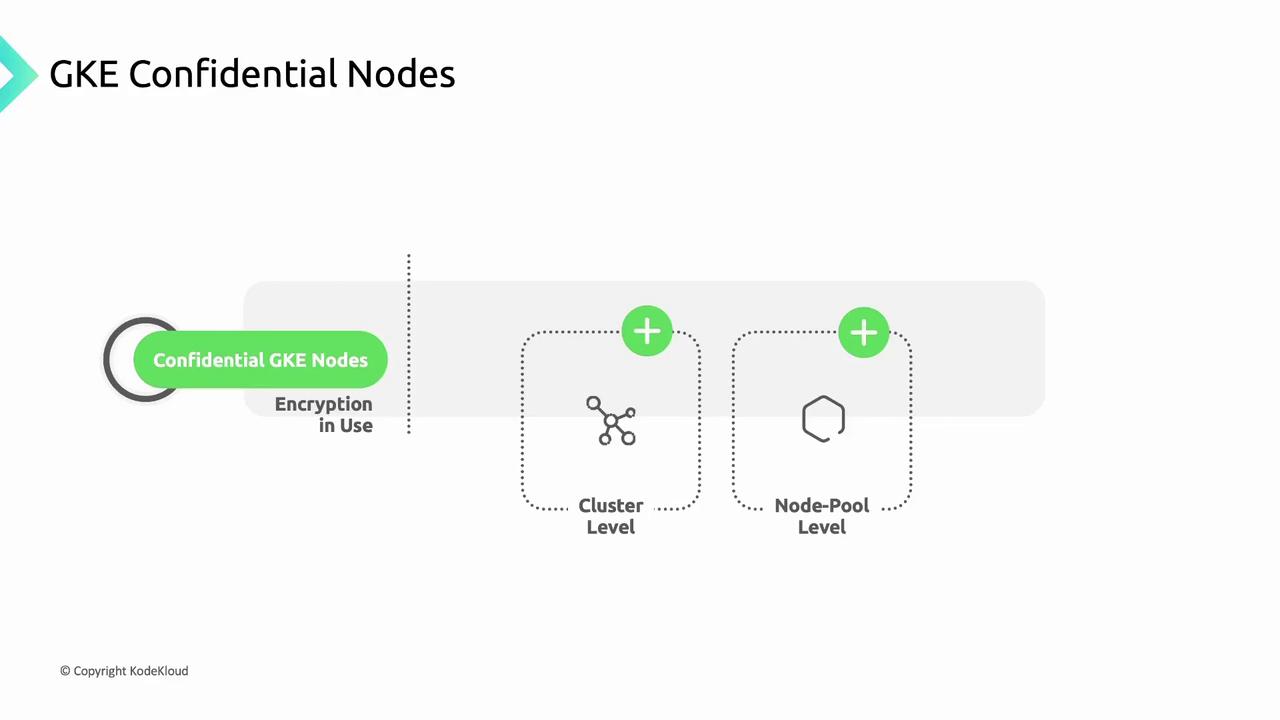
Confidential Nodes can be activated at:-
Cluster level
- Enable during cluster creation to apply encryption-in-use across all node pools.
- This setting is irreversible for existing and new pools.
-
Node pool level
- In clusters with Confidential Nodes enabled, toggle per node pool when creating or updating.
- Only selected pools will enforce memory encryption.