

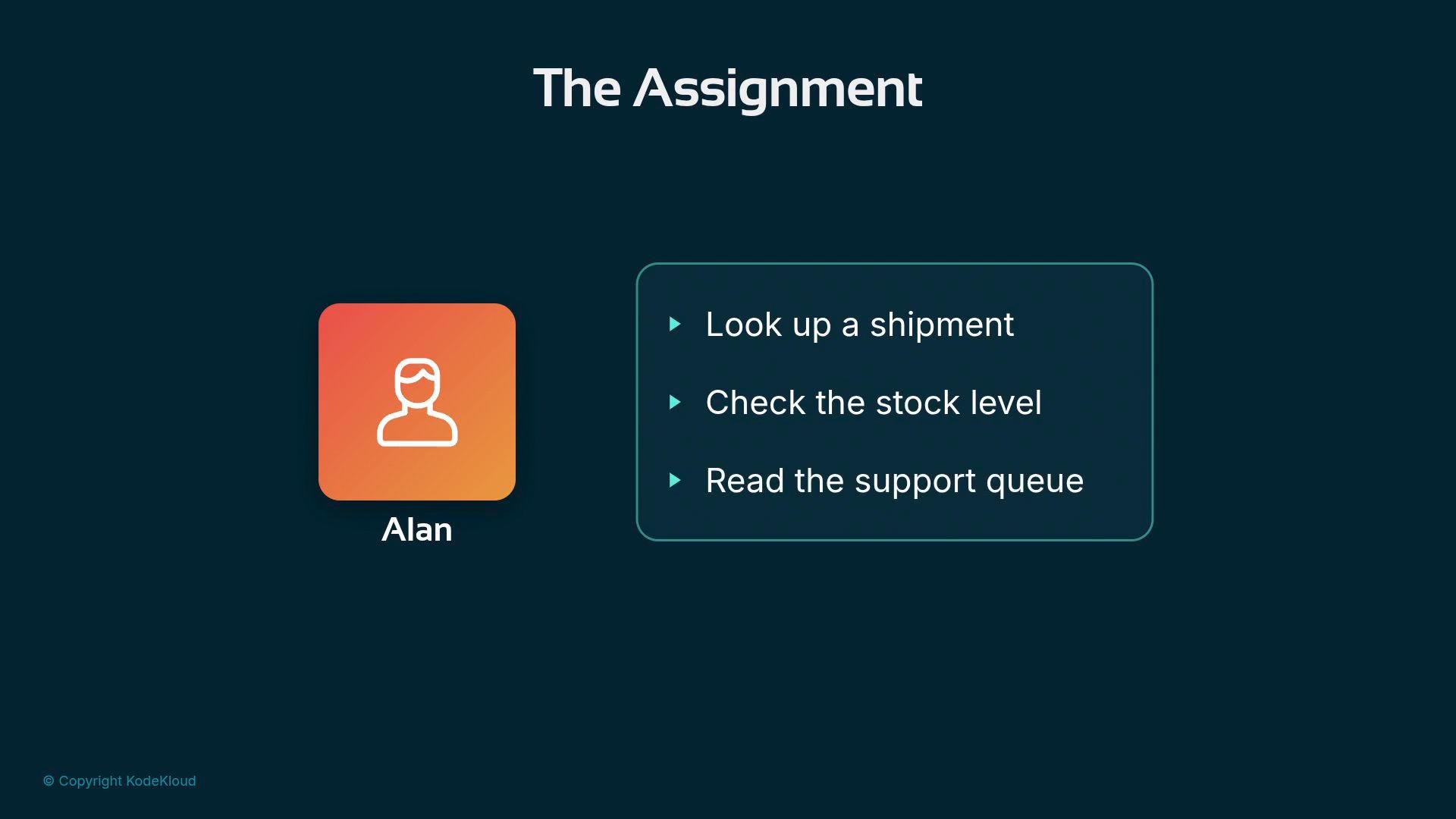
- Look up a shipment
- Check product stock levels
- Read the support message queue
- The warehouse database — knows what’s on the shelves and where.
- The support queue — holds every open customer complaint.
- Billing — knows who has paid and who hasn’t.
- Shipment tracking — knows the current location of every parcel.
Why wrappers become a maintenance problem
Each wrapper is its own small server with its own deployment, auth, and testing. As you add more integrations, the cost of maintaining these wrappers grows nonlinearly:
A colleague, Dana, points Alan to an alternative: Model Context Protocol (MCP).
Alan hadn’t heard of MCP — and you might not have either — which is why you’re reading this article. Instead of maintaining many wrappers, Alan adopts MCP for the assignment. The rest of this lesson follows his decision and explains what MCP is, why it matters, and how it reduces long-term integration costs.
Alan’s journey will also help you prepare for topics on the Model Context Protocol Associate (MCPA) exam.
What the MCPA covers
The MCPA (Model Context Protocol Associate) is administered by the Agentic AI Foundation under the Linux Foundation umbrella. The exam tests five domains of MCP knowledge:
Integrations and security account for the majority of exam content — because they’re the parts that matter most when connecting models to real systems.
What is MCP?
MCP stands for Model Context Protocol. It is an open standard for connecting AI applications to the systems where your data and tools live. “Open standard” means the specification is public and anyone can implement compatible servers and clients. A brief timeline:- November 2024: Anthropic released MCP as open source.
- December 2025: Governance moved to the Agentic AI Foundation under the Linux Foundation.
- MCP uses date-based versioning (
YYYY-MM-DD); the current revision is2026-07-28.
MCP standardizes how models discover, request, and use external context (databases, APIs, queues, etc.). Instead of building one-off wrappers for each model, you build or adopt an MCP server that exposes a consistent interface to any MCP-enabled model or agent.
What MCP enables for different roles
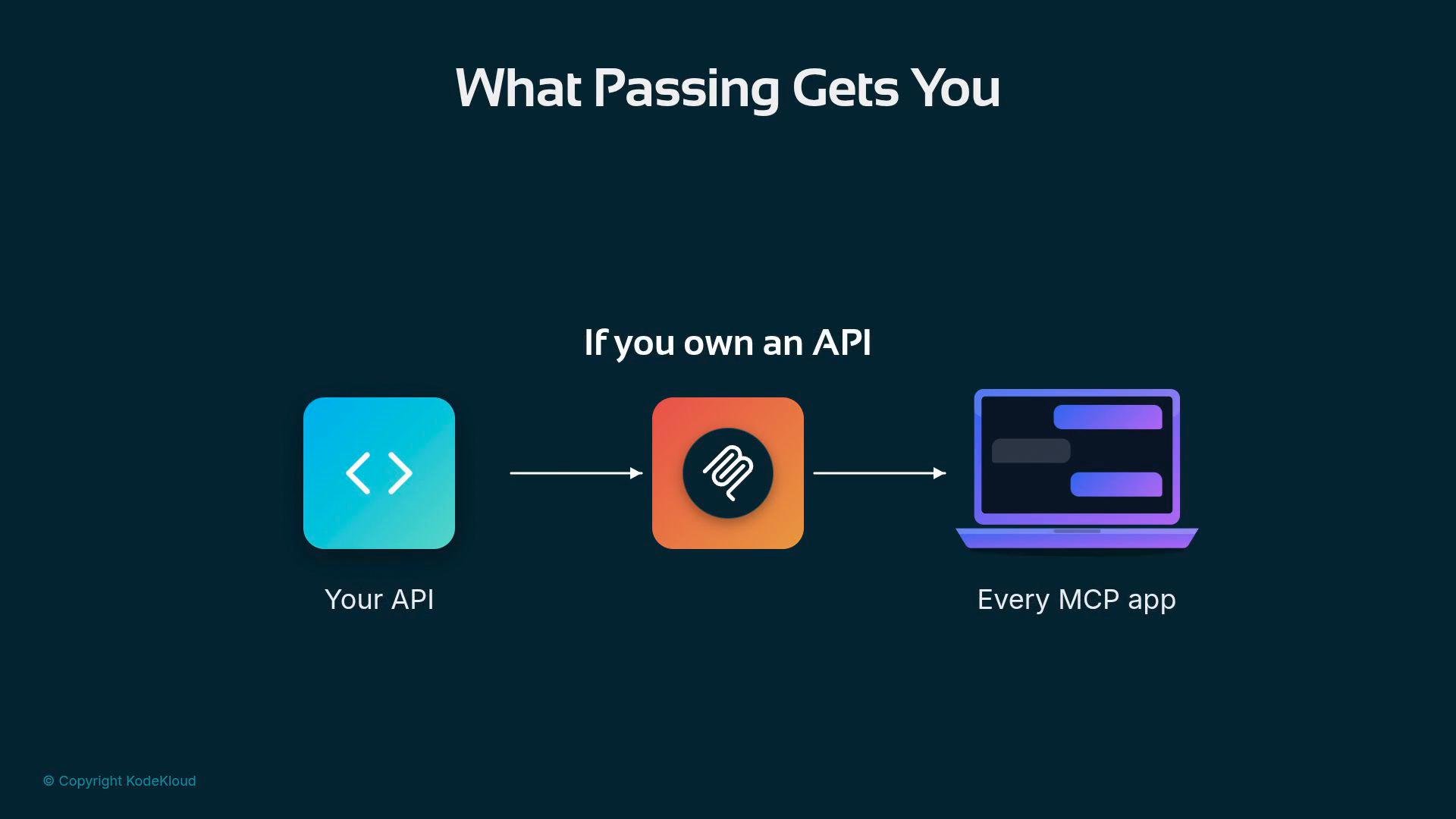
- If you build AI applications (like Alan), you’ll know how to implement MCP servers and integrate them securely with many AI clients. This dramatically reduces per-integration work because the MCP server provides a uniform, discoverable interface for tools and data.
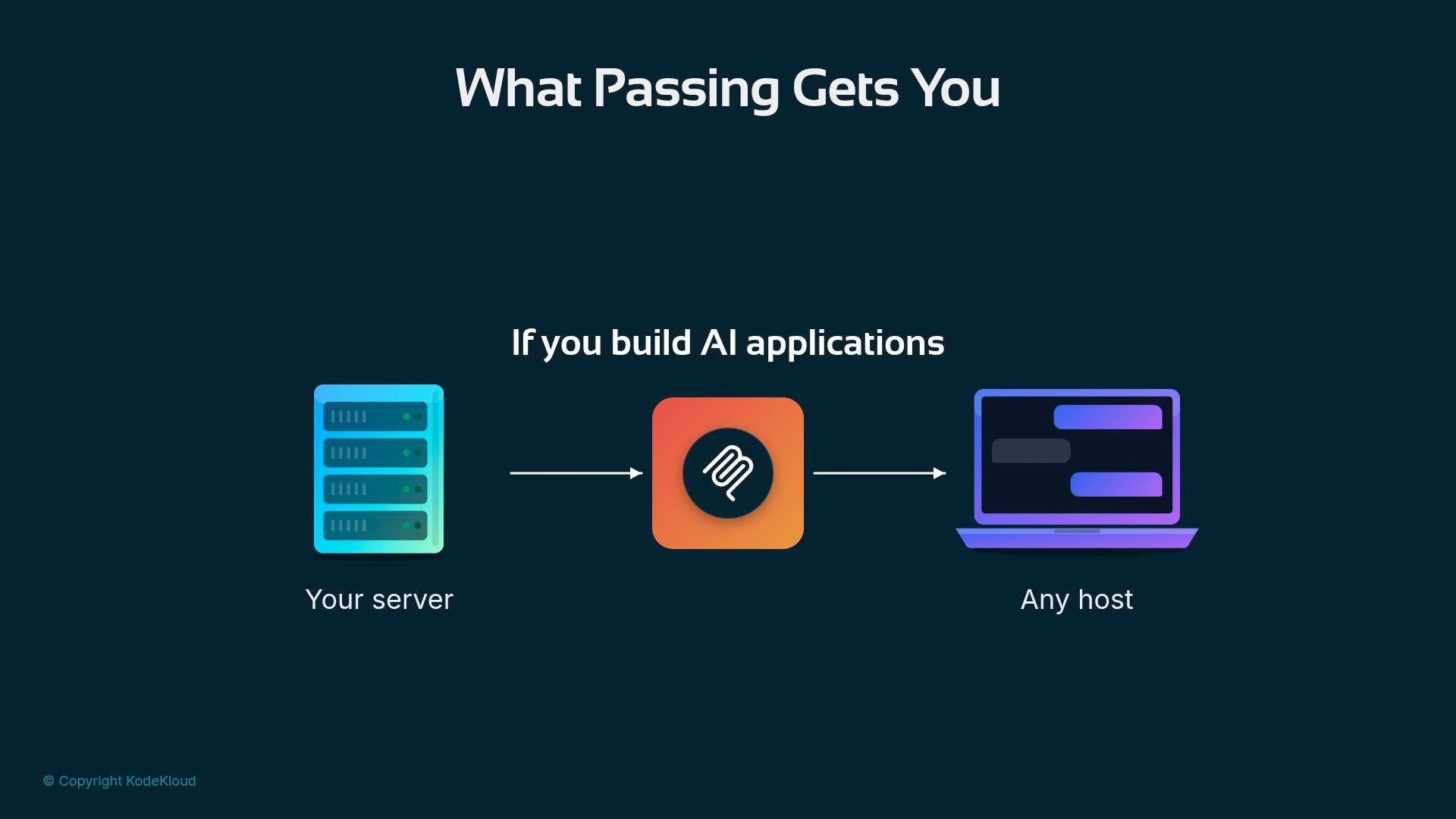
- If you run an API, you can implement a single MCP integration so your API becomes reachable by every MCP-enabled application without each consumer writing custom adapters.
- If you run a company, adopting MCP means all AI tools that touch your data can be routed through a single, governable surface — which simplifies auditability and policy enforcement.
Adopting MCP centralizes integration, which helps governance — but also means you must design your MCP servers with strong authentication, fine-grained authorization, and comprehensive logging. Security mistakes at the MCP layer can expose multiple systems at once.
Quick comparison: Wrappers vs MCP
Next steps
This article introduced the problem Alan faced and why MCP is compelling. Next, we’ll cover what the protocol standardizes — endpoints, message formats, capability discovery, and recommended security patterns — and walk through a minimal MCP server implementation so you can see how it replaces multiple wrappers with a single, maintainable integration.Links and references
- Linux Foundation
- Agentic AI Foundation
- If you’re researching MCP implementations, search for “Model Context Protocol” and the revision tag
2026-07-28to find current specs and examples.