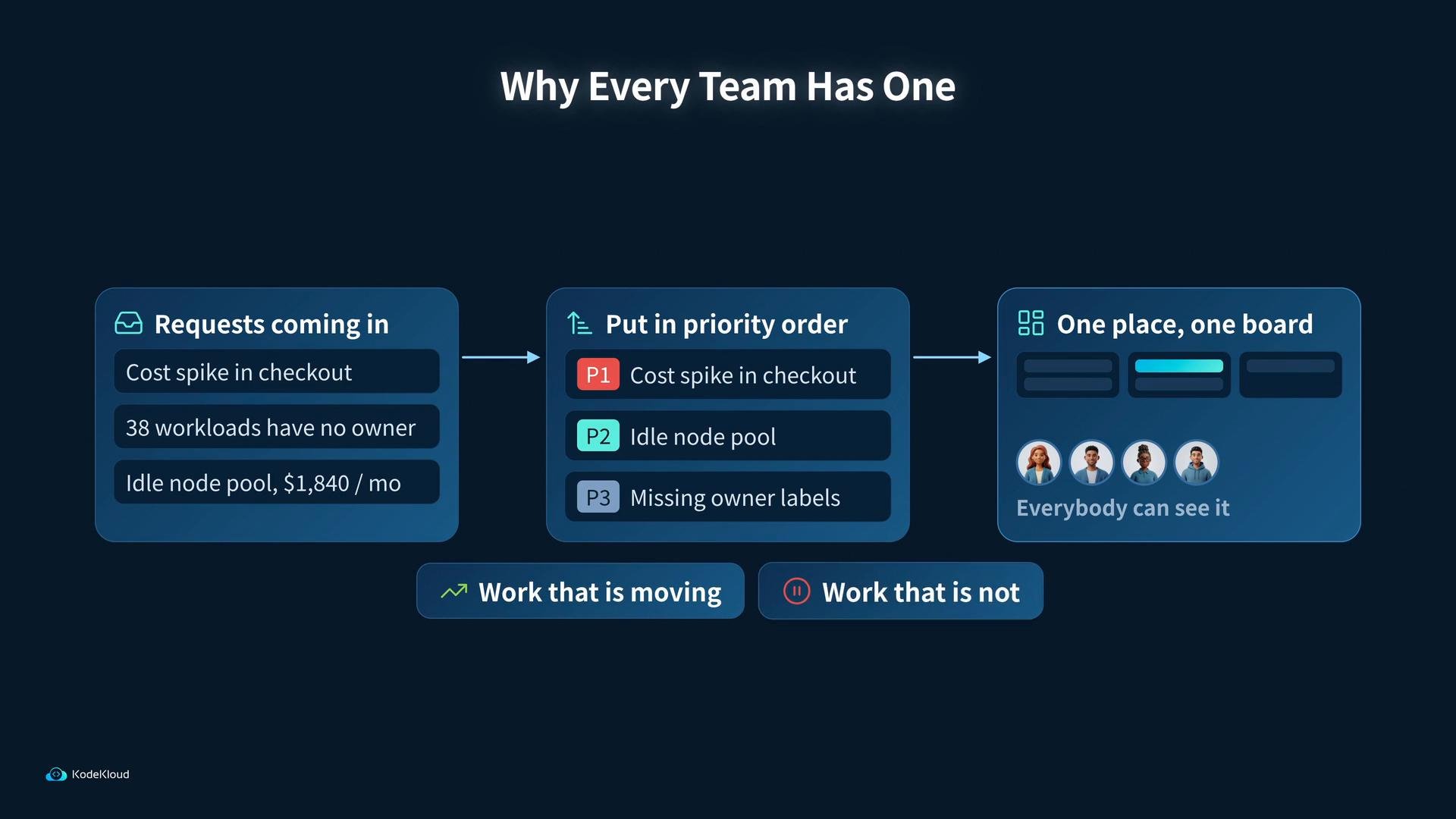
Hello and welcome back. In this lesson we focus on making the agent’s output actionable. In most organizations you already use issue-tracking tools such as Jira, Linear, and others. These systems collect incoming requests, prioritize work, and provide a shared view of what is moving and what is stalled. Agent logs and raw alerts are useful, but to drive engineering work we must translate findings into structured tickets that teams can act on. There are many incoming signals across a large platform: cost spikes in checkout, idle node pools, misconfigured services, and more. These signals must be triaged, prioritized, and surfaced on a shared board so the right teams take ownership.
A dark-themed infographic titled "Why Every Team Has One" showing a workflow from incoming requests (e.g., cost spike in checkout, idle node pool) to prioritized items labeled P1/P2/P3 and then to a shared board where team members can see tasks. A small legend at the bottom contrasts "work that is moving" and "work that is not."
Issue-tracking systems let teams order work, set priorities, and annotate complexity or ownership. To be actionable, agent findings should be emitted in a structured format that maps directly to ticket fields. A typical structured finding looks like this:
Emit structured findings that map to your issue tracker fields (title, description, priority, owner, tags, cost estimates). This enables automation for creating tickets, assigning owners, and grouping related findings.
Use this field mapping table as a reference when designing the agent output and ticket templates: Raw log lines provide signals but lack discrete fields for automation. For example:
This alert is useful as an indicator, but it does not include structured metadata such as cluster, priority, or owner_team. Converting alerts into structured findings enables several operational improvements:
  • Automated ticket creation in your tracker (Jira, Linear, etc.)
  • Clear ownership and SLA assignment
  • Prioritization and aggregation (e.g., all P2 cost items across clusters)
  • Better reporting and decision-making across teams
Practical steps to turn findings into actionable tickets:
  1. Enrich the raw alert with structured fields (resource, cost, severity, suggested remediation, links to logs/runbooks).
  2. Classify and map the finding to a ticket template or project (e.g., CostOps, Infra).
  3. Assign or suggest an owner team and set an initial priority.
  4. Create the ticket via your issue-tracker API, or surface the structured payload for manual review.
  5. Include links to traces, dashboards, and runbooks to shorten mean time to resolution.
References and further reading: That is it for this particular lesson. Speak with you soon.

Watch Video