

- Removed:
cURLand the Supergateway layer. - Added/kept:
- MCP as the tool endpoint for Kubernetes.
- An LLM provider (diagram shows KodeKloud; you can use ChatGPT, Claude, or another provider).
- A Python agent implemented with LangChain to host the prompt and runtime.
- Outputs surfaced as logs (for now).
- MCP — Kubernetes control endpoint: https://learn.kodekloud.com/user/courses/mcp-for-beginners
- Kubernetes — cluster where workloads run: https://learn.kodekloud.com/user/courses/kubernetes-for-the-absolute-beginners-hands-on-tutorial
- Docker — MCP runs via Docker in this setup: https://learn.kodekloud.com/user/courses/docker-training-course-for-the-absolute-beginner
- LLM provider — shown as KodeKloud (replaceable with ChatGPT, Claude, etc.)
- Agent runtime — Python + LangChain: https://learn.kodekloud.com/user/courses/python-basics and https://learn.kodekloud.com/user/courses/langchain
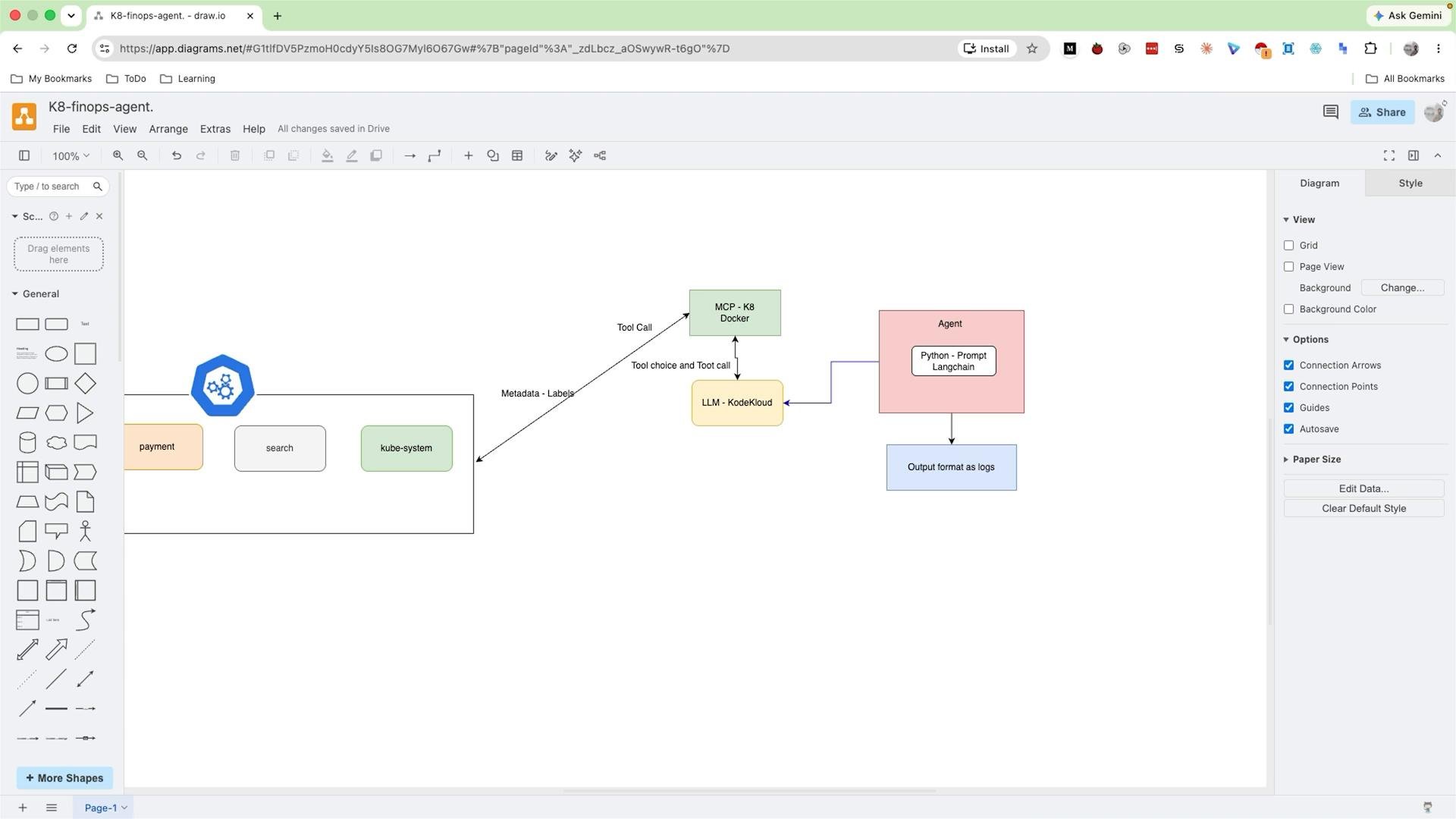
- The agent runtime (Python + LangChain) formats a prompt and sends it to the LLM.
- The LLM returns a decision that includes a tool choice (for example, “call MCP to list pods”).
- The agent runtime interprets that decision and issues the corresponding tool call to the MCP (the runtime performs the actual request).
- MCP forwards the request to the Kubernetes cluster and later returns the callback/result to MCP.
- MCP returns the result back to the agent runtime.
- The agent runtime either:
- passes the result back to the LLM in the next prompt/turn for further reasoning, or
- uses the result locally to continue orchestration, then prints the outcome as logs.
- The agent runtime is implemented with LangChain and contains both the prompt and the orchestration logic.
- MCP serves as the tool endpoint for interacting with Kubernetes and is shown running via Docker.
- For now outputs are surfaced as logs; the output format can be extended later (e.g., to dashboards, databases, or monitoring systems).
- In a follow-up article we’ll focus on extracting accurate labels and metadata from the Kubernetes cluster and how to surface that information into the agent’s observations and prompts.
- Consider which LLM provider best fits your operational constraints and cost model; the runtime design keeps the LLM provider pluggable.