

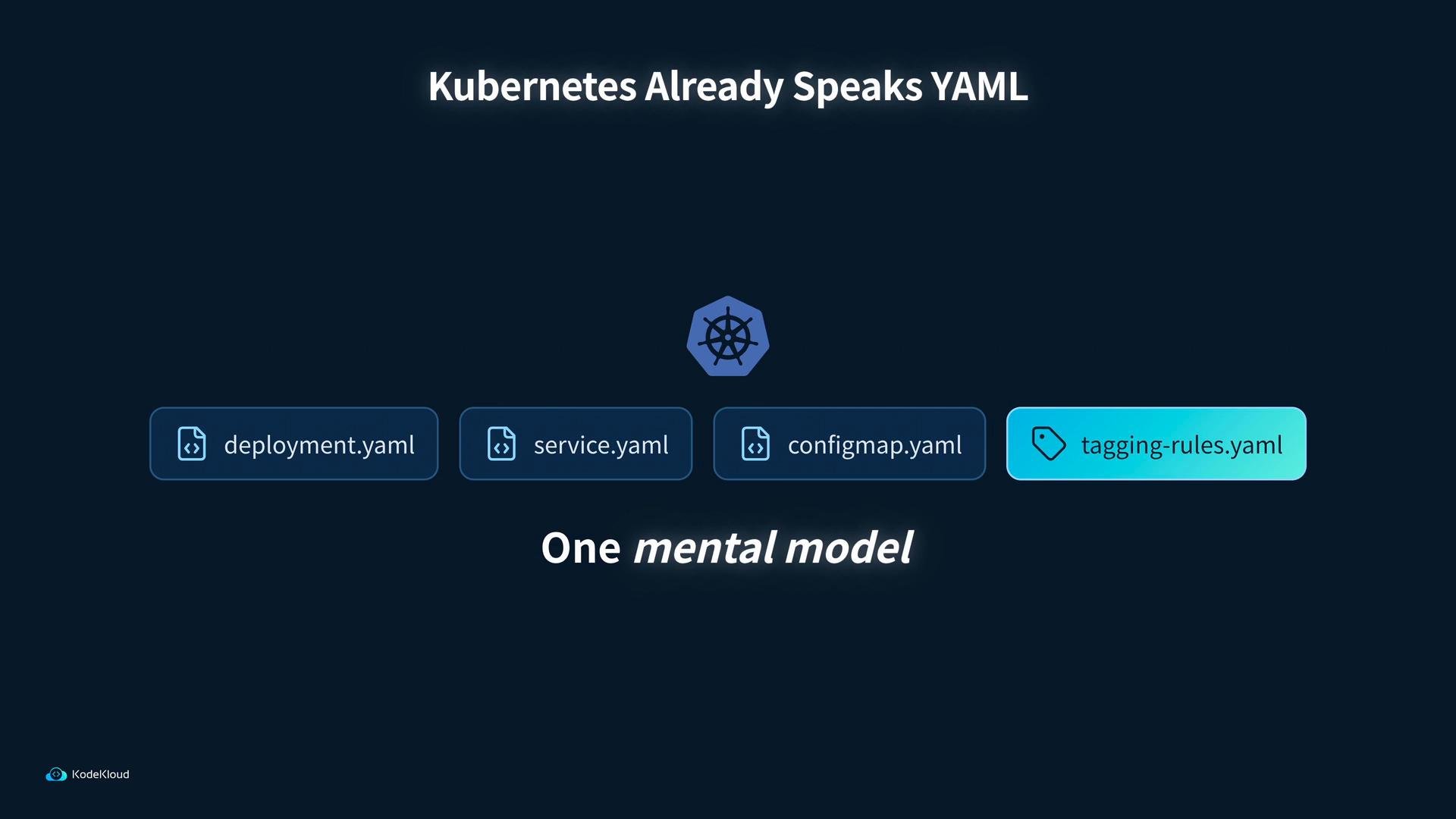
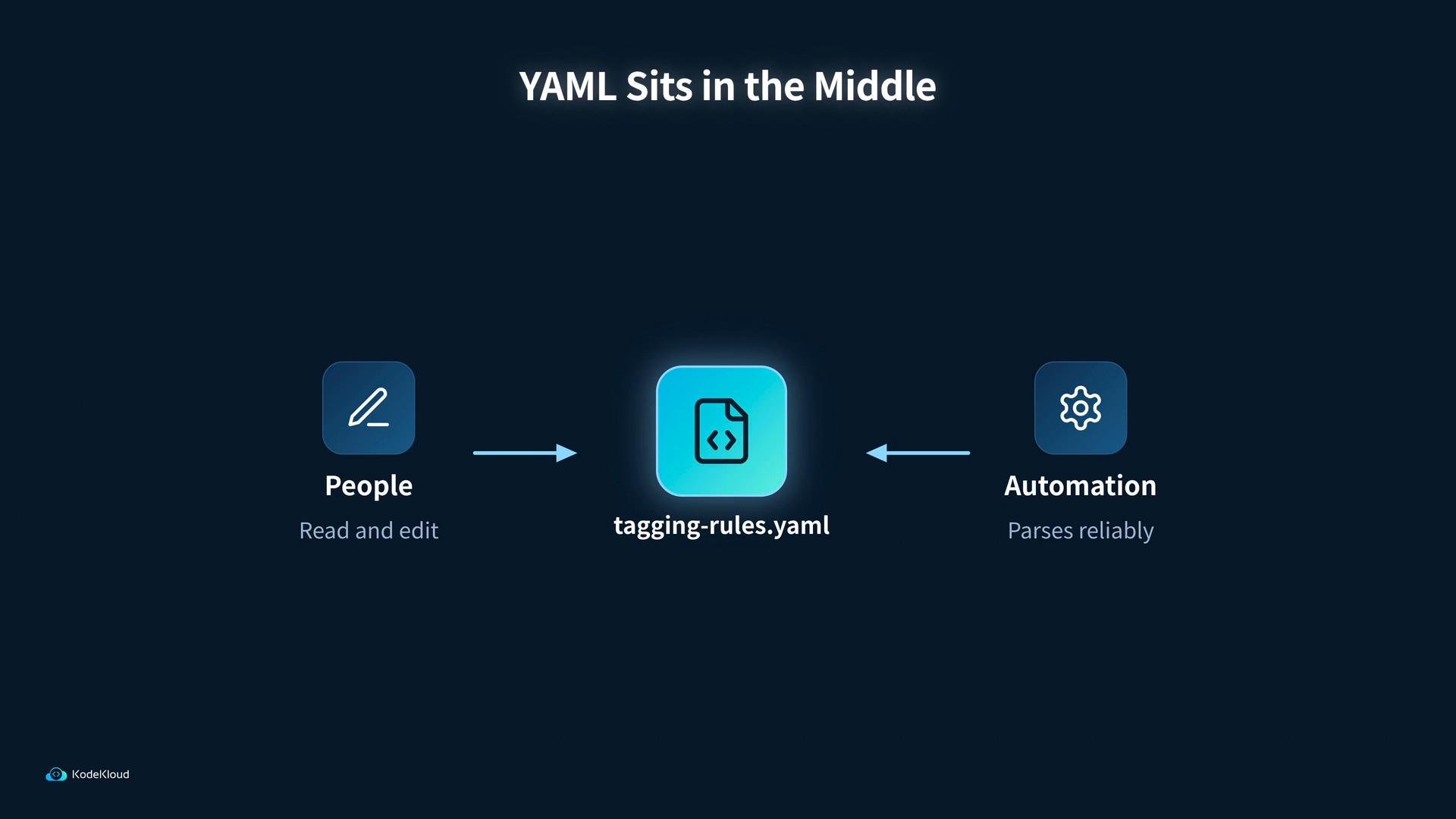
tagging-rules.yaml. Below explains why YAML is the right choice for that policy file, and shows a practical example you can adopt.
Why not spreadsheets, wiki pages, or JSON?
- Spreadsheets and wiki pages can serve human readers well, but they are hard to consume programmatically in automation pipelines.
- JSON is great for API responses and structured findings (we’ll use JSON later for FinOps results), but it’s a poor authoring format for a policy file that people will edit frequently: no native comments, strict syntax, and fragile to trailing commas or minor errors.
- native support for comments and inline notes,
- familiar structure (lists, maps, nesting) for platform engineers and SREs,
- the same declarative format as Kubernetes manifests, lowering cognitive overhead.
A concise tagging-rules.yaml example
- This skeleton shows the most useful fields for a cluster tagging policy: global defaults, namespace overrides, owners, compliance tier, and exclusions.
- Keep the policy opinionated and focused on metadata that answers ownership and billing questions.
- Keep the file small, opinionated, and single-purpose: metadata and ownership belong here; enforcement and cost calculations belong in the automation that consumes it.
- Prefer defaults with namespace-level overrides to limit duplication.
- Use clear owner identifiers (team aliases or on-call rotations) so remediation can be routed reliably.
- Exclude system namespaces explicitly to avoid noisy findings.
Keep the tagging policy small and opinionated. Store ownership, required labels, and exclusions here; leave enforcement rules and cost calculations to the automation that consumes this YAML.
- Kubernetes Basics
- YAML specification: https://yaml.org/
- Consider tools that validate YAML and apply policy (e.g., CI validation, OPA/Gatekeeper) to enforce tagging consistency during manifest deployment.