

Learn more about AGI and its implications in the OpenAI Charter.
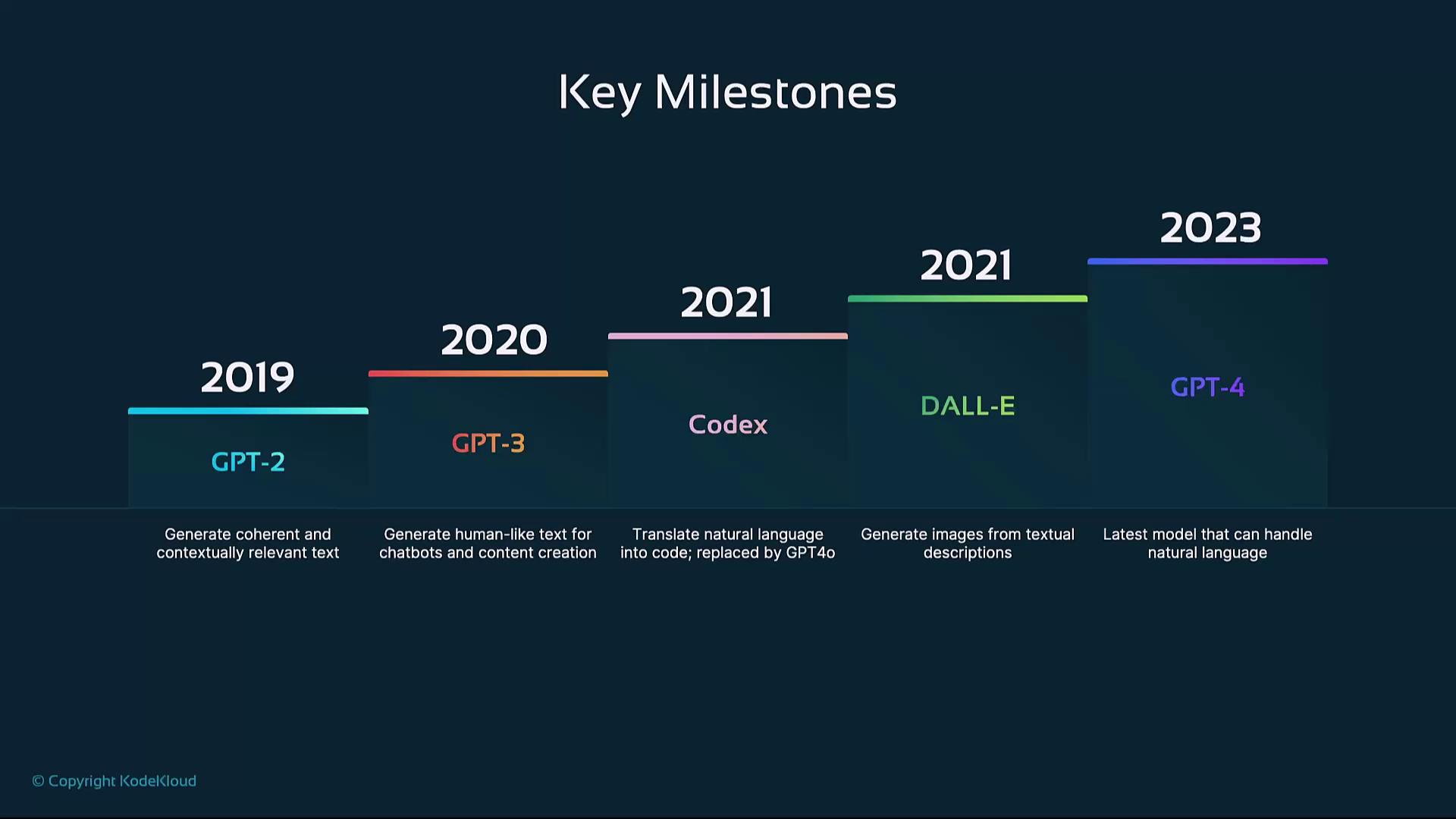
Key Milestones
2019 – GPT-2
In early 2019, OpenAI unveiled GPT-2, showcasing how transformer architectures can produce long-form, context-aware text. Despite its capabilities, the full model was initially withheld due to concerns about potential misuse.- Transformer-based architecture
- 1.5 billion parameters
- Demonstrated coherent text generation across diverse topics
2020 – GPT-3
The release of GPT-3 in mid-2020 marked a major leap:- 175 billion parameters for deep language understanding
- Zero- and few-shot learning capabilities
- Applications: chatbots, virtual assistants, automated content writing, and more
2021 – Codex
Building on GPT-3, Codex was introduced to bridge natural language and programming. It can:- Interpret plain-English prompts
- Generate code in multiple languages (e.g., Python, JavaScript)
- Power developer tools like GitHub Copilot
Use Codex responsibly. Generated code may require security reviews and testing before production deployment.
2021 – DALL·E
DALL·E demonstrated creative AI by converting text descriptions into images:- Leveraged GPT-style transformers for image synthesis
- Supported diverse artistic styles and novel object combinations
- Found use cases in marketing, digital art, and rapid prototyping
2023 – GPT-4
The latest milestone, GPT-4, extends OpenAI’s models to be truly multimodal:- Processes both text and image inputs
- Delivers finer-grained reasoning and problem-solving
- Powers advanced applications in research, software development, and creative industries
Further Reading
- OpenAI Official Site
- Understanding Transformers
- Generative Pre-trained Transformers (GPT)
- GitHub Copilot Documentation
References
- OpenAI Charter: https://openai.com/charter/
- “Language Models are Few-Shot Learners” (GPT-3 paper): https://arxiv.org/abs/2005.14165