

Personal Finance Assistant Example
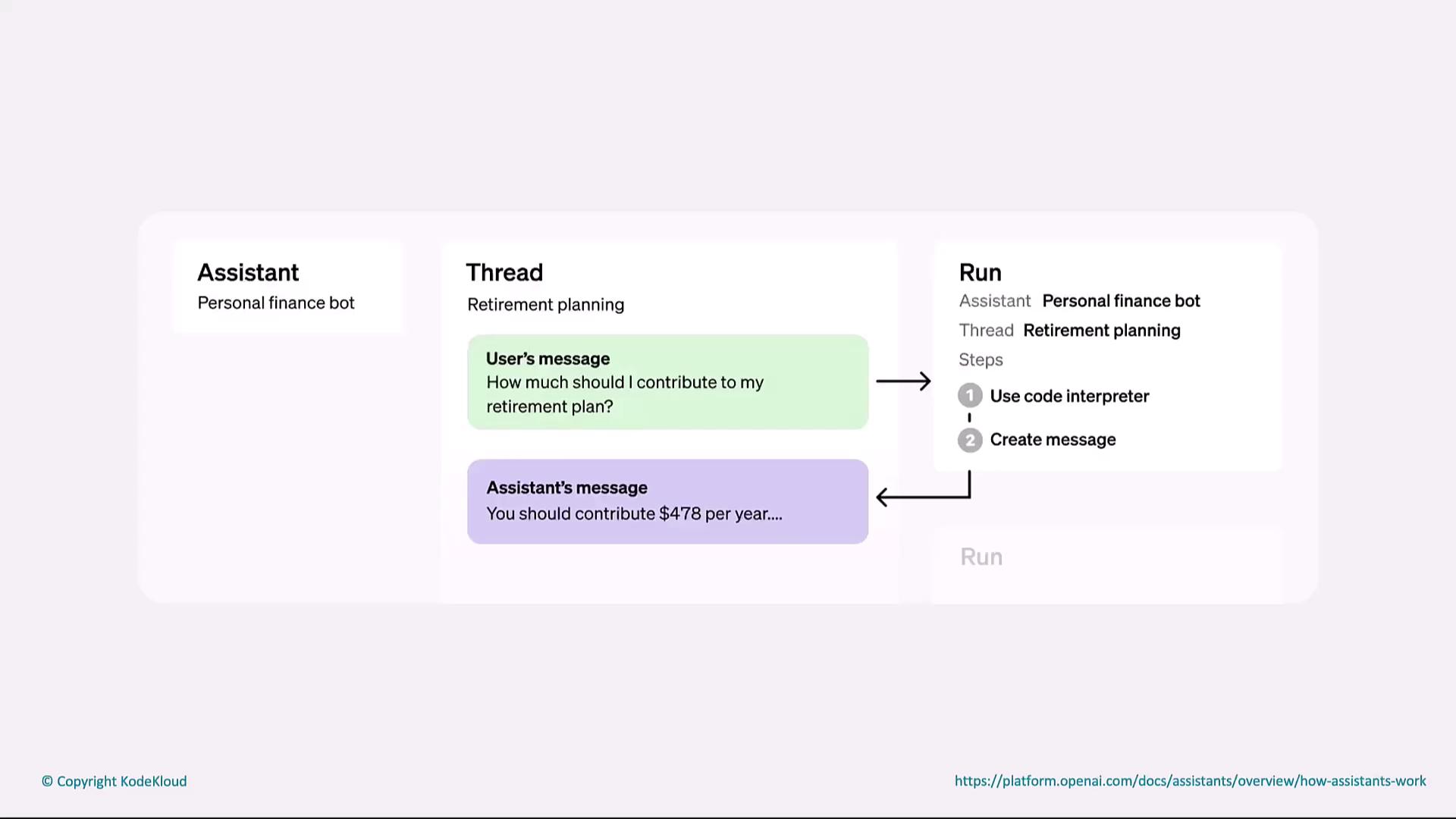
This scenario showcases a personal finance bot helping with retirement planning. When a user asks, “How much should I contribute to my retirement plan?” the assistant:- Receives the user message.
- Uses a code interpreter to calculate the optimal contribution.
- Sends back: “You should contribute $478 a year.”
What Are OpenAI Assistants?
OpenAI Assistants leverage large language models to:- Perform specific tasks and automate repetitive workflows
- Engage in natural language conversations
- Integrate with external tools (APIs, databases, code interpreters)
Core Workflow States
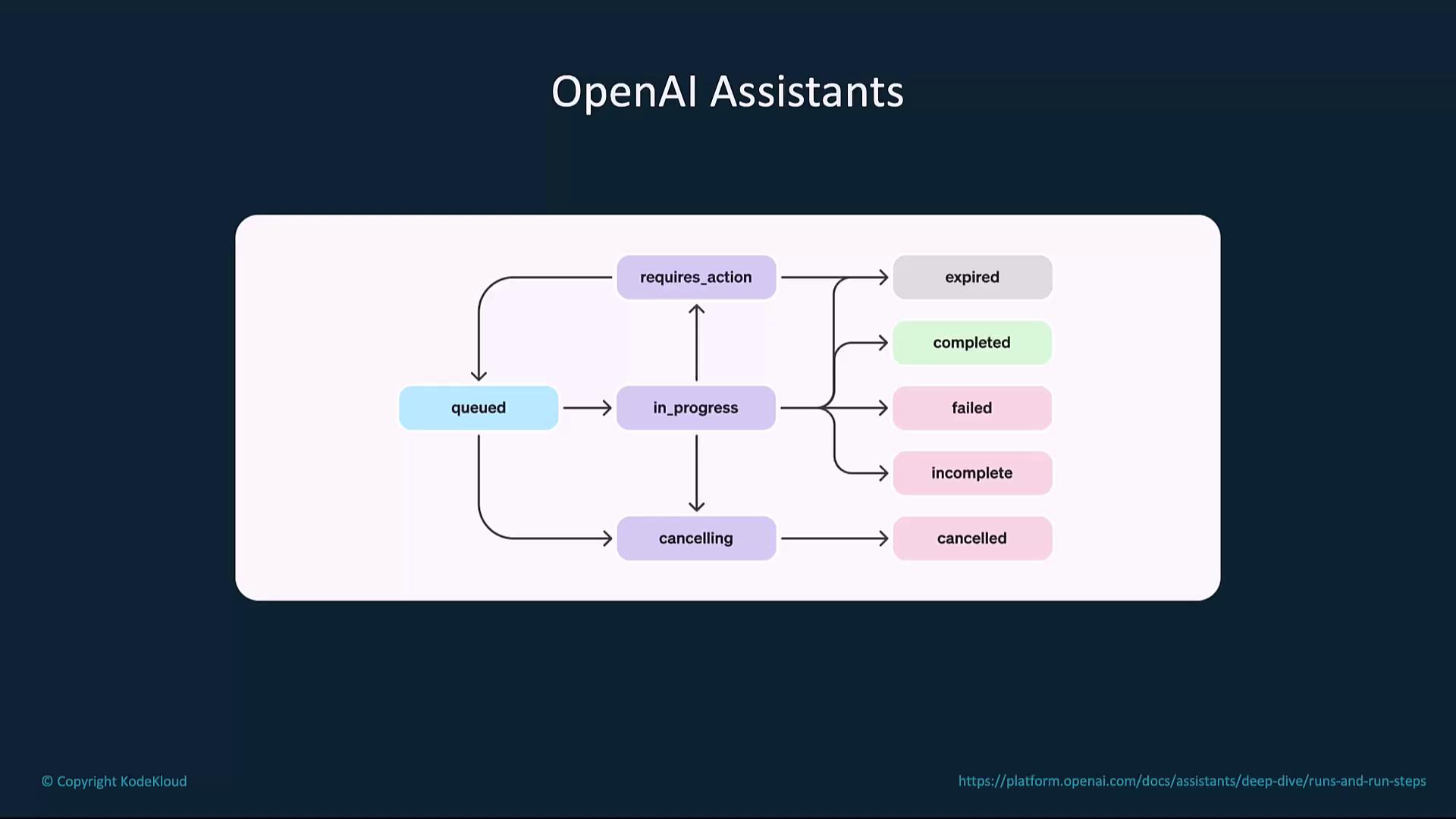
OpenAI Assistants track each task through a series of states:
Final outcomes:
Key Benefits
-
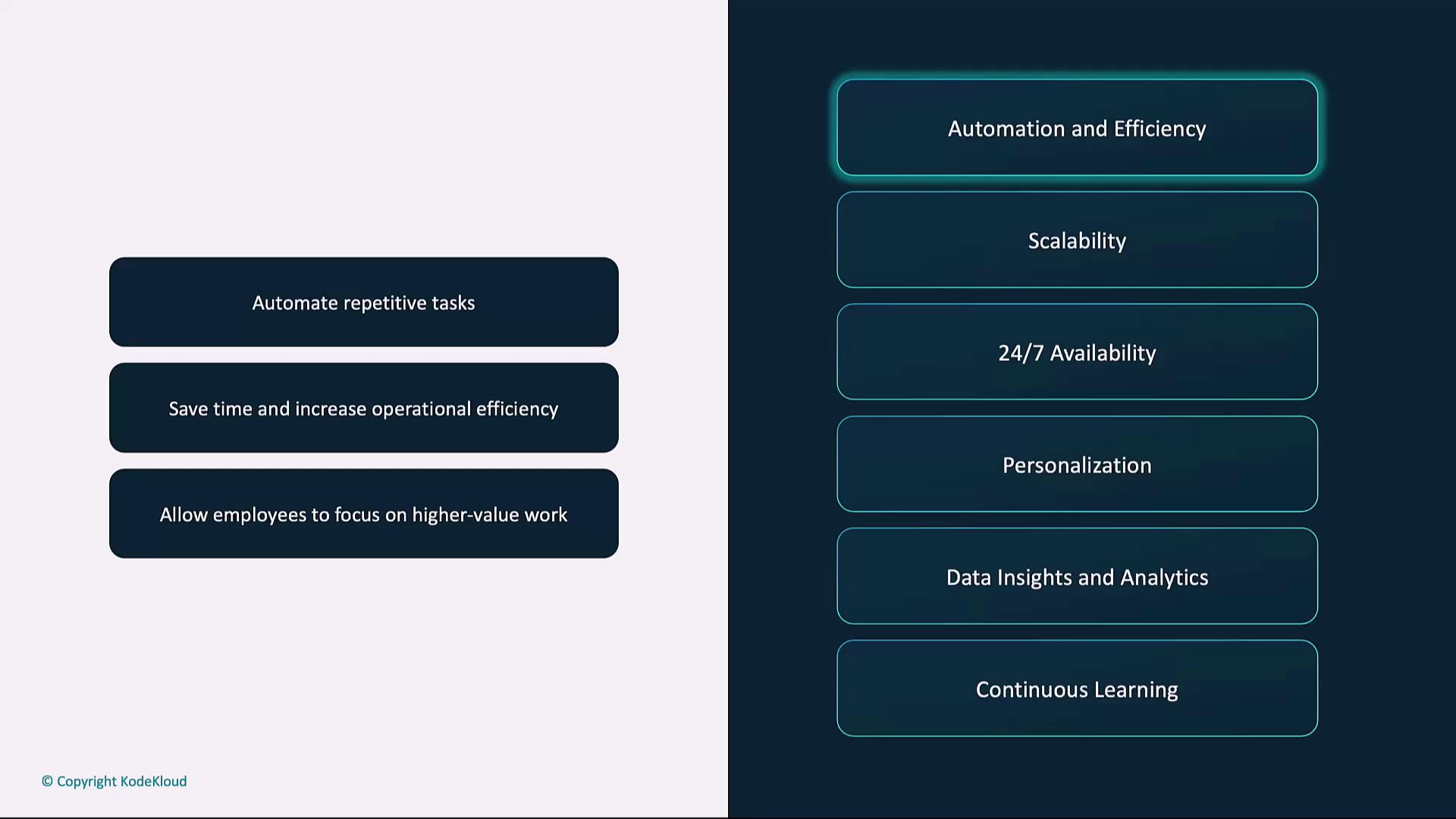
Automation & Efficiency
Free up teams by automating FAQs, ticket routing, and data processing. -
Scalability
Seamlessly handle spikes in demand without hiring additional staff. -
24×7 Availability
Provide nonstop support—ideal for global audiences or critical services. -
Personalization
Adapt responses based on user history and preferences. -
Data Insights & Analytics
Monitor conversations to extract sentiment, trends, and improvement areas. -
Continuous Learning
Fine-tune on domain-specific datasets (e.g., legal, medical) to boost accuracy.
Assistant Example: Customer Support
Here’s a Python snippet demonstrating a simple customer support assistant with GPT-4:Adjust
temperature, max_tokens, and top_p to control response creativity, length, and diversity.Building Custom OpenAI Assistants
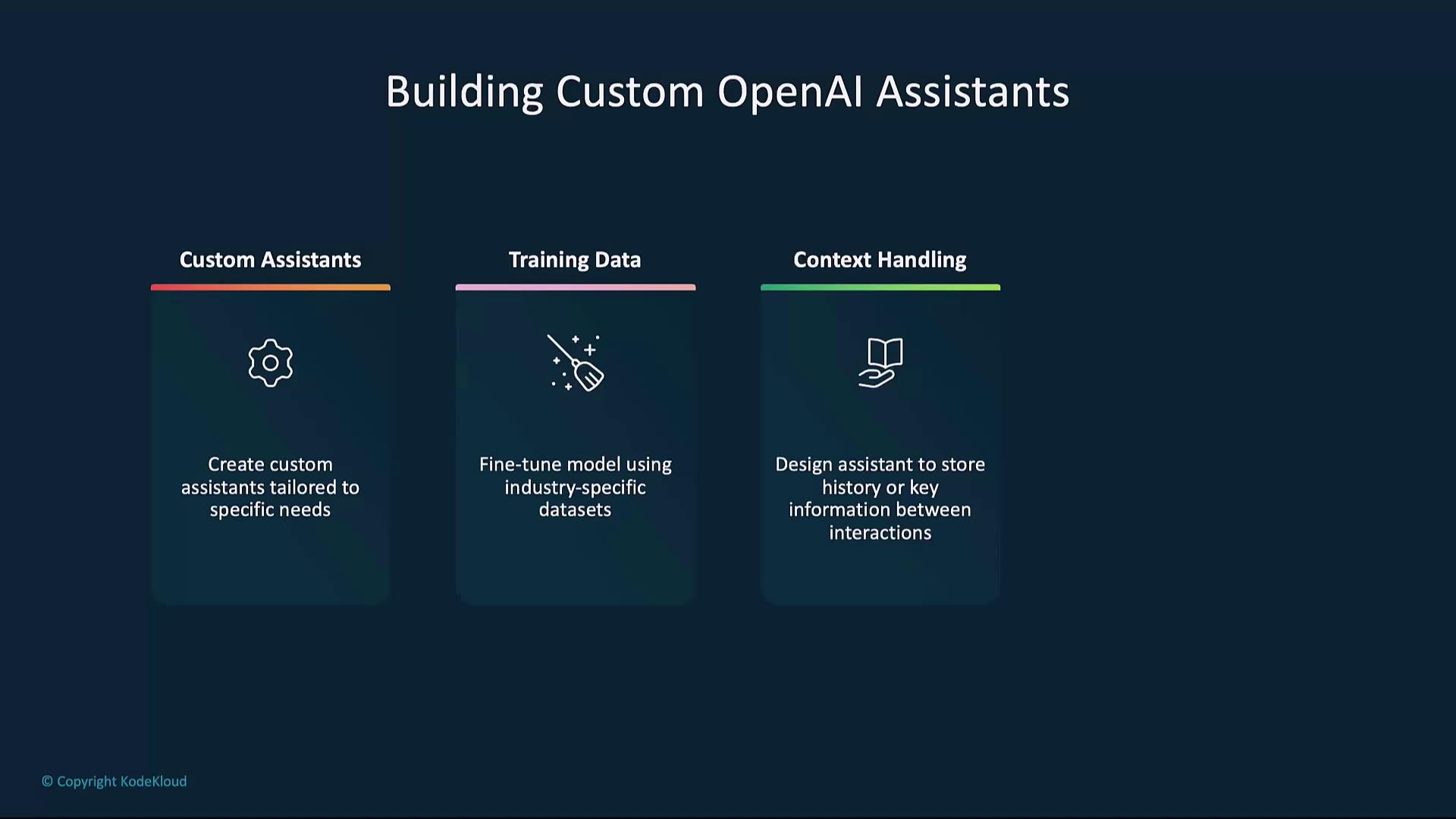
You can tailor assistants to your business needs by focusing on:-
Training Data
Fine-tune on domain-specific records or custom corpora to enhance subject-matter accuracy. -
Context Handling
Implement memory by storing conversation history, user preferences, or session variables. -
Model Parameters
Configuretemperature,max_tokens, andtop_pfor your desired output style.
When fine-tuning with sensitive or personal data, ensure you comply with privacy regulations (e.g., GDPR, HIPAA). Always anonymize PII and validate data sources.