

Welcome to this comprehensive guide on OpenAI. In this tutorial, you’ll discover how to harness cutting-edge AI technologies—from text generation to vision models—to build innovative applications. Whether you’re a developer, data scientist, or AI enthusiast, you’ll find practical examples, best practices, and pointers to official documentation. Take your time to explore each section, experiment with code samples, and refer to the provided links for deeper dives. Let’s embark on this journey into the world of intelligent systems!Documentation Index
Fetch the complete documentation index at: https://notes.kodekloud.com/llms.txt
Use this file to discover all available pages before exploring further.
Table of Contents
| Module | Subtopics |
|---|---|
| Introduction to OpenAI | What is OpenAI?, Account setup & API keys, OpenAI models & capabilities |
| History of AI Technology | Evolution of AI, Transformers & LLMs, Pretraining & Fine-tuning, Encoders & Fairness, Reinforcement Learning & Ethics |
| Text Generation | Prompt engineering, Chat completions, Sentiment analysis, OpenAI Assistant, Text-to-speech & Speech-to-text |
| OpenAI Features | Function calling, Structured outputs, Embeddings, Batch processing, Advanced usage |
| Vision Capabilities | Overview of Vision, DALL·E, CLIP, Applications & Ethical considerations |
Quick Start: Chat Completions
Jump right in with a simple Python example that sends prompts to a GPT model and prints the responses.Ensure your
OPENAI_API_KEY is exported as an environment variable before running these examples.History of AI Technology
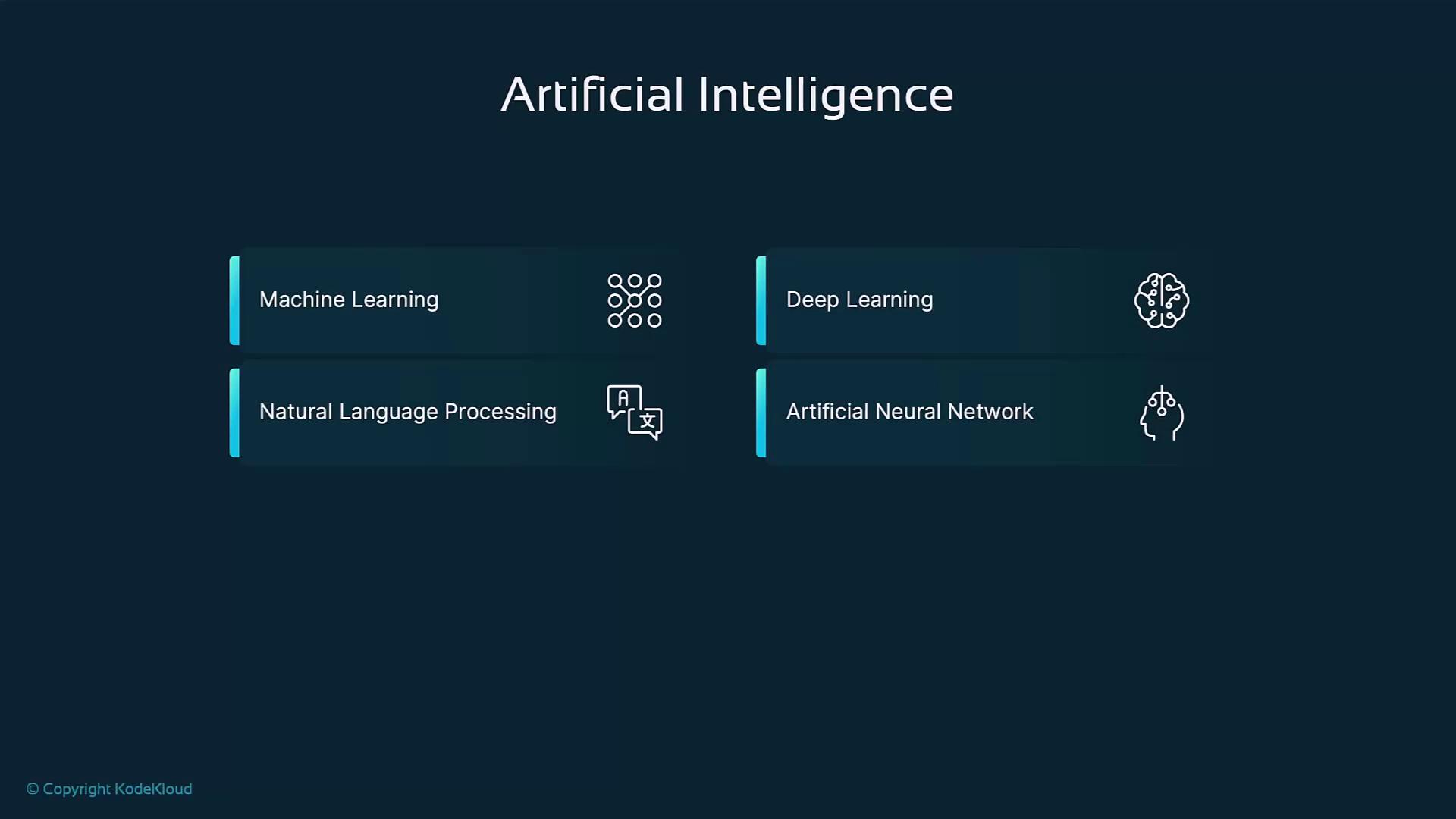
Artificial intelligence has progressed through multiple layers. Understanding these foundations helps you appreciate modern models:- Machine Learning
- Natural Language Processing
- Deep Learning
- Artificial Neural Networks
Text Generation Capabilities
OpenAI’s APIs empower you to generate, analyze, and transform natural language:- Prompt engineering best practices
- Conversational agents with chat completions
- Sentiment analysis pipelines
- Custom OpenAI Assistants
- Text-to-speech and speech-to-text endpoints
Core OpenAI Features
Beyond simple completions, OpenAI offers advanced tooling to structure and scale your workflows:- Function calling for predictable JSON outputs
- Embeddings to implement semantic search
- Batch processing for high-throughput scenarios
- Advanced usage patterns like fine-tuning and orchestration
Vision Capabilities
OpenAI’s vision suite allows you to generate and interpret images:- Create images with DALL·E
- Bridge vision and language with CLIP
- Build OCR, classification, and synthetic media applications
- Address ethical considerations for generative content
Be mindful of usage quotas and rate limits when using high-capacity models like DALL·E-3.