

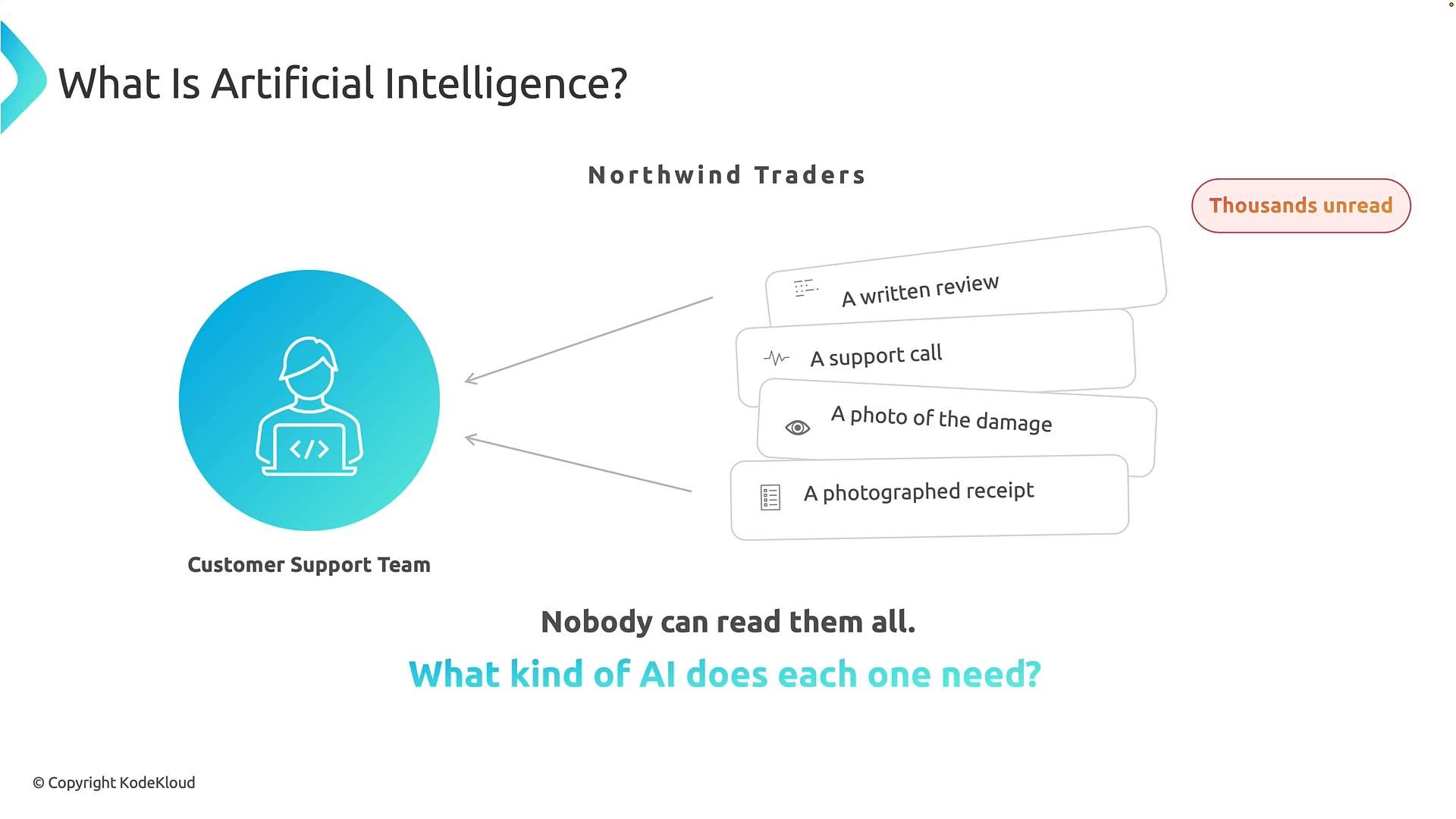
- A written review: text describing a customer’s experience. AI can detect sentiment, extract topics, or flag reported problems.
- A support call: spoken audio that AI converts to text, analyzes for intent, and extracts critical details.
- A photograph of a damaged product: vision AI can detect objects, damage, or other visual cues.
- A photographed receipt: document AI can read printed text, identify invoice fields, and extract structured data such as date, items, quantities, and totals.
This definition emphasizes three points: AI is implemented as software and systems, it reproduces certain human-like capabilities (not full human reasoning), and it is aimed at tasks that normally need cognition such as understanding, reasoning, and pattern recognition.
- AI is implemented through software and computing systems. The system receives input, processes it using models or algorithms, and produces outputs such as predictions, classifications, recommendations, generated content, or actions.
- “Simulates human intelligence” means the system performs tasks we typically associate with human abilities: recognizing objects, understanding language, transcribing speech, identifying patterns, or assisting decisions.
- Cognition includes mental processes such as perception, reasoning, learning, and judgment. For example, when you look at a photo and recognize a car, you’re interpreting visual information; a trained vision model performs a similar recognition task.
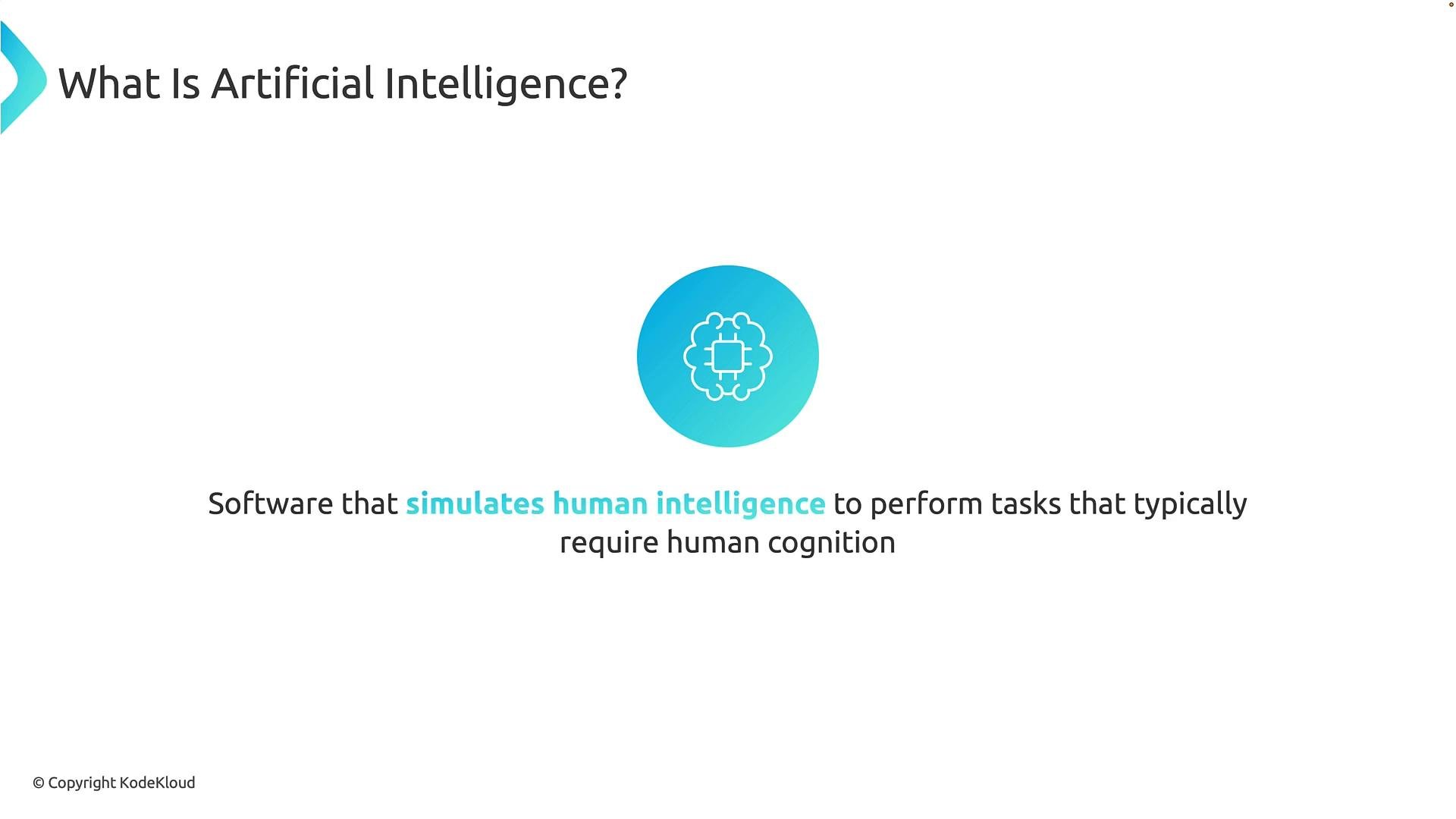
AI systems do not think or reason exactly like humans. Saying AI “simulates” human intelligence means it reproduces specific capabilities using computational methods and data — not that it is a human brain inside a computer.
-
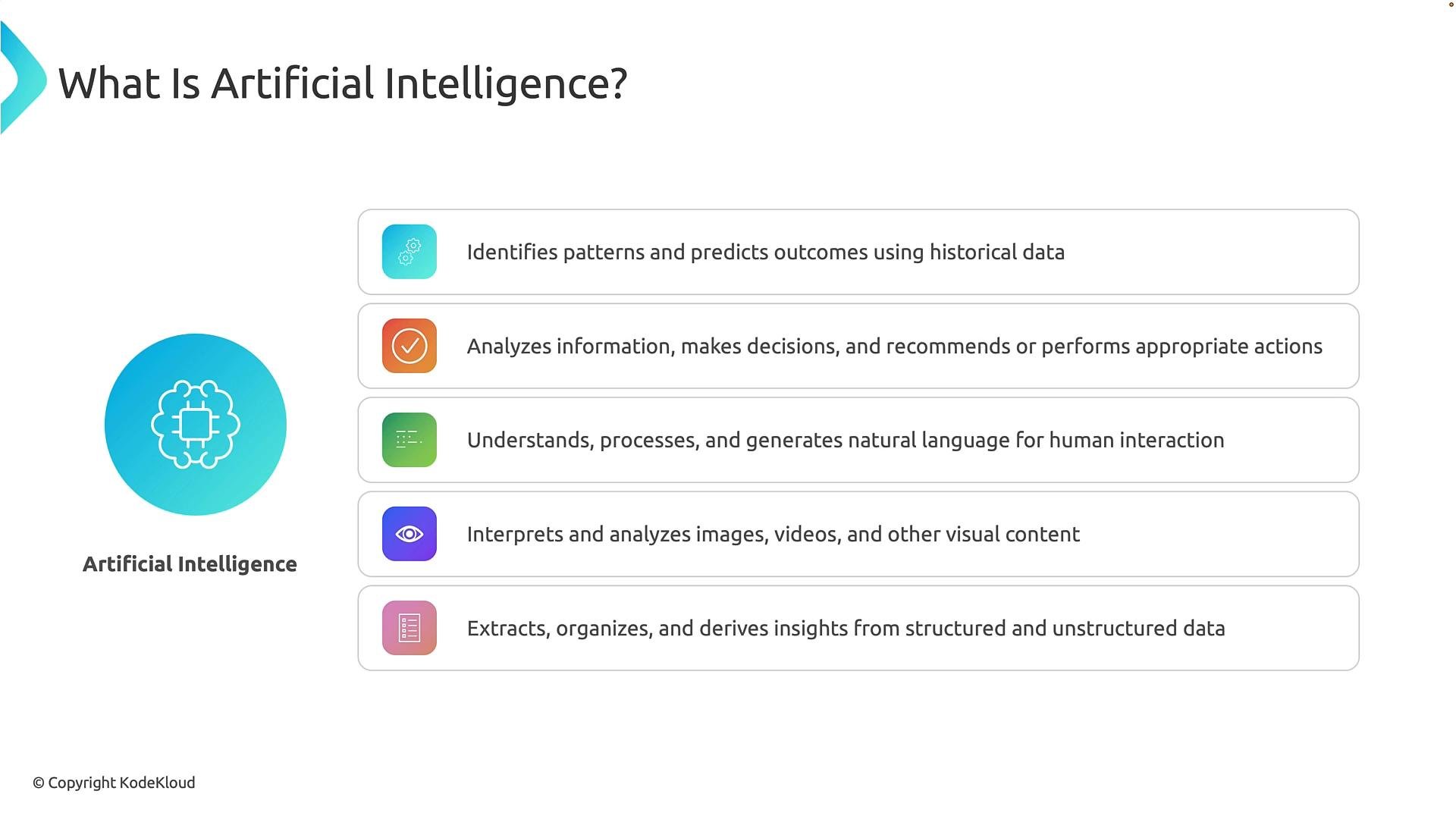
Identify patterns and predict outcomes from historical data.
- Example: Train a model on years of sales data to predict future demand.
-
Analyze information, make decisions, and recommend or trigger actions.
- Example: An e-commerce recommender that suggests products and triggers personalized offers.
-
Process and generate natural language.
- Example: Parse user questions, summarize documents, translate text, or generate coherent content for chatbots.
-
Interpret and analyze visual information (images and video).
- Example: Detect objects in a photo, read text in images (OCR), or detect defects on a production line.
-
Extract, organize, and derive insights from structured and unstructured data.
- Example: Extract invoice number, supplier, date, and line items from scanned invoices for downstream processing.
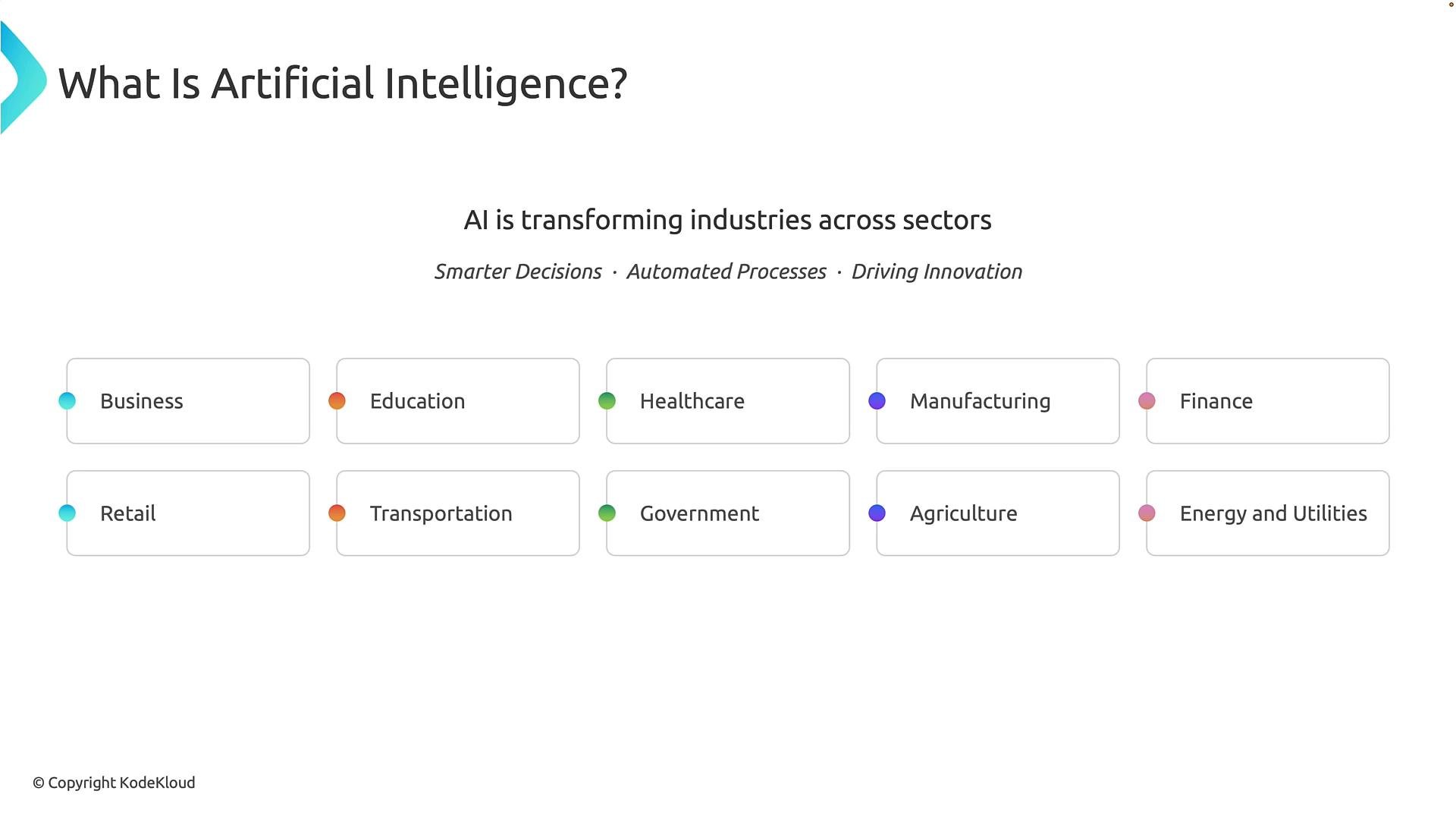
- Business: customer analytics, automation, demand forecasting.
- Education: personalized learning and performance analytics.
- Healthcare: medical imaging analysis, clinical workflow support.
- Manufacturing: predictive maintenance, quality inspection.
- Finance: fraud detection, risk modeling, automated advisory.
- Retail: personalization, inventory optimization, demand forecasting.
- Transportation: route optimization, demand prediction, traffic analysis.
- Government: public-data analytics, process automation, service improvement.
- Agriculture: crop monitoring using field sensors and imagery.
- Energy & Utilities: load forecasting, equipment monitoring, optimization.
At the foundation of these workloads is machine learning. Models learn patterns from data so they can predict or decide on new inputs. A simple conceptual formula is
y = f(x), where x is input data and y is the model’s output (prediction, classification, or generated content).
Real applications often combine workloads. For example, when a customer calls about damaged goods:
- Speech AI transcribes the call.
- Text & language analysis identifies intent and urgency.
- Computer vision inspects photos of the damage.
- Information extraction parses the receipt for order details.
- A generative agent compiles a summary, updates the case system, and triggers follow-up actions.
- AI is software that simulates human-like capabilities for tasks requiring cognition.
- Different inputs (text, speech, images, documents) require different AI capabilities.
- Key workloads include generative AI & agents, text & language, speech, vision, and information extraction — all supported by machine learning.
- Understanding workloads helps you choose appropriate Azure AI services for business scenarios.
Tip: When designing AI solutions, start by identifying the input types and the exact task you want automated (e.g., extract invoice fields vs. summarize a support call). This makes selecting the right workload and Azure service straightforward.