

Four common NLP tasks
-
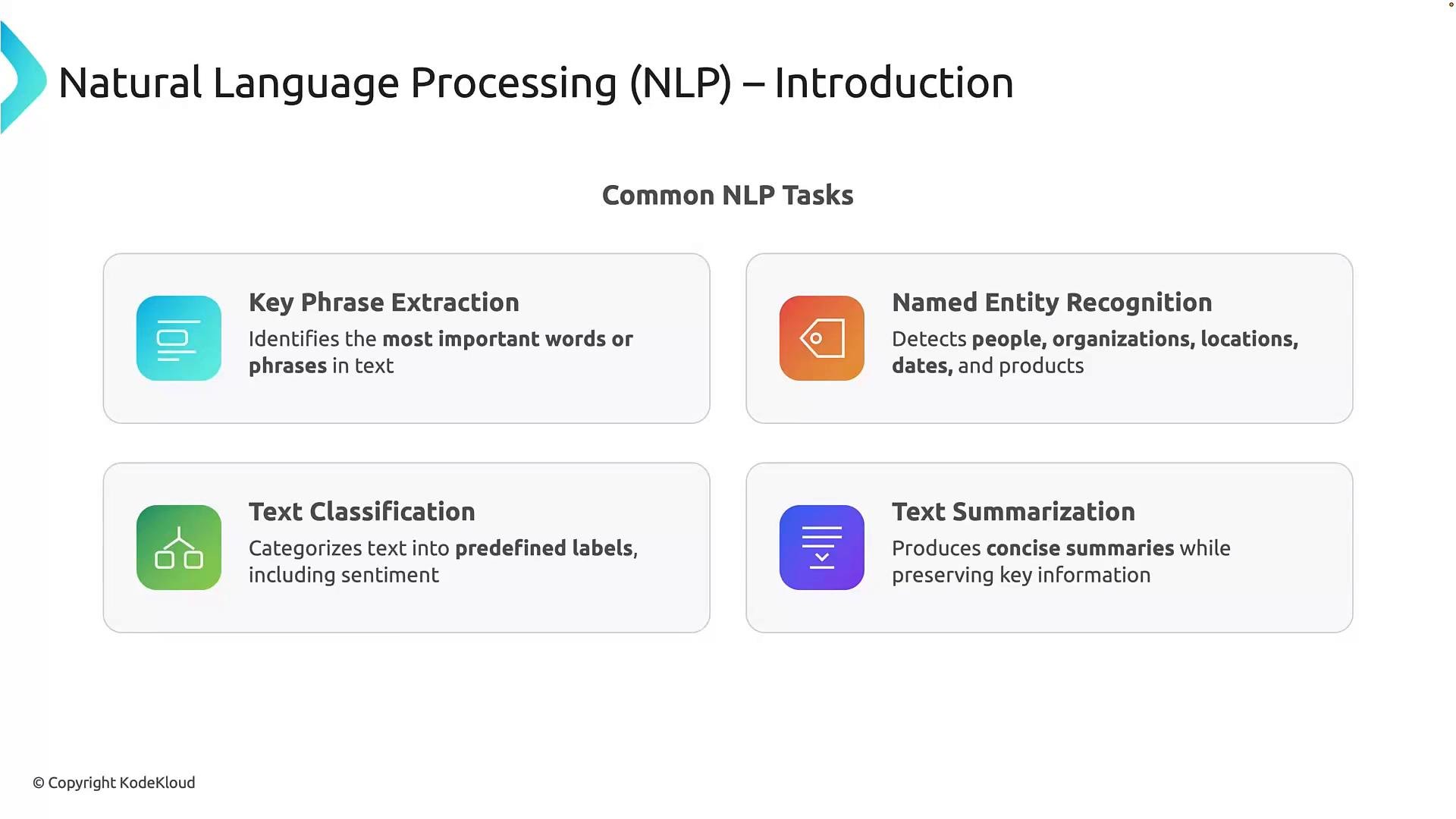
Key phrase extraction
Identify the most important words or short phrases in text. Key phrases act as concise labels summarizing a document’s main concepts — useful for tagging, indexing, and speeding search across large document collections. -
Named entity recognition (NER)
Detect and categorize entities such as people, organizations, locations, dates, or products. NER converts unstructured text into structured entity labels, enabling indexing and entity-based queries. -
Text classification
Assign one or more predefined labels to a text sample. Common uses include spam detection, topic tagging, and sentiment analysis (positive/negative/neutral). Classification helps automate routing and filtering at scale. -
Text summarization
Produce a shorter version of a longer document that preserves the essential facts and intent. Summaries help readers quickly grasp long documents, support triage, and reduce reading time.
Quick reference table
Common real-world use cases
-
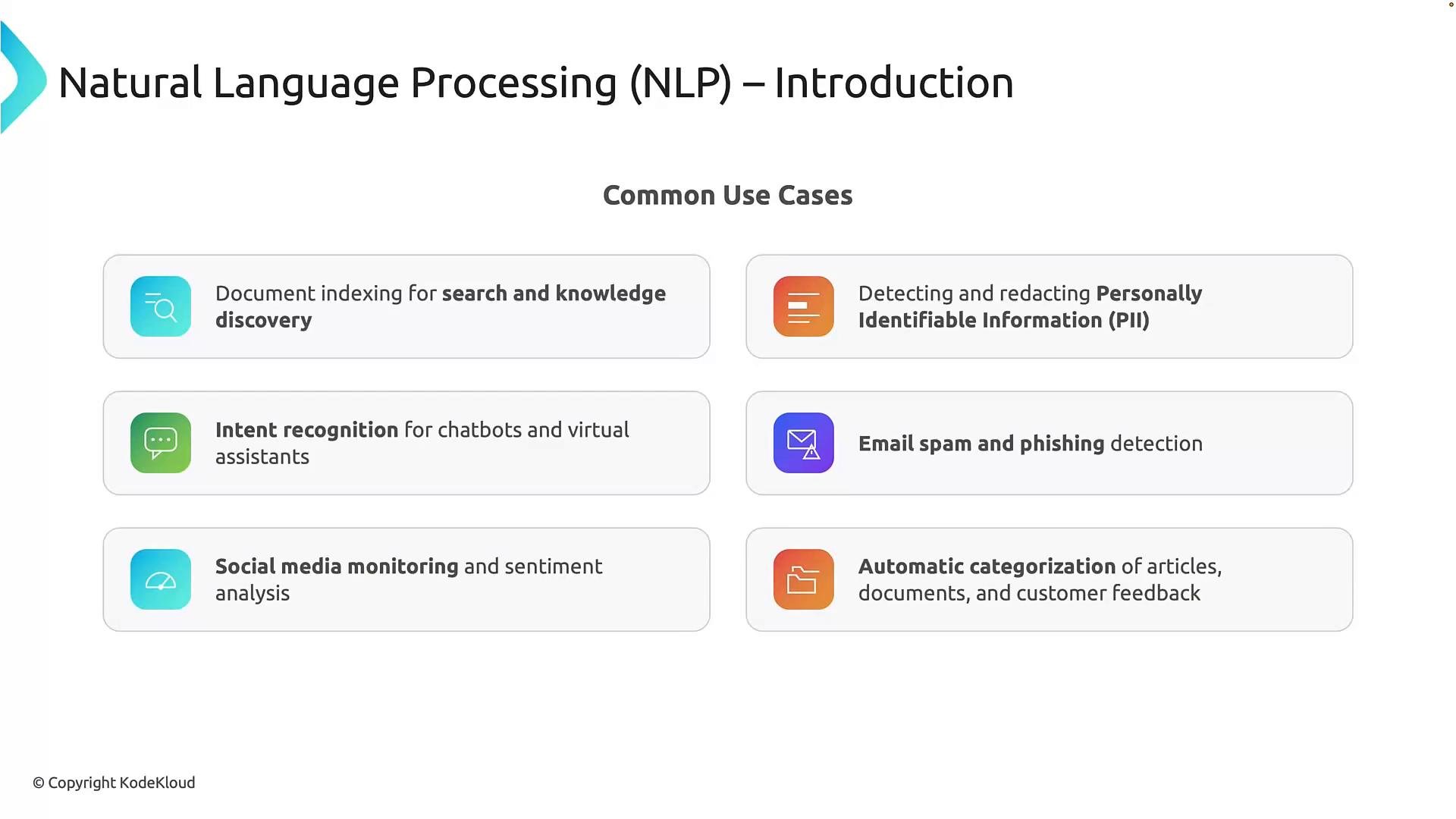
Document indexing and knowledge discovery
Extract terms and concepts from large repositories to improve search relevance and surface related content. -
PII detection and redaction
Detect personally identifiable information (PII) such as names, phone numbers, emails, credit card numbers, and Social Security numbers for masking or removal before sharing documents.
When using PII detection and redaction, be aware of privacy laws and organizational policies. Redaction decisions should be verified and logged to meet compliance requirements.
-
Intent recognition for chatbots and virtual assistants
Detect user intent (e.g., “reset my password”) to route requests or trigger automated workflows. -
Spam and phishing detection
Analyze language patterns to flag suspicious or malicious emails and messages. -
Social media monitoring and sentiment analysis
Aggregate sentiment across thousands of comments to detect trends and public perception. -
Automatic categorization of content
Group customer feedback, support tickets, and articles into categories like billing, support, delivery, or product quality for faster triage.
Concrete example: applying multiple NLP capabilities to the same text
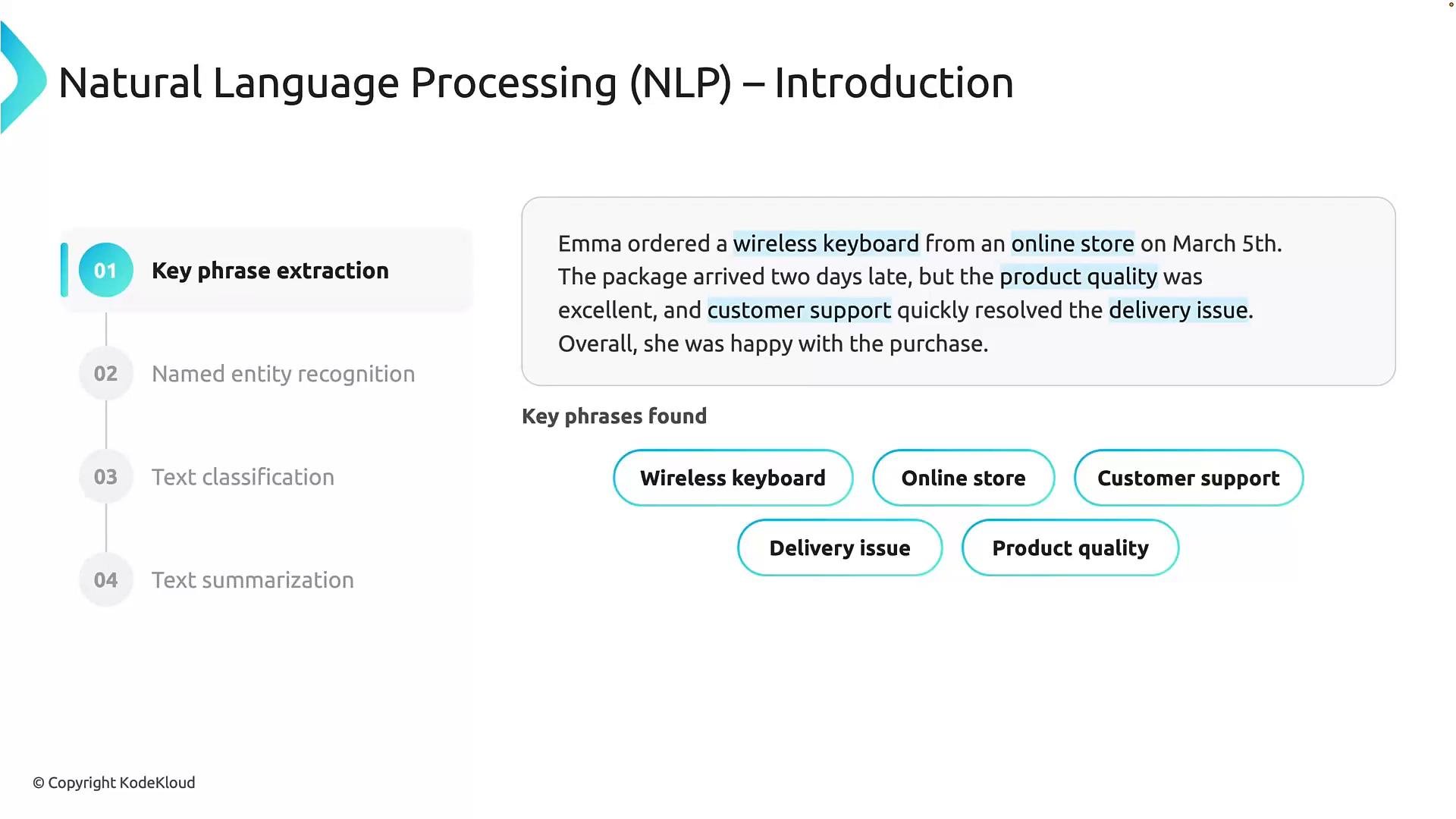
Consider this passage: “Emma ordered a wireless keyboard from an online store on March 5th. The package arrived two days late, but the product quality was excellent, and customer support quickly resolved the delivery issue. Overall, she was happy with the purchase.” Key phrase extractionAn NLP system highlights the main topics: “wireless keyboard,” “online store,” “product quality,” “customer support,” and “delivery issue.” These phrases succinctly represent the passage’s core subjects.
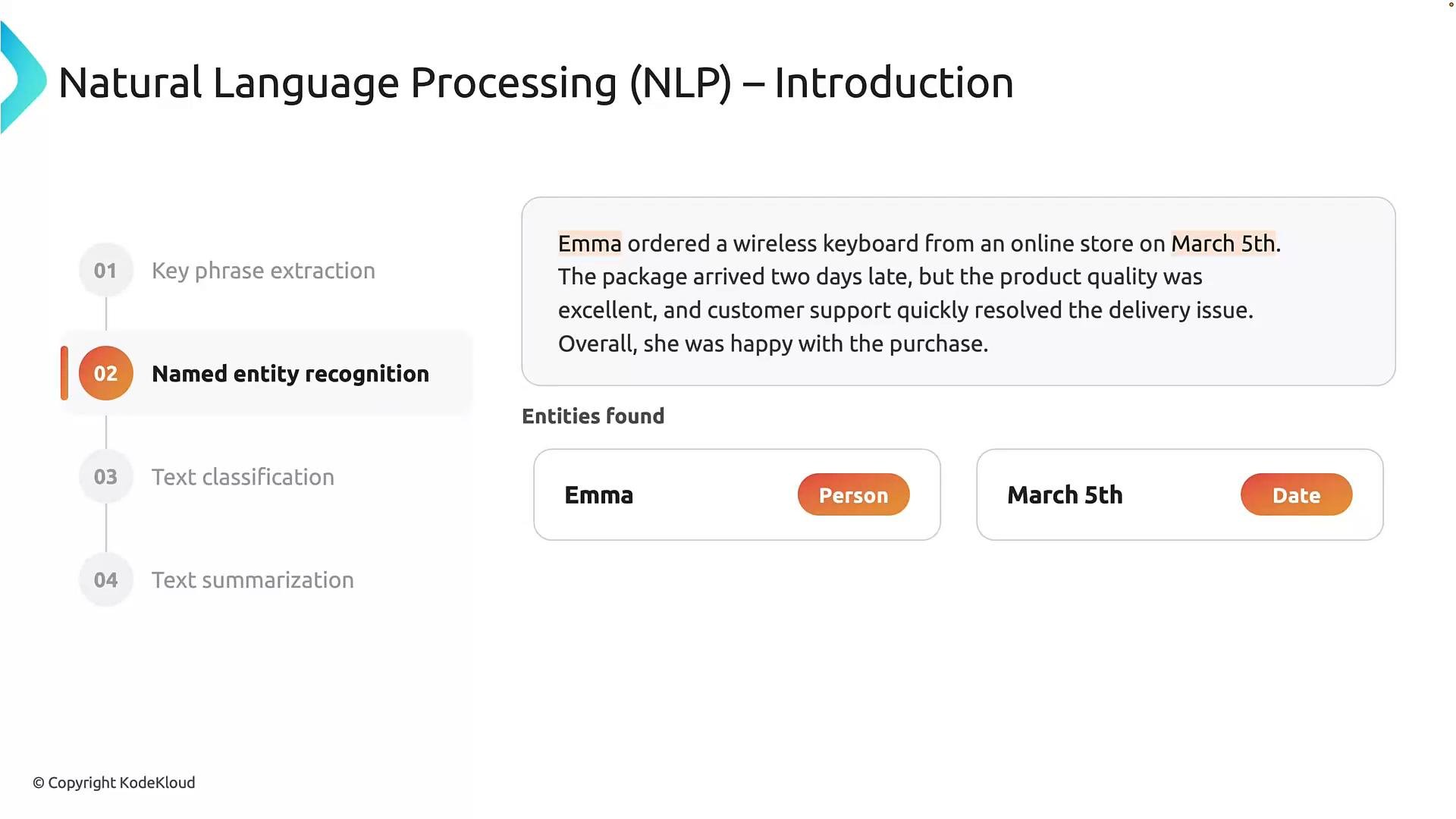
NER extracts named items and their types. From the passage, a model would likely identify
Emma as a Person and March 5th as a Date. It may also label wireless keyboard as a Product or online store as an Organization depending on the model’s taxonomy.
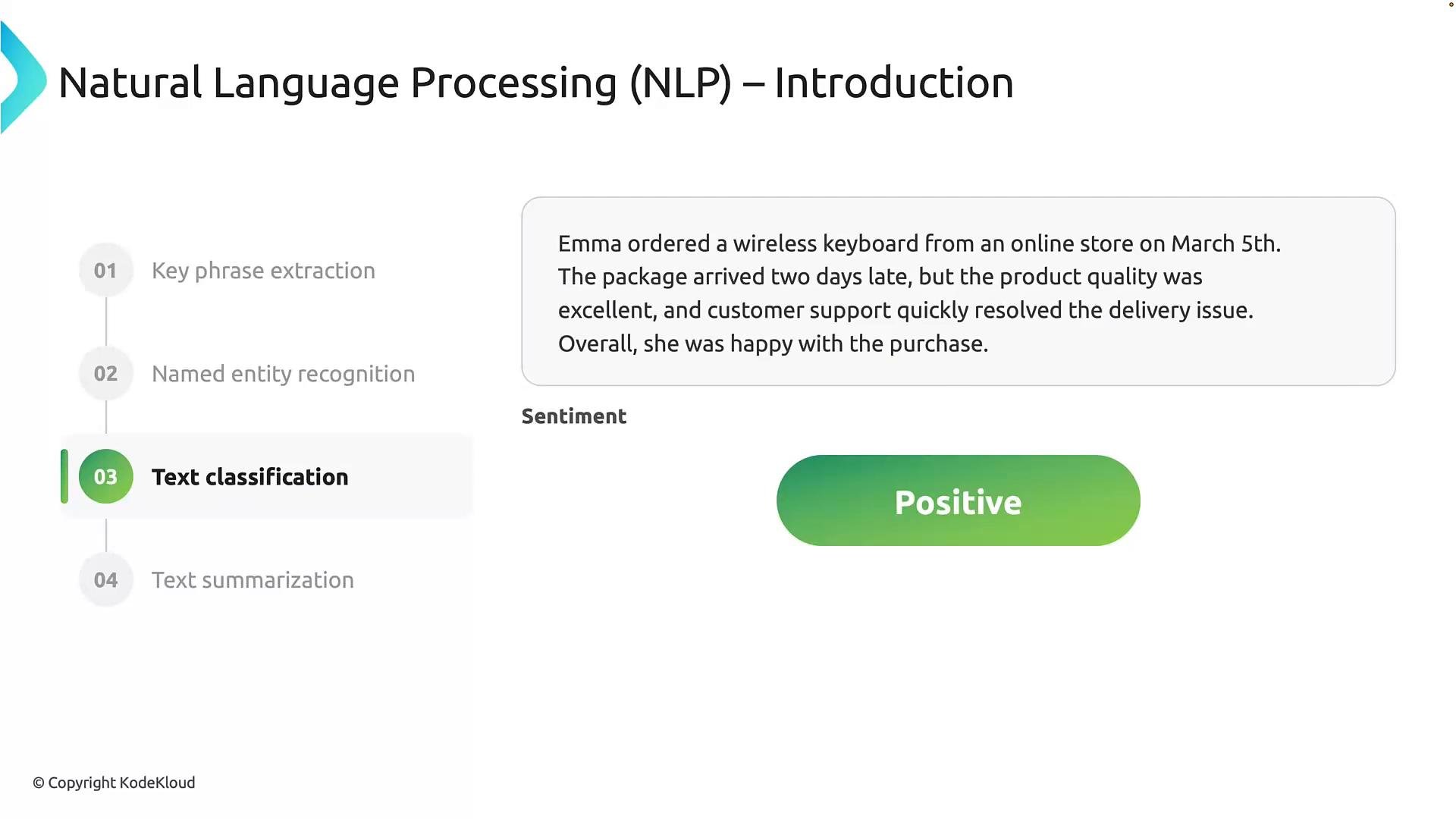
Classification looks at the entire passage to assign a label. Although there’s a delivery delay (negative event), the excellent product quality and effective customer support produce a positive overall sentiment. Sentiment analysis assesses context across all sentences rather than individual phrases.
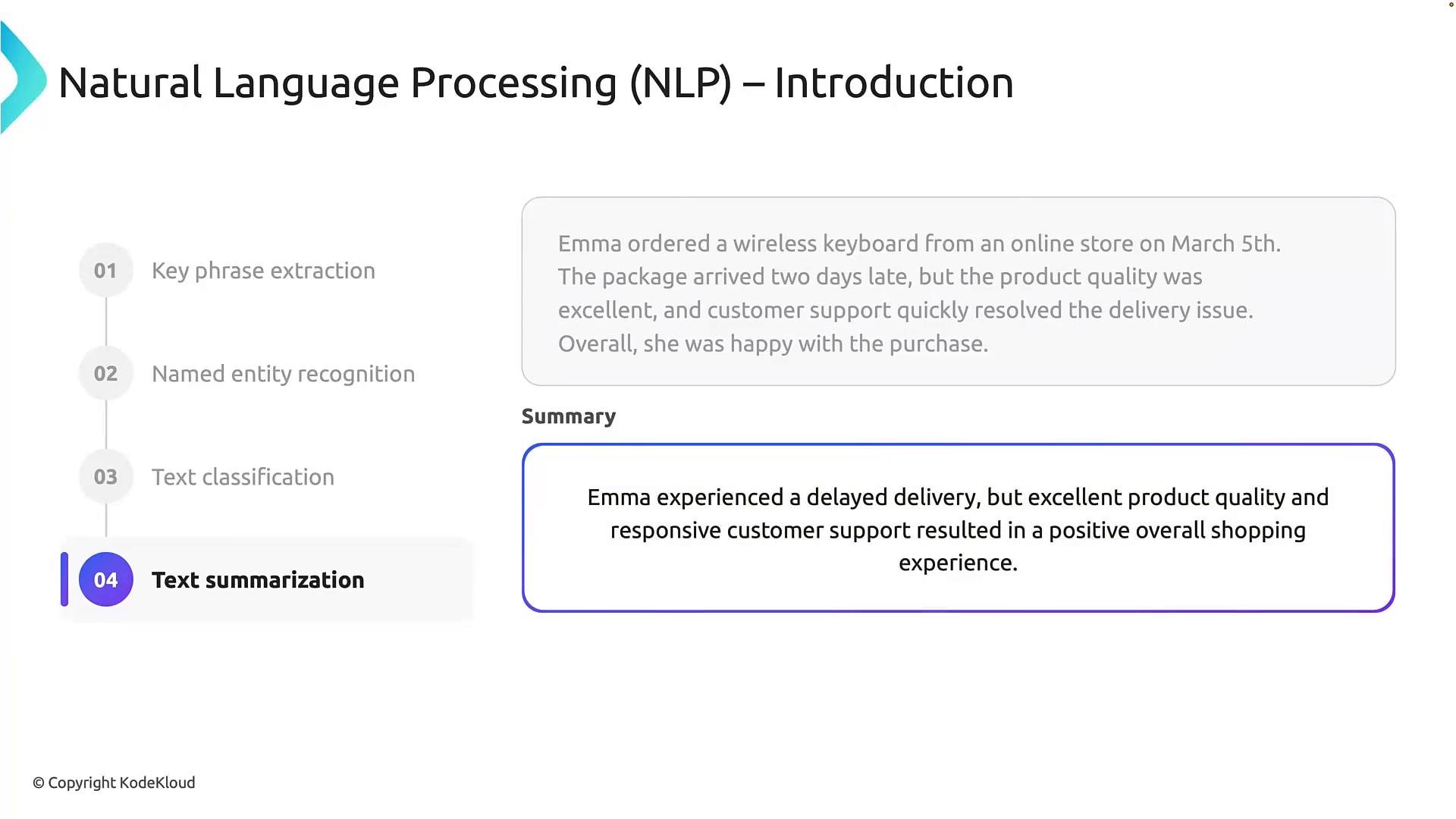
Summarization condenses the passage while preserving the essential facts: the package was delayed but product quality and support were excellent, leading to an overall positive experience. The summary reduces reading time but keeps the important points.
Recap
- Key phrase extraction surfaces the most important concepts for indexing and discovery.
- Named entity recognition identifies specific entities and their types for structured indexing.
- Text classification assigns categories such as sentiment, topic, or spam.
- Text summarization produces concise versions that preserve essential information.
Choose the NLP capability (or combination of capabilities) that matches your business goal: indexing/search, compliance (PII), automation (intent or routing), or customer insights (sentiment/summarization).