

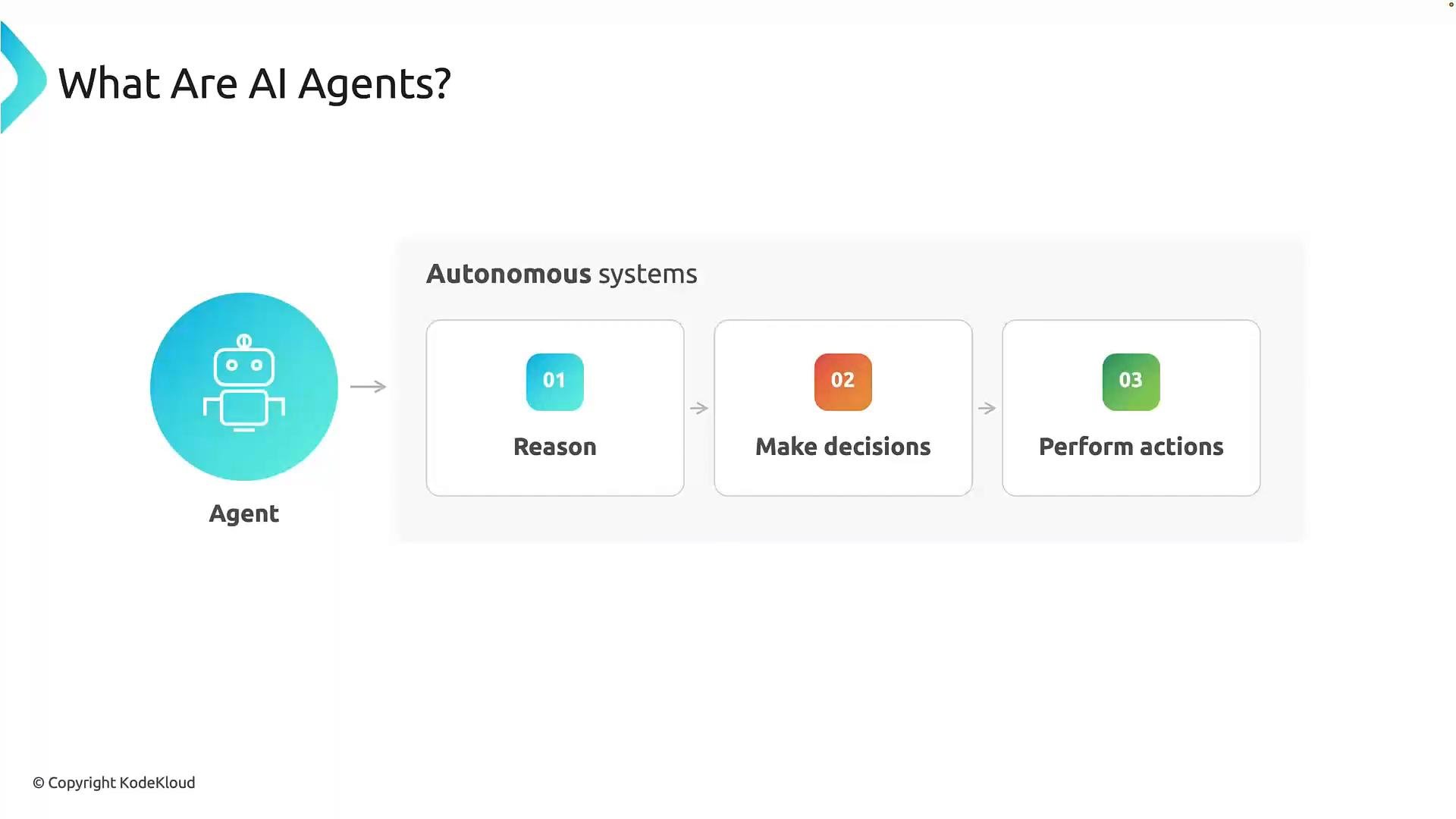
- Reason: Interpret the user’s goal and derive sub-steps.
- Decide: Evaluate options and select the most appropriate next action.
- Act: Use tools and integrations to perform actions that move toward the goal.
- Reasoning: The agent analyzes the user’s objective and identifies necessary sub-tasks. For example, when asked “Find me a suitable time with my team,” an agent infers participants, inspects calendars, and determines availability windows.
- Decision-making: If multiple valid actions exist, the agent selects the best one given constraints, priorities, and context (e.g., picking one of several candidate meeting times).
-
Performing actions: The agent performs real-world tasks by calling APIs or tools. Instead of saying “schedule a meeting,” it can use a calendar API like
OutlookorGoogle Calendarto create the event, or call a database to fetch or update records.
Remember the core flow: Reason → Decide → Act. This sequence is what gives an agent practical autonomy to pursue a user goal.
Core building blocks of an AI agent
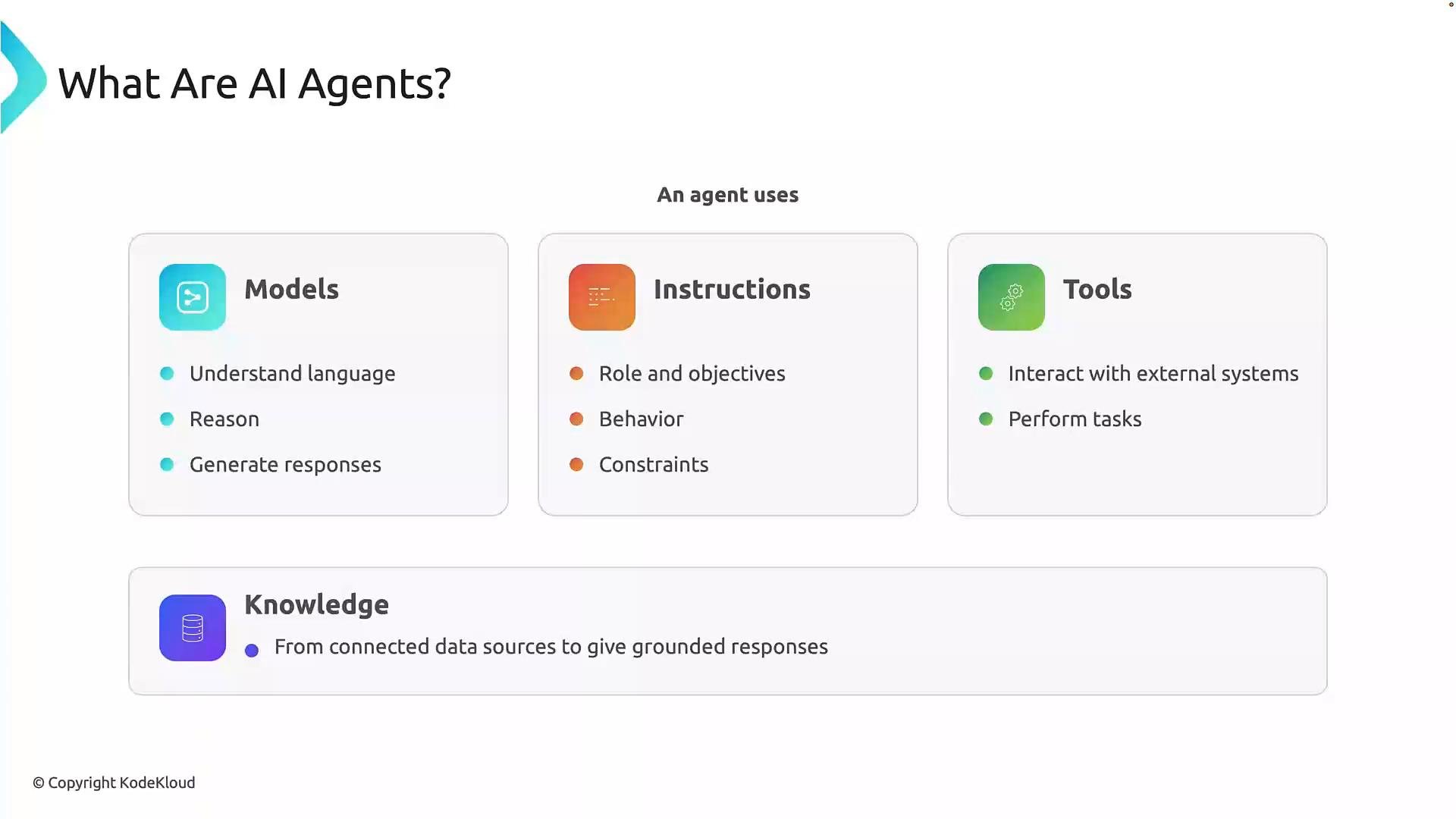
An agent combines several components so it can reason, act, and stay aligned with policies and data. These building blocks are typically modular and work together in production systems.
These components let the model reason and produce language, keep behavior aligned with instructions, allow tools to perform actions, and ground results with accurate knowledge.
Collaboration patterns: people and multi-agent workflows
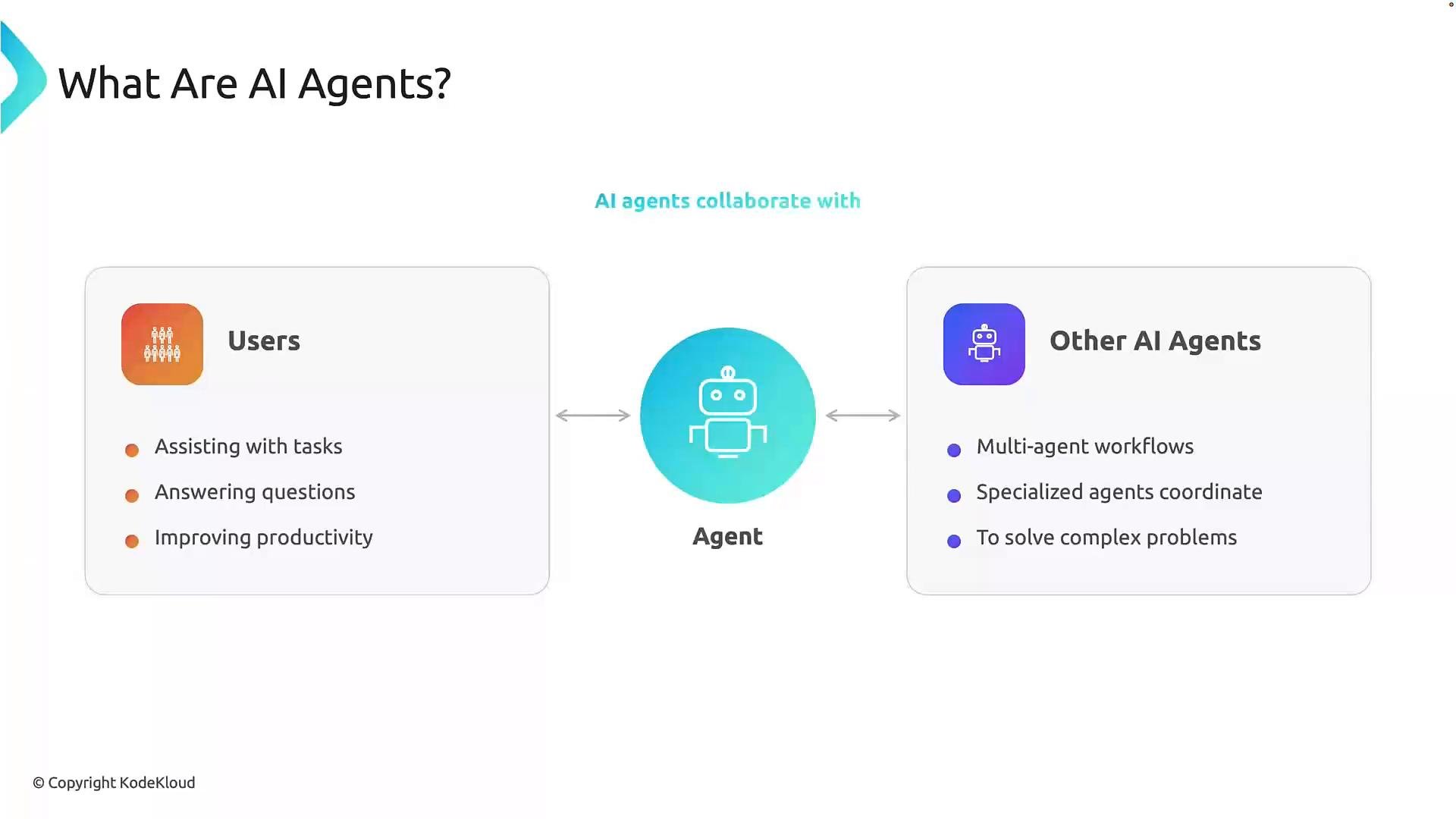
Agents rarely operate alone. They can work directly with users or coordinate with other agents in multi-agent systems. Agent + User collaboration- The user provides a goal (e.g., “Prepare for tomorrow’s customer meeting”).
- The agent gathers documents, summarizes key points, answers follow-up questions, and — if authorized — performs actions like creating an agenda or scheduling the meeting.
- This model increases user productivity by letting the user describe outcomes instead of enumerating steps.
- For complex or specialized tasks, multiple agents can coordinate.
- Each agent focuses on a domain (e.g., data analysis, financial calculations, report generation). Agents exchange intermediate results and combine their outputs to solve the larger problem.
- This multi-agent pattern avoids monolithic designs and enables scalable specialization, similar to a cross-functional team.
Agents that perform external actions must be designed with access controls, auditing, and data handling policies. Limit permissions to the minimum necessary and ensure sensitive data is never exposed unintentionally.