Welcome to this module: Getting Started with Text Analysis. Earlier lessons covered generative AI topics such as deploying models, experimenting with them in the Microsoft Foundry Playground, and learning how prompts and model parameters shape outputs. In this module we pivot from generation to understanding: we will analyze text to extract structure and meaning. Every day, organizations process vast amounts of text — customer reviews, support tickets, emails, survey responses, social media posts, and long-form documents. Computers do not automatically interpret human language the way people do. Natural language processing (NLP) provides the methods and tools to bridge that gap, turning unstructured text into structured signals you can act on. In this module we will:
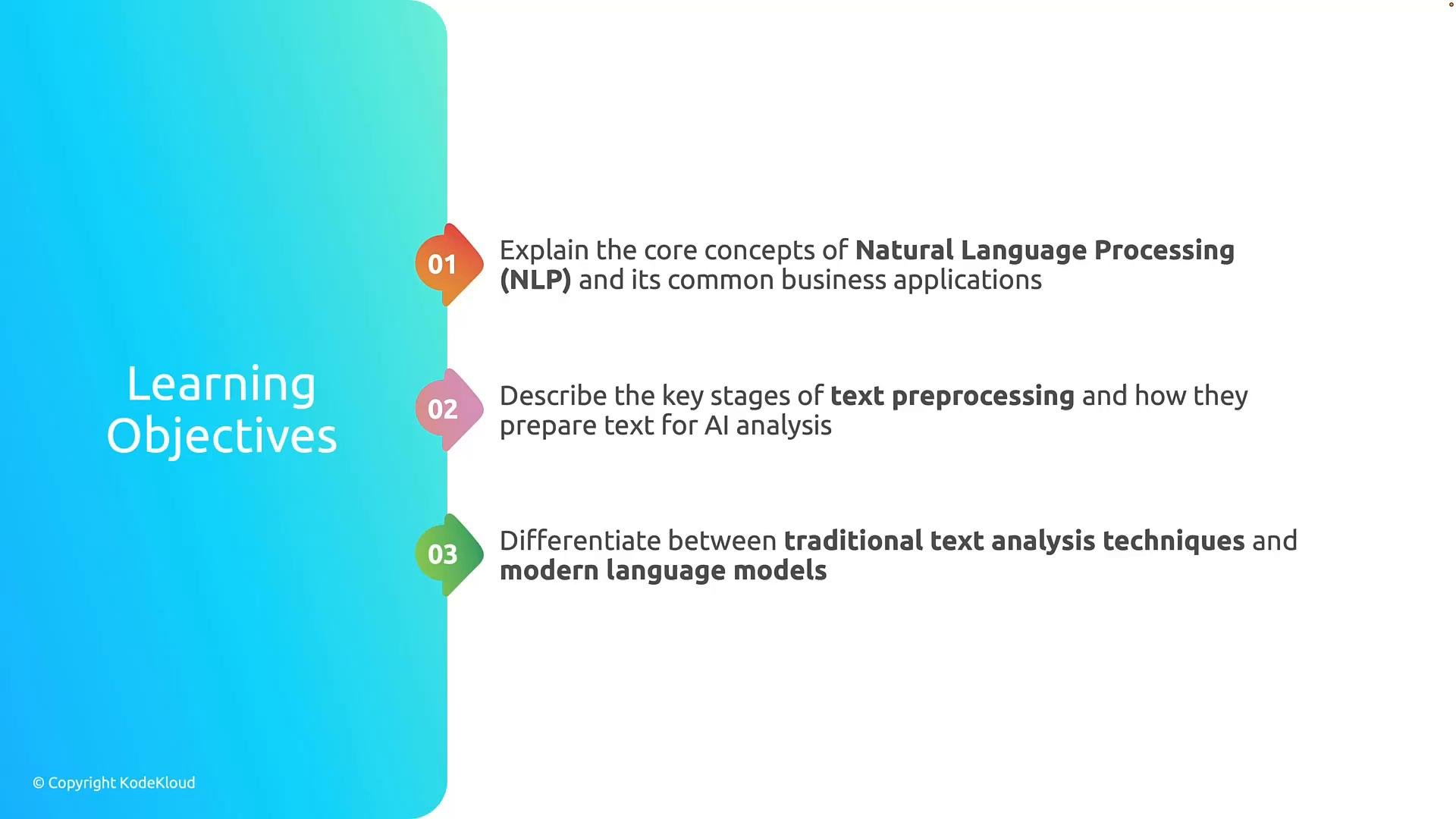
  • Review NLP fundamentals and common business use cases (search, classification, extraction, summarization).
  • Describe key stages of text preprocessing and why each step is important for analysis.
  • Compare traditional text analysis techniques (rule-based or statistical) with modern large language models and foundation models.
Traditional approaches often rely on hand-engineered features, lexicons, or statistical models to detect patterns in text. Modern language models learn language patterns from large corpora and can generalize across many language tasks, enabling richer and more flexible analysis.
A presentation slide titled "Learning Objectives" with three numbered items. They list goals to explain core concepts of Natural Language Processing (NLP) and business uses, describe text preprocessing stages for AI, and differentiate traditional text analysis techniques from modern language models.
This module combines theory with hands-on examples using Microsoft Foundry and Azure AI services. You will see multiple approaches: using general-purpose foundation models or specialized Azure AI Language models for tasks such as language detection, named entity recognition (NER), and PII detection. We focus on the Azure AI Language SDK because it provides a developer-friendly, programmatic way to send text to Azure’s language service and receive structured, actionable results. Rather than manually inspecting text, applications can call the SDK to run detection, extraction, and classification tasks at scale. Key SDK capabilities covered in this module:
  • Language detection
  • Named entity recognition (NER)
  • PII detection and redaction
  • Sentiment analysis and key-phrase extraction
  • Integration patterns for agents and automation
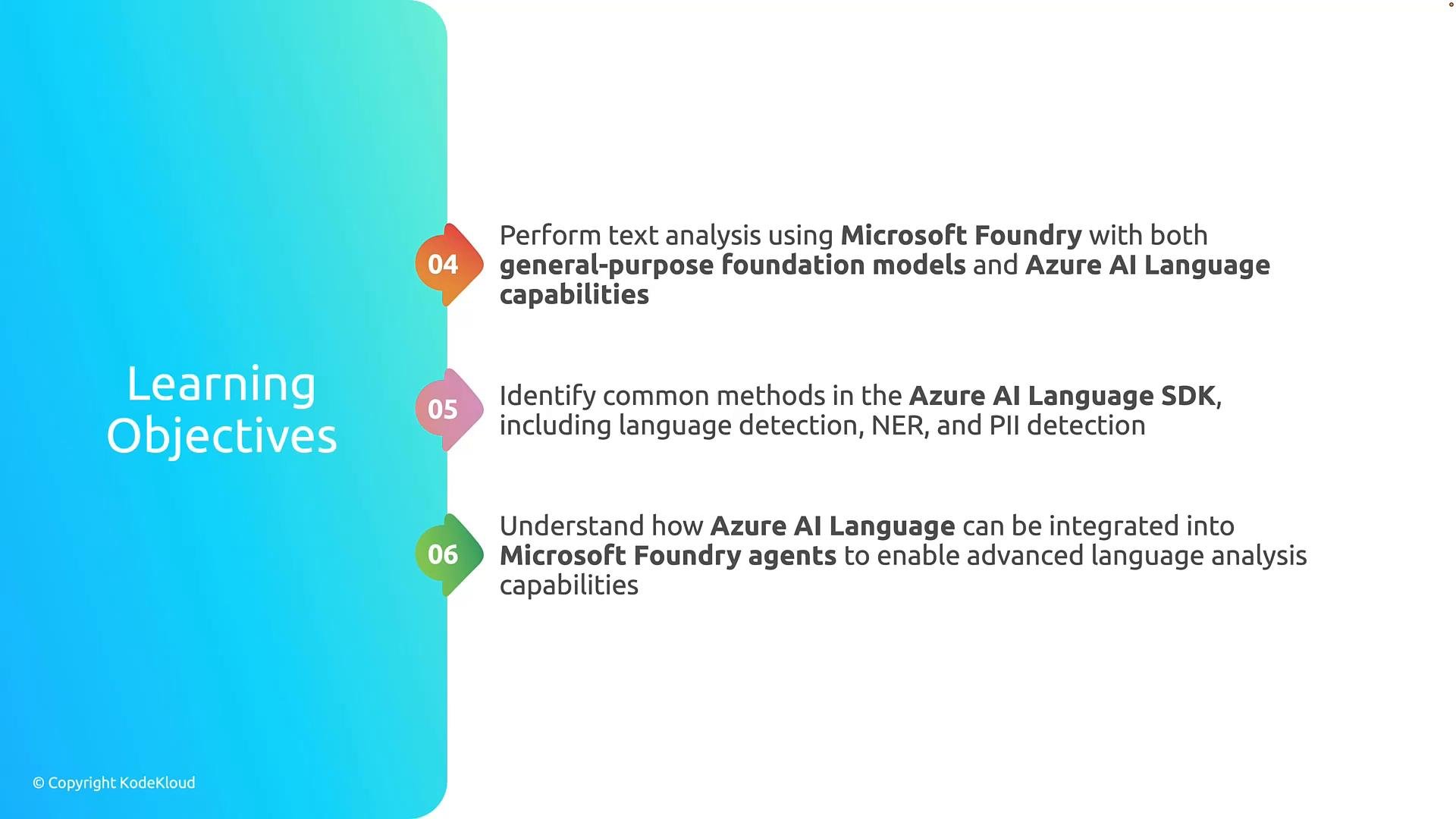
A presentation slide titled "Learning Objectives" with a blue gradient left panel and three numbered objectives on the right. The objectives describe using Microsoft Foundry and Azure AI Language (foundation models, SDK features like language detection, NER, PII detection, and agent integration).
By the end of this module you will understand:
  • Core concepts behind text analysis and NLP workflows.
  • How to prepare text (tokenization, normalization, cleaning) so models and pipelines perform reliably.
  • How to call Azure AI Language from code using the SDK and interpret structured results.
  • How to embed language capabilities into Microsoft Foundry Agents to include analysis steps in automated workflows.
This module assumes a basic familiarity with cloud concepts. To follow the hands-on examples, you will need an Azure subscription and permissions to create or use Azure AI Language resources. For SDK references and setup guidance, see the Azure AI Language documentation linked in the Resources section below.
Module at-a-glance Recommended next steps
  • Read the Azure AI Language SDK quickstart and setup your credentials.
  • Try a small sample: send a short text to the SDK for language detection and NER to compare results.
  • Follow the module’s hands-on lab where we integrate Azure AI Language calls into a Foundry Agent chain.
References and further reading
When working with PII or sensitive data, ensure compliance with your organization’s privacy policies and Azure data protection guidelines. Use data minimization, encryption, and access controls as required.

Watch Video