

Responsible AI is a continuous practice applied across the entire AI lifecycle: problem definition, data collection, model development, deployment, monitoring, and maintenance.
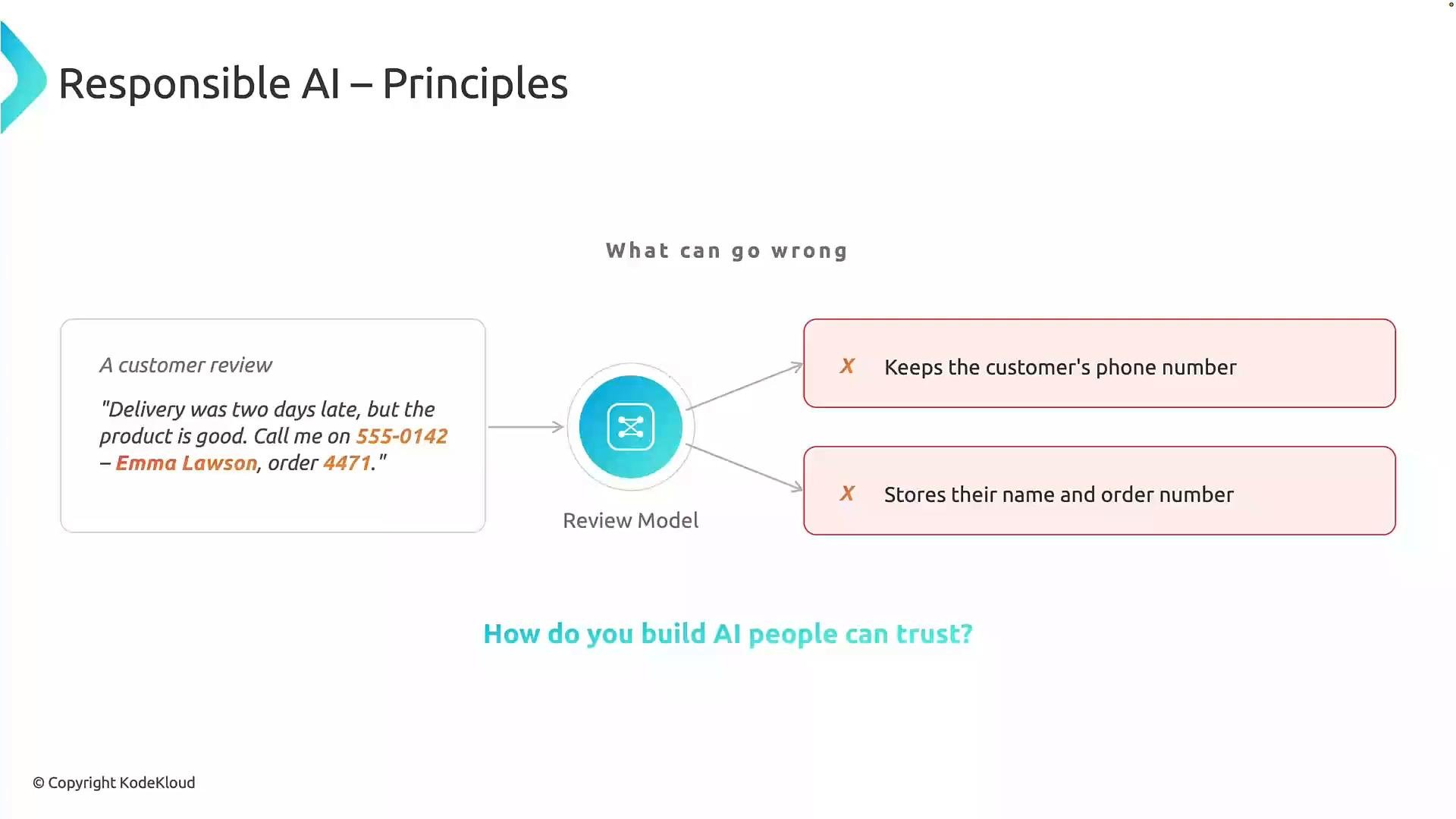
- Unnecessary data collection: Does sentiment analysis actually require the customer’s phone number?
- Overexposure: Order numbers or names might be needed for limited business workflows, but should not be accessible everywhere.
- Data retention and access controls: Storing PII without clear purpose or protection increases privacy and security risk.
- What information is the AI collecting and is it necessary?
- Who can access the information and how is it secured?
- Could the system produce unfair or harmful outcomes?
- Who is accountable when something goes wrong?
Detailed explanations and considerations
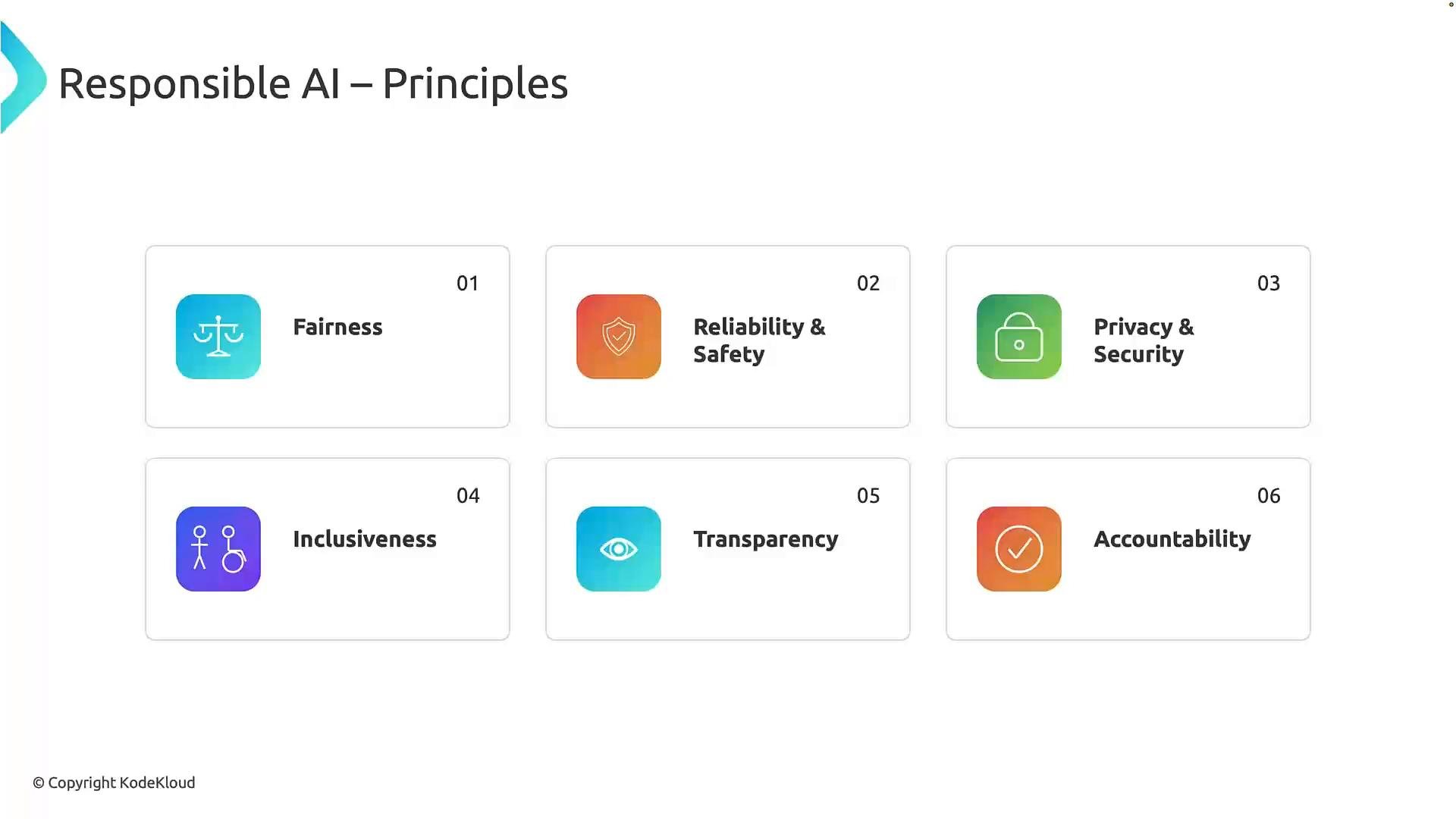
- Fairness
- Goal: Avoid systematic discrimination and ensure similar outcomes across comparable groups.
- Example: If a hiring or loan model rates a demographic lower because of biased training data, it is exhibiting unfair behavior.
- Considerations: Audit datasets, evaluate model fairness using metrics appropriate to the context, and apply bias mitigation techniques.
- Reliability and safety
- Goal: Ensure the system performs consistently, detects failures, and prevents unsafe behavior.
- Example: A defect-detection model that intermittently misses critical faults is unsafe in manufacturing.
- Considerations: Comprehensive testing (including adversarial and edge-case tests), clear safety margins, continuous monitoring, and throttles or circuit breakers for unexpected behavior.
- Privacy and security
- Goal: Respect user privacy and protect systems from misuse, data leaks, and unauthorized access.
- Example: Do not collect or store phone numbers when analyzing product sentiment.
- Considerations: Follow data minimization principles, apply anonymization or pseudonymization, use encryption, and implement least-privilege access.
Avoid storing or exposing personally identifiable information (PII) unless absolutely required. Treat PII as high-risk data: minimize use, secure storage, and clearly document purpose and retention.
- Inclusiveness
- Goal: Make the AI usable and beneficial for people with different abilities, cultures, and contexts.
- Example: An app that assumes a particular screen layout may exclude users with visual or motor impairments.
- Considerations: Include accessibility testing, support localization, and gather feedback from diverse user groups.
- Transparency
- Goal: Provide clear information about how AI is used, what it does, and its limitations, especially where decisions affect people.
- Example: Users interacting with an AI assistant should know they’re speaking with AI and understand the scope of its advice.
- Considerations: Clear disclosures, human-review options for high-stakes decisions, and documentation of model boundaries and known failure modes.
- Accountability
- Goal: Ensure people and organizations are responsible for AI behavior and can investigate and remediate issues.
- Example: If an AI harms users or produces incorrect results, there must be defined roles and processes to address it.
- Considerations: Governance frameworks, assigned ownership, incident response plans, and documented audit trails.
- Fairness ensures equitable treatment.
- Reliability and safety reduce risk and unexpected harm.
- Privacy and security protect people and systems.
- Inclusiveness widens accessibility and fairness.
- Transparency builds user understanding and trust.
- Accountability creates ownership and remediation pathways.
- OECD AI Principles: https://www.oecd.org/going-digital/ai/principles/
- Microsoft Responsible AI resources: https://learn.microsoft.com/ai/responsible-ai/
- Partnership on AI: https://www.partnershiponai.org/
- NIST AI Risk Management Framework: https://www.nist.gov/itl/ai-risk-management