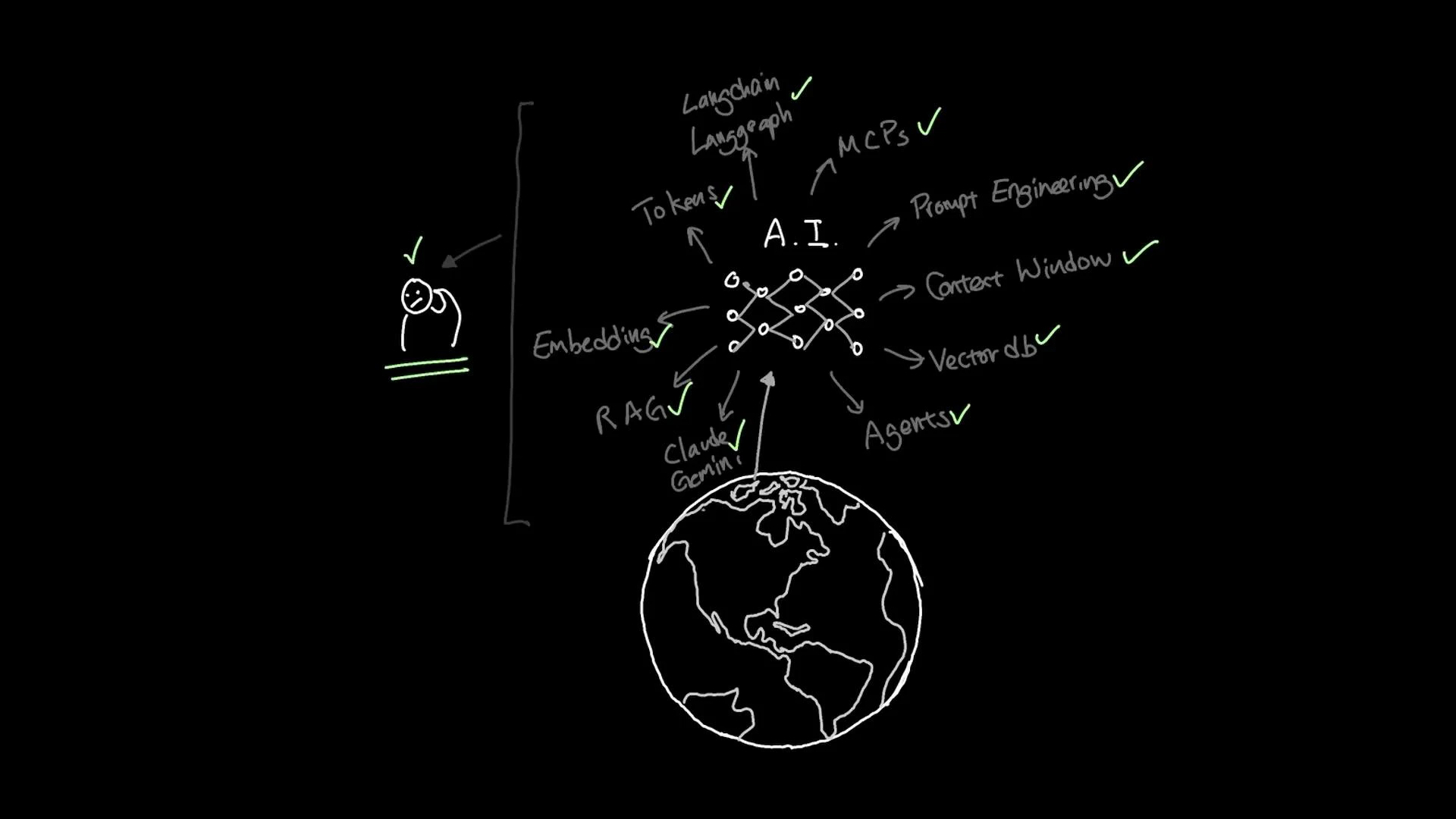
Hands-on overview of AI agents and related technologies including tokens, embeddings, RAG, vector databases, orchestration libraries, MCPs, and practical end-to-end project for building robust AI applications.
AI has advanced rapidly over the past few years. Today’s practical toolkit for building intelligent applications includes concepts and technologies such as prompt engineering, context windows, tokens, embeddings, Retrieval-Augmented Generation (RAG), vector databases, Model Context Protocols (MCPs), orchestration libraries like LangChain and LangGraph, and AI agents. This lesson gives a concise, hands-on overview so you can understand how these pieces fit together and start building right away.
This lesson assumes no prior knowledge. It’s structured around a single, practical project that integrates fundamental AI concepts (tokens, embeddings, context windows, prompt design) with retrieval and orchestration (RAG, vector databases, LangChain/LangGraph, MCPs, and agents).
We’ll cover these topics and why they matter:
Topic
What it is
Why it matters
Tokens, context windows, prompt design
The basic units and limits for language model input and strategies for guiding behavior
Impacts cost, capability, and response quality
Embeddings
Numerical vectors that represent text semantics
Enables semantic search and similarity-based retrieval
Retrieval-Augmented Generation (RAG)
Combining retrieval from a knowledge store with generation by a model
Improves factual accuracy and relevance for LLM outputs
Vector databases
Storage and indexing systems for embeddings
Fast, scalable similarity search for RAG pipelines
LangChain / LangGraph
Orchestration libraries for composing models, prompts, and tools
Simplifies building complex, multi-step AI workflows (agents)
MCPs (Model Context Protocols)
Conventions for how models share context and tools
Helps agents coordinate model calls and external tools
AI Agents
Systems that use models + tools to perform tasks autonomously
Enables multi-step, tool-enabled workflows like data lookups, API calls, and reasoning
We’ll progress in a practical order:
Core AI fundamentals (tokens, embeddings, context windows, prompt design)
Retrieval-Augmented Generation and vector databases — how embeddings are stored and searched
Orchestration with LangChain and LangGraph, and how they help build agents
MCPs and agent coordination across models and tools
A single end-to-end project that ties these components together
Along the way you’ll see how each layer interacts with the others so you can design robust, production-ready AI applications that are both accurate and cost-effective. Useful references and deeper-dive resources are linked inline for each topic.