

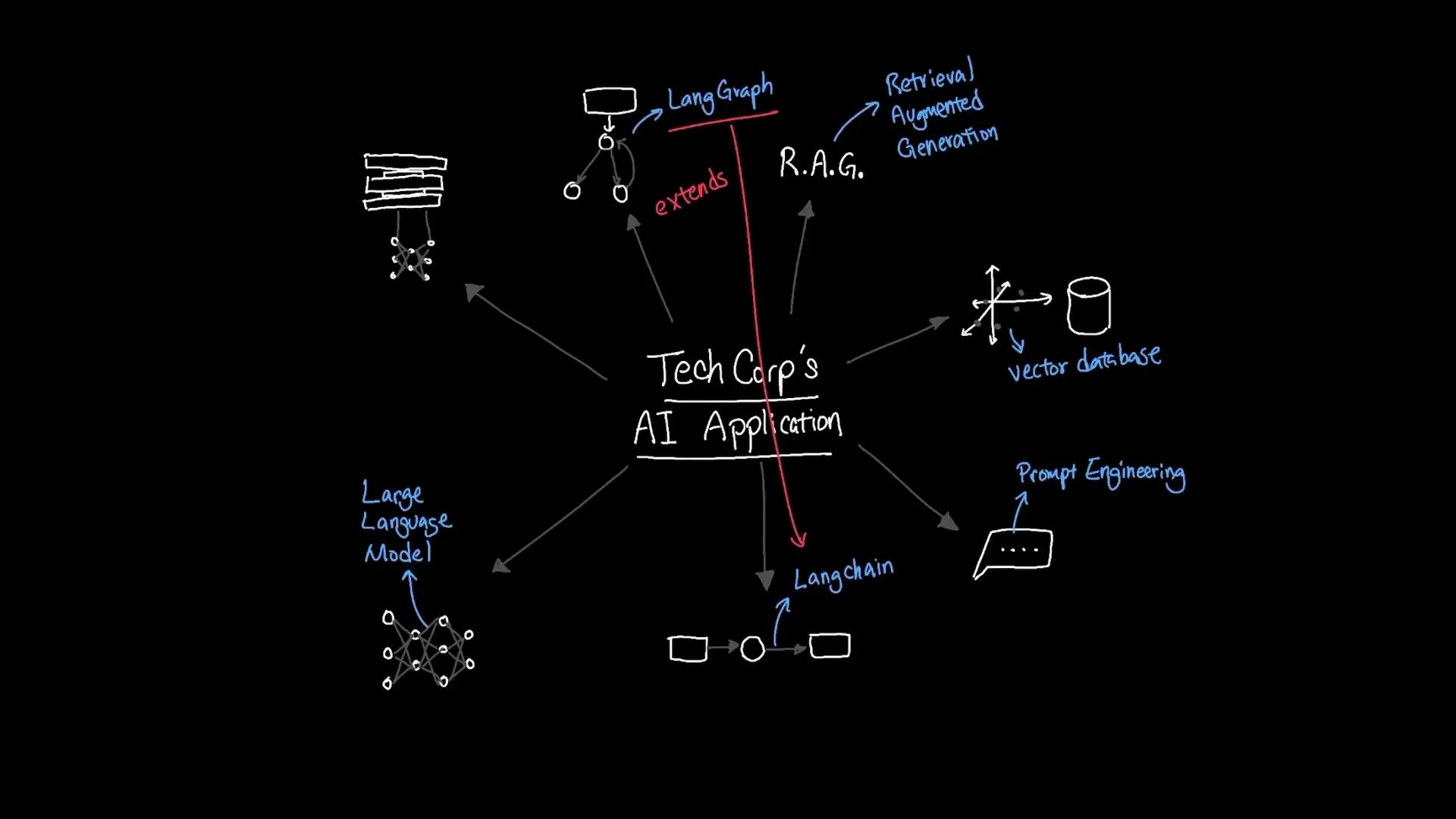
- LangGraph models complex workflows as a graph of nodes (units of computation) connected by edges (execution flow).
- Each node encapsulates a specific responsibility (search, extraction, evaluation, reporting, etc.).
- Edges can be conditional, enabling branching and loops.
- A shared, persistent state (state graph) is accessible to all nodes, allowing context to carry across the entire workflow.
Assume TechCorp has a 500GB data store that contains EU-specific policy documents. The system must locate relevant documents, extract the content, evaluate GDPR compliance, cross-reference local regulations, and produce an actionable report. Typical LangGraph node workflow for this compliance task:
- Search and gather privacy policy documents.
- Extract and clean document content.
- Evaluate GDPR compliance with an LLM.
- Cross-reference local EU regulations.
- Identify compliance gaps and generate recommendations.
- After Node 1 gathers documents, the edge routes to Node 2 for extraction.
- After Node 3 evaluates compliance, a conditional edge can route to Node 4 for deeper analysis or directly to Node 5 for reporting.
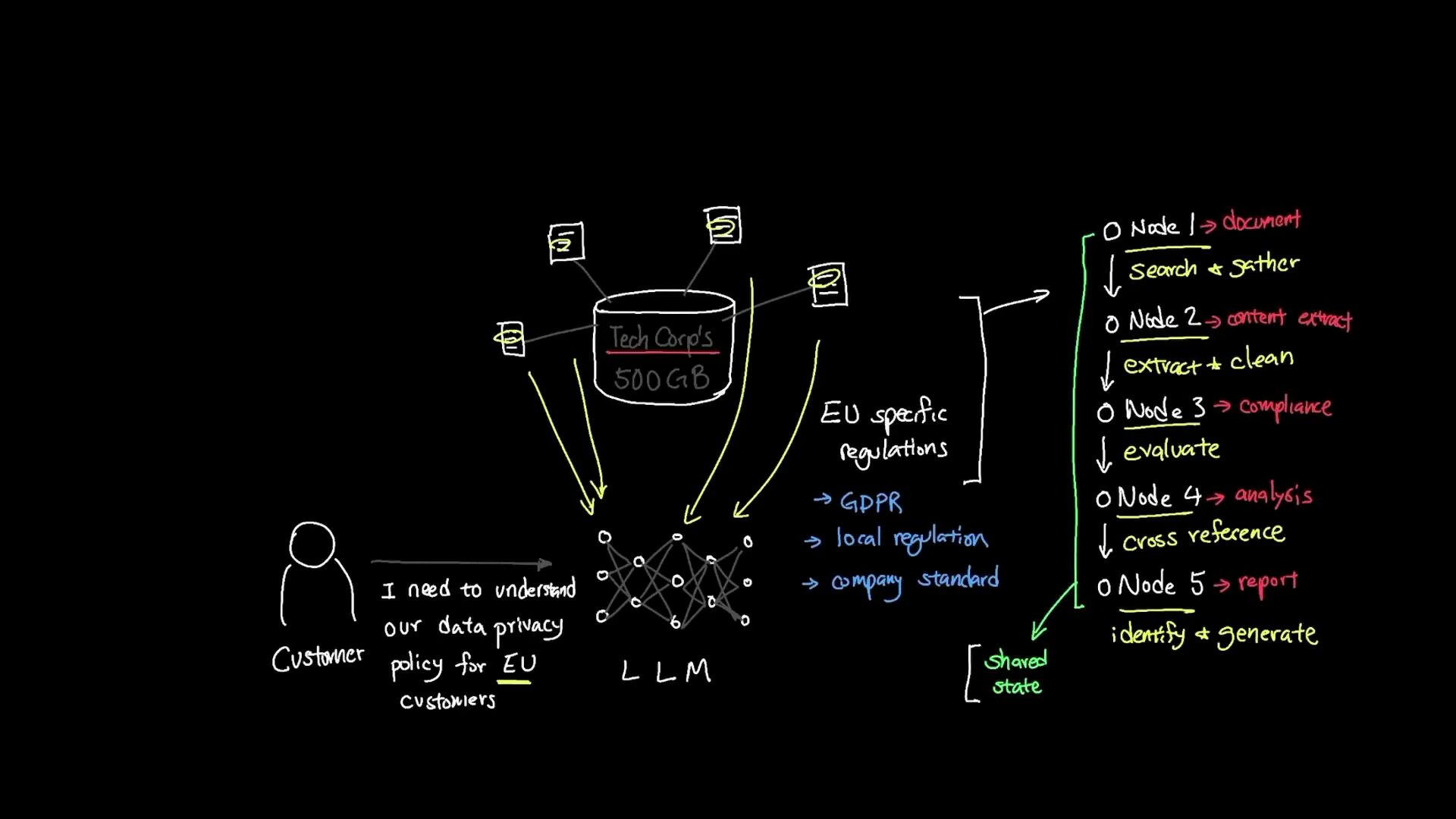
- Node 1 (search) populates
documentswith found policy files. - Node 2 (extract) iterates documents and sets
current_document. - Node 3 (evaluate) computes
compliance_score. - Node 4 (cross-reference) identifies
gaps. - Node 5 (report) appends
recommendations.
- If Node 3 sets
compliance_scorebelow 75%, a conditional edge can loop back to Node 1 to gather more documents (iterative analysis). - If the score exceeds 75%, the flow can proceed directly to Node 5 to generate the final report.
Benefits for the TechCorp compliance assistant
- Declarative modeling of complex workflows (no monolithic scripts).
- Clear separation of concerns (each node focuses on a single responsibility).
- Reusable nodes and conditional edges for flexible behavior.
- Persistent typed state for robust, type-safe orchestration.
Run verify_environment.py first to confirm your Python version, required packages, and API keys are configured. This prevents common runtime errors during the labs.
- LangChain — Core abstractions for chains and agents.
- Retrieval-Augmented Generation (RAG) — pattern for combining LLMs with external data sources.
- GDPR overview — https://gdpr.eu/ for regulation context when building compliance workflows.