

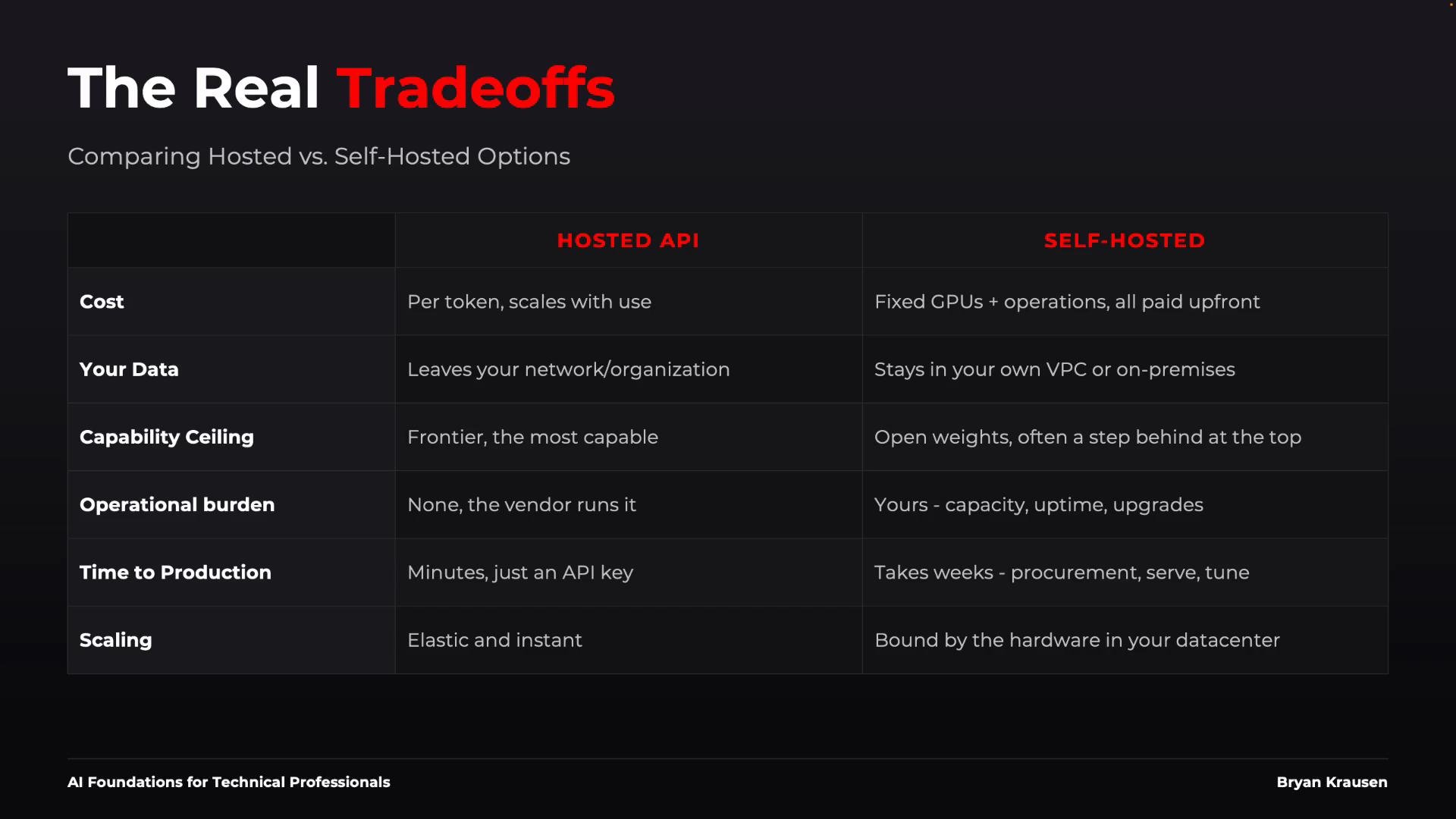
- Cost: Hosted APIs are pay-as-you-go with little upfront cost. Self-hosting requires capital expenditure (GPUs, servers, networking) and personnel.
- Data residency: Hosted APIs typically send data outside your environment; self-hosting keeps data inside your network or data center.
- Operations & scaling: Vendors handle operations for hosted APIs. Self-hosting makes your team responsible for scaling, monitoring, patching, and reliability engineering.
- Time to production: Hosted APIs can be integrated in minutes; building a dependable self-hosted stack can take weeks or months.
- Hosted: low initial cost, linear growth with usage (pay-per-request/token).
- Self-hosted: high up-front capital and operational overhead, then lower marginal cost as utilization increases.
- Break-even point: where the lines cross. Below it, renting is usually cheaper. Above it (and with high, consistent utilization), owning can be cheaper — but only if GPUs are kept busy and operational costs are contained.
When to reach for a hosted API
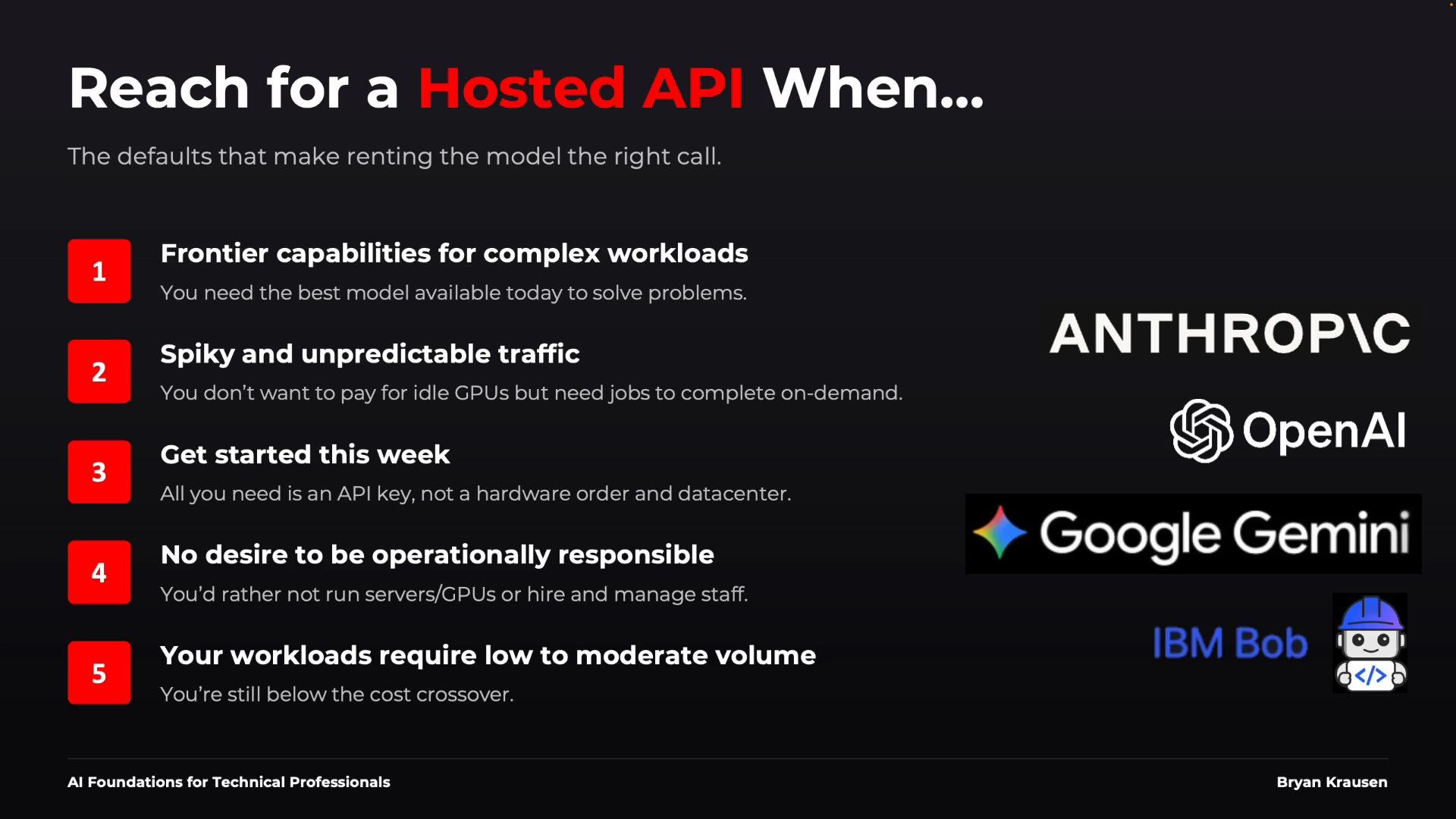
- Frontier capabilities — you need the most advanced, frequently-updated models.
- Spiky or unpredictable traffic — pay-as-you-go avoids paying for idle GPUs.
- Fast time-to-market — integrate with an API key and ship quickly.
- No operational responsibility — vendor handles scaling, monitoring, and patches.
- Low-to-moderate or unpredictable overall volume — usually cheaper than owning.
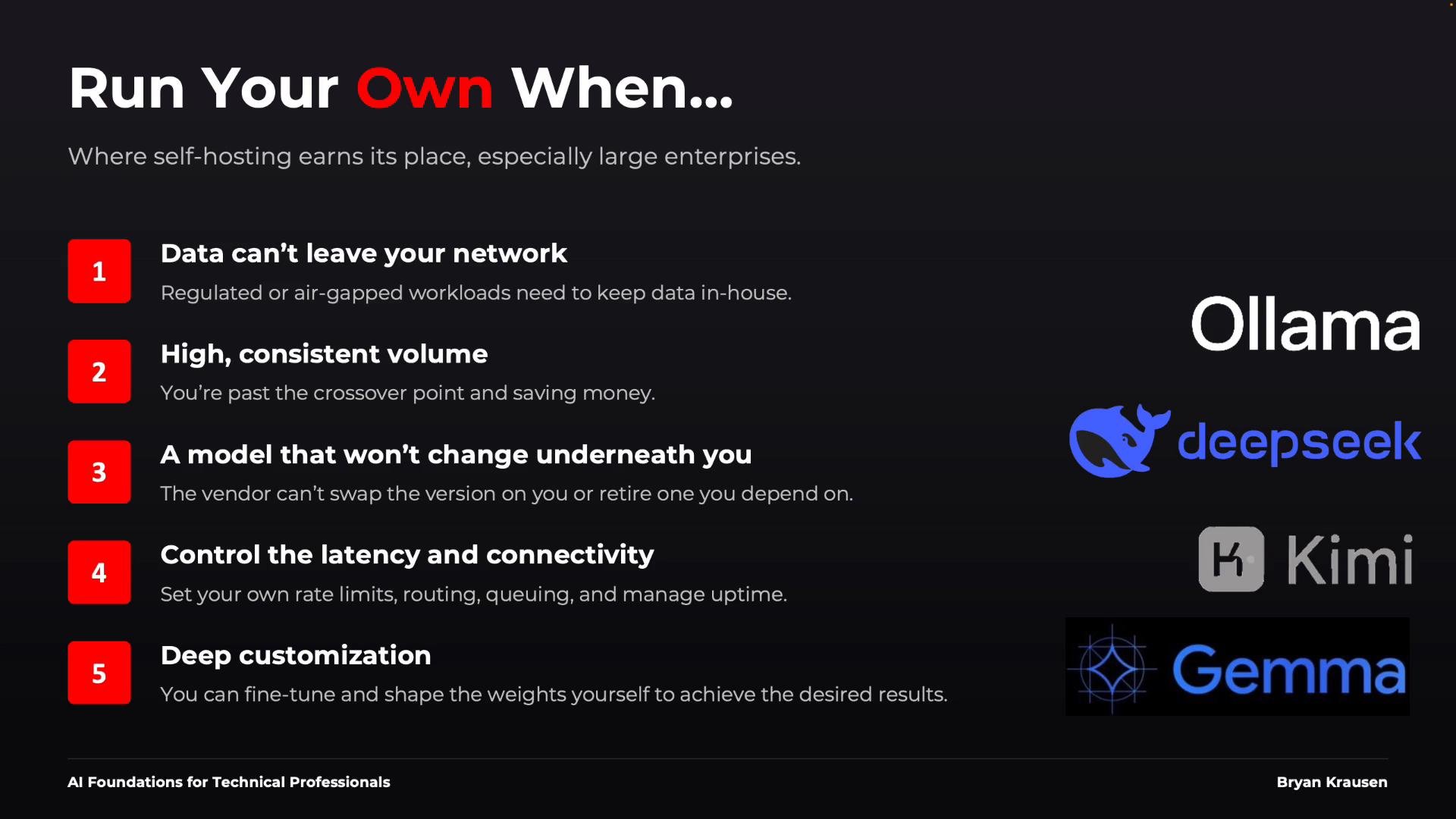
- Data cannot leave your network — regulatory, privacy, or air-gapped environments.
- High, steady volume that exceeds the break-even point.
- Model stability — you need the model behavior to remain unchanged over time.
- Strict latency requirements — colocated inference reduces round-trip time.
- Deep customization — fine-tuning or directly modifying model weights to meet application-specific needs.
- GPU scarcity and acquisition: High demand can make procurement expensive and slow.
- Staffing and expertise: MLOps, infra engineers, and reliability specialists are required.
- Infrastructure complexity: Batching, autoscaling, observability, and fault-tolerance add engineering overhead.
- Idle capacity risk: Unused GPUs still incur power, cooling, and depreciation costs.
- Keeping pace with innovation: Frontier models advance quickly; your self-hosted model can lag without active upgrade planning.
- Route sensitive or high-volume requests to your self-hosted stack.
- Forward rare, capability-hungry, or exploratory requests to hosted vendor APIs (for frontier models).
- Make routing decisions per request so a single application can transparently use both.
Choose the deployment approach that matches each workload: use hosted APIs for speed, flexibility, and low operational overhead; self-host for control, compliance, and predictable high volume. Hybrid routing lets you combine both where appropriate.
- Hosted APIs: fastest route to the best public models, minimal upfront cost, vendor-managed operations, data typically leaves your network.
- Self-hosted: full control of data and stack, potentially lower unit cost at high scale, requires capital investment, talent, and ongoing operations.
- Many organizations run a mix and route workloads per request; re-evaluate as volumes, regulatory needs, and model capabilities evolve.