

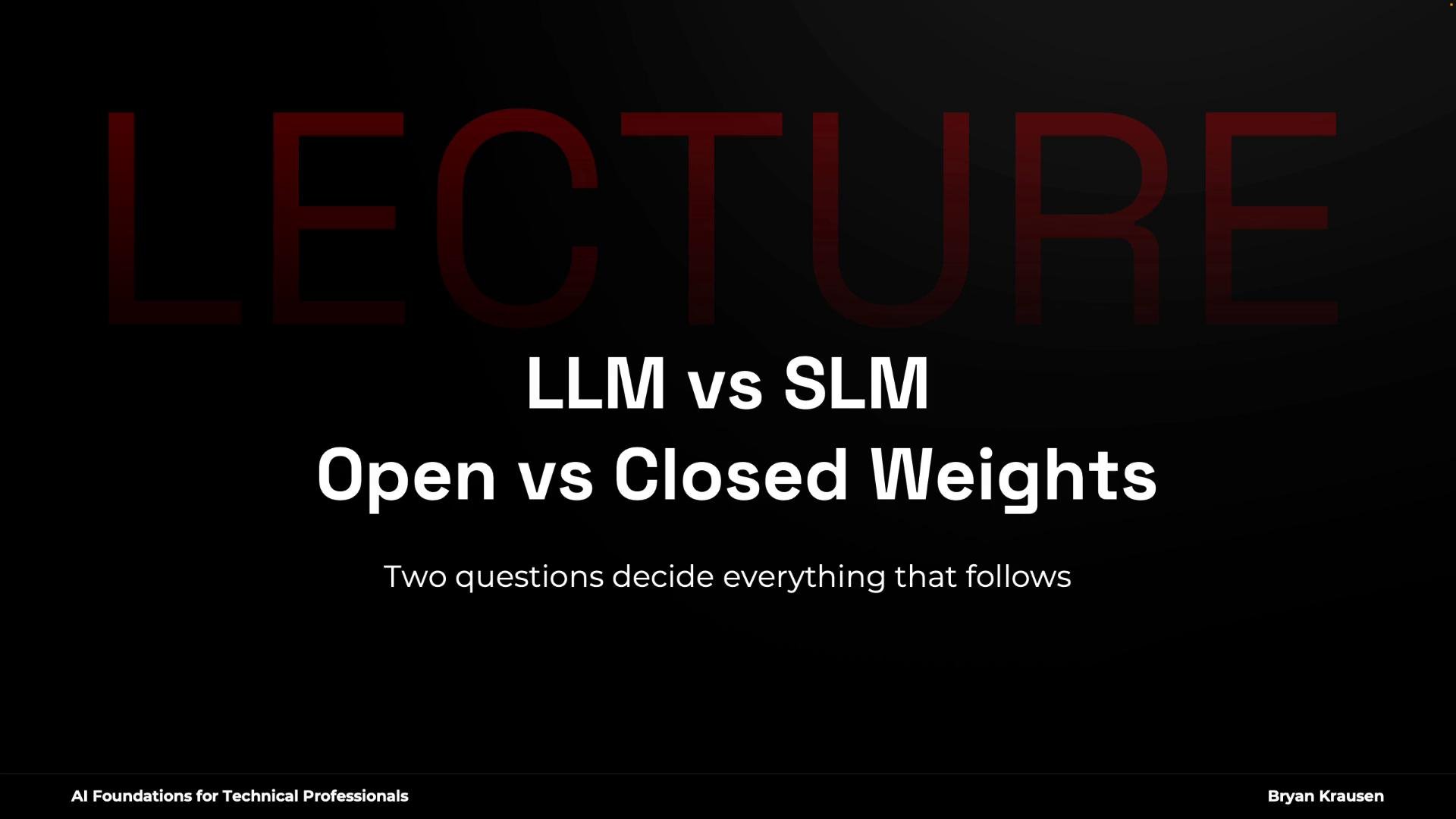
- How big is the model?
- Who holds or maintains the model file?
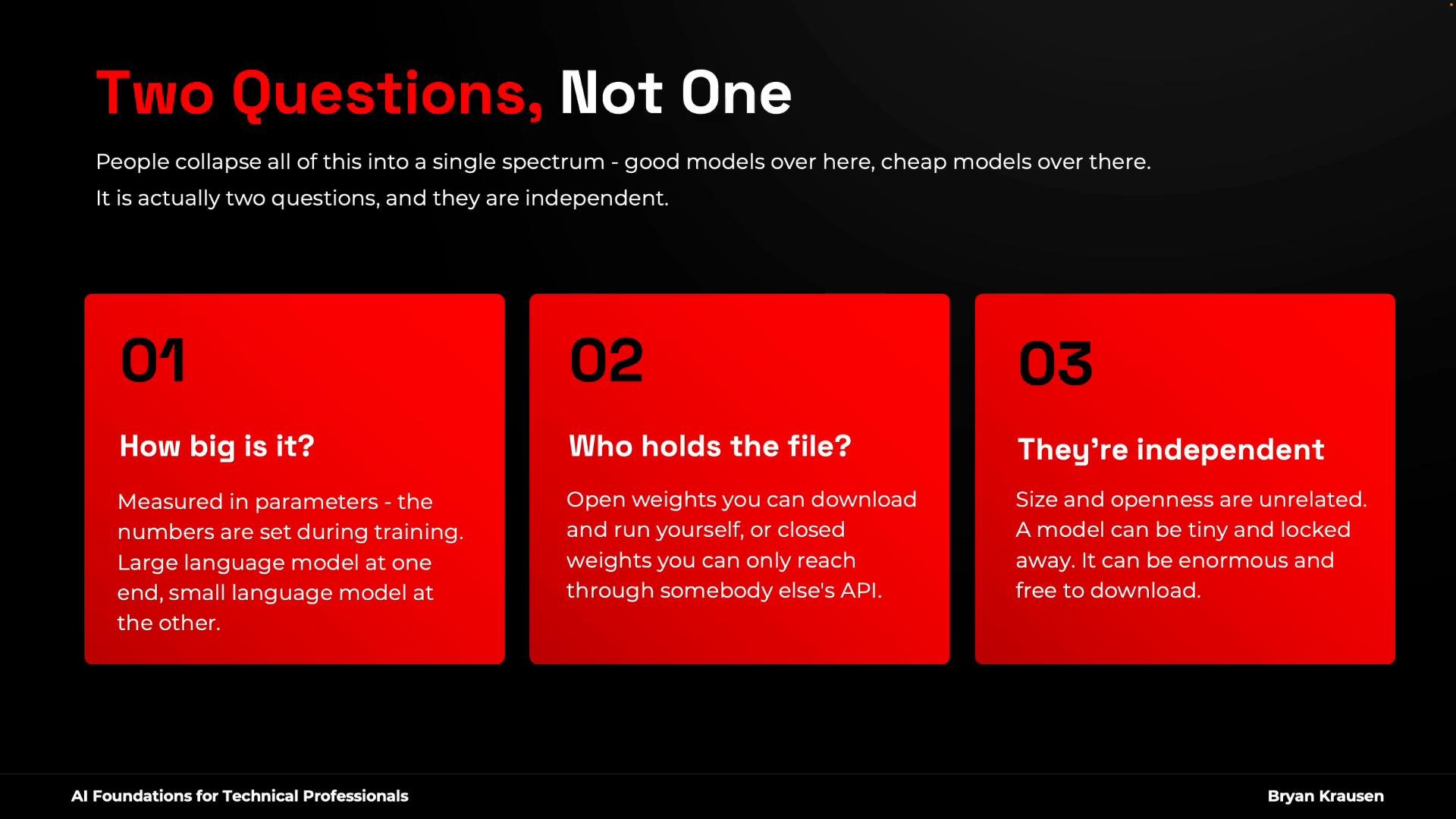
Model size (what “big” means)
“Size” is shorthand for parameter count. There is no formal industry cutoff, but a practical breakdown is:
Also watch for Mixture-of-Experts (MoE) architectures: a model marketed as 100B parameters may only activate a small fraction (for example, ~5B) per token. Headline parameter counts do not always equal compute used at inference time.
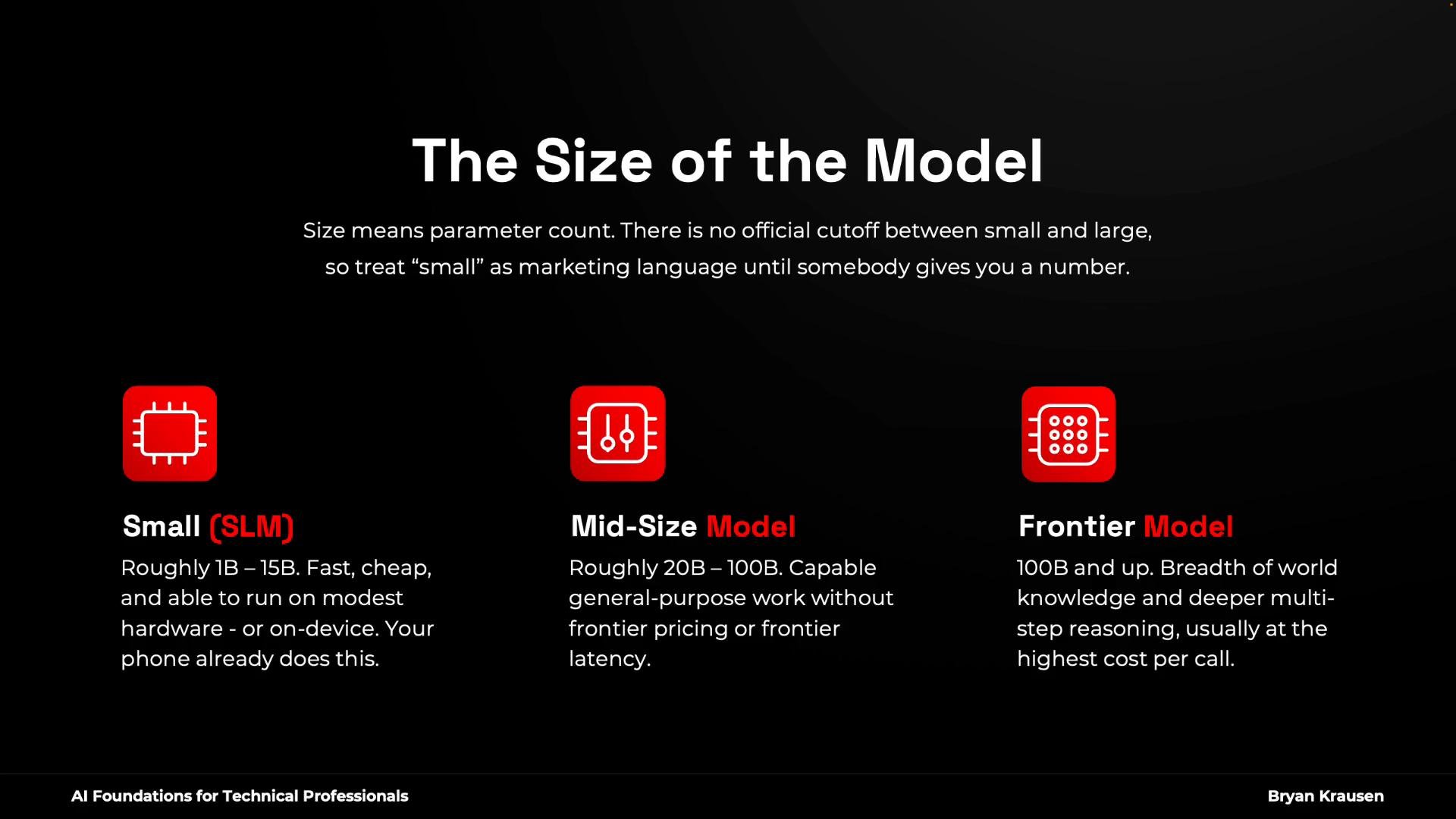
- Larger models tend to deliver broader capability and stronger multi-step reasoning, but they cost more and can be slower.
- Smaller models trade breadth for speed, lower cost, and the ability to run in constrained environments (on-device, air-gapped, or low-latency edge scenarios).
- “Small” does not mean “bad” — it means “narrower.” For many production tasks (ticket routing, structured extraction, consistent-form summarization), a well-chosen SLM or mid-size model is cheaper, faster, and fully adequate.
Who holds the model file? (Open vs closed weights)
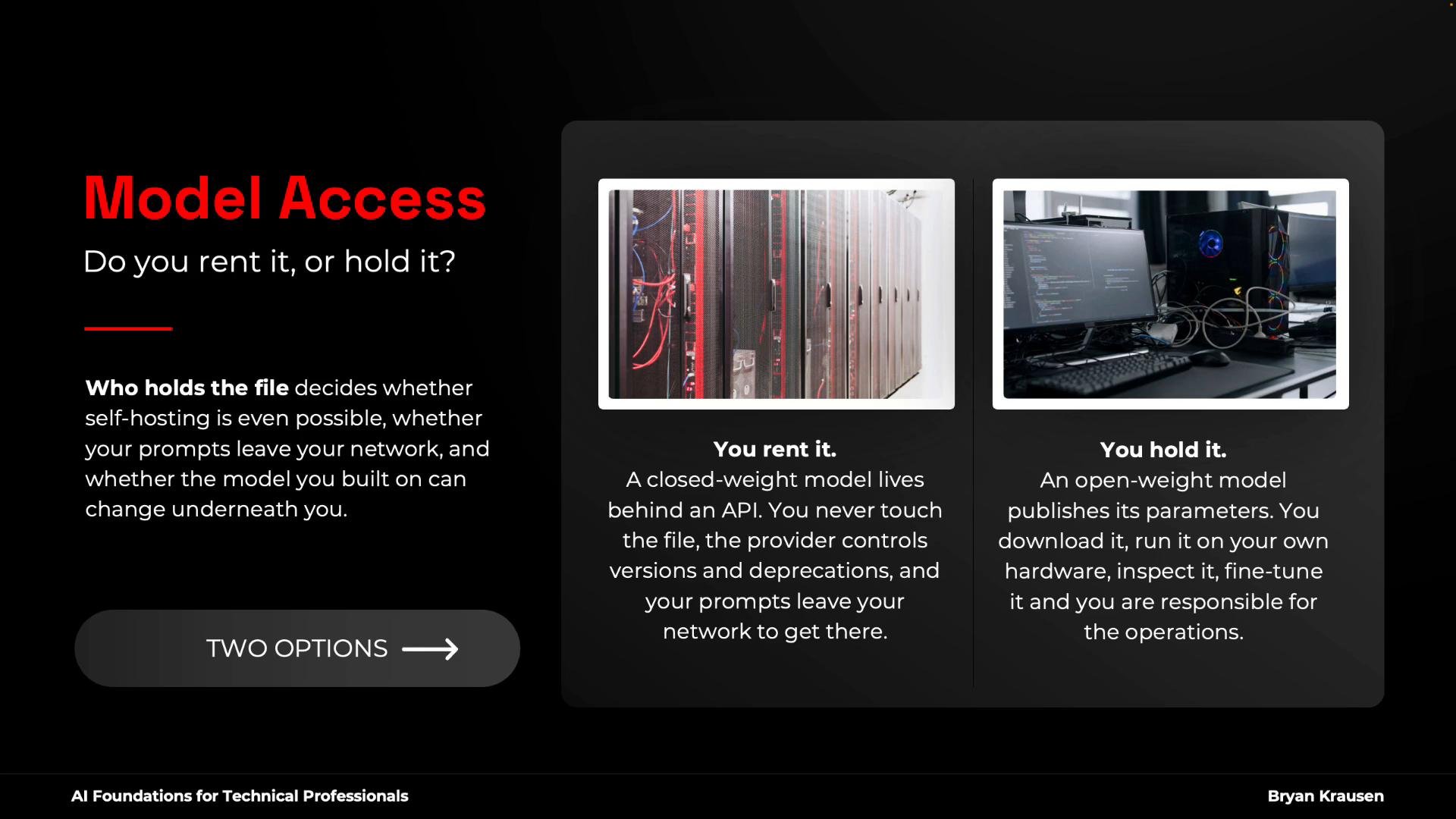
The second independent axis is access and control.- Closed weights: you rent access via a vendor API. You never possess the trained model file; prompts and responses traverse the network to the provider, which controls model versions and updates.
- Open weights: the trained parameter file is published. You can download it, run it locally, inspect or fine-tune it, and control the version you use. That brings data residency, customization, and version stability advantages — with added hosting, maintenance, and compliance responsibilities.
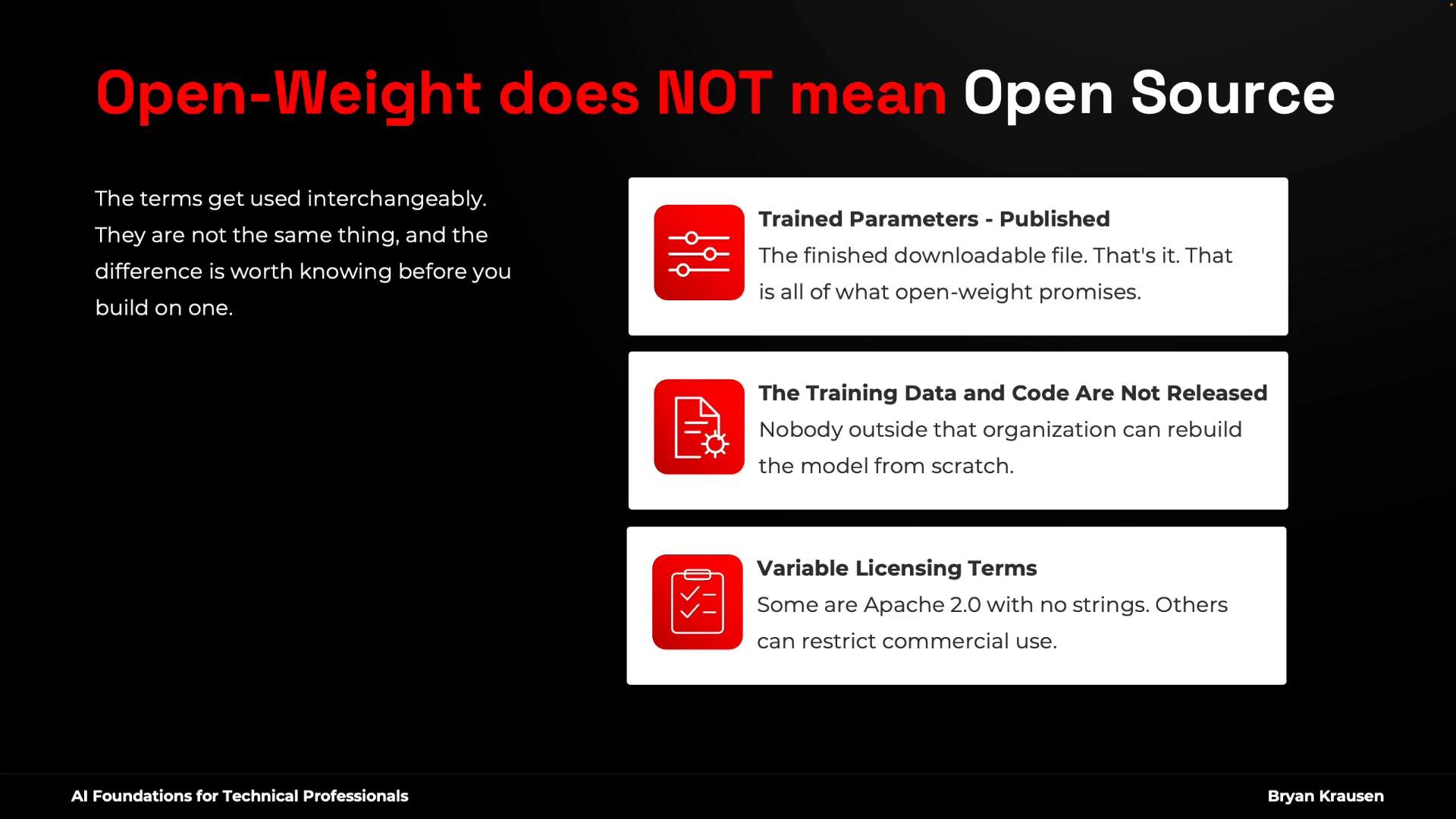
Open weights let you run and modify a published model file, but they typically do not include the original training data or the full training pipeline. Check license terms and export/compliance restrictions before using a model in production.
Putting the axes together: a 2×2 model access map
Every real model falls into one of four corners. Use the table below to identify tradeoffs quickly.
When vendors sell closed models they often expose tiers (fast, balanced, frontier) rather than explicit parameter counts. The vendor maps a tier to a particular model configuration behind the scenes.
How to choose: practical guidance
- Prioritize openness (self-hosting) when you must guarantee data residency, avoid sending sensitive data to third parties, or require long-term version stability.
- Prioritize size (larger models) when you need broad knowledge, complex reasoning, or capabilities only found in frontier models.
- For many production workflows (routing, structured extraction, lightweight summarization), a small or mid-size model — open or closed — will be more cost-effective and performant than an oversized LLM.
- Consider MoE and activation strategies: a headline parameter count alone may mislead about inference compute and cost.
If your application handles sensitive or regulated data, prioritize openness (self-hosting or a compliant deployment) and carefully review licenses and vendor policies before sending any data to third-party APIs.
- Review model licenses before production use (e.g., check Apache 2.0 or vendor-specific terms).
- Explore self-hosting frameworks and inference stacks if you need open weights and local control.
- Track developments in MoE and efficient inference to understand real-world compute costs.