

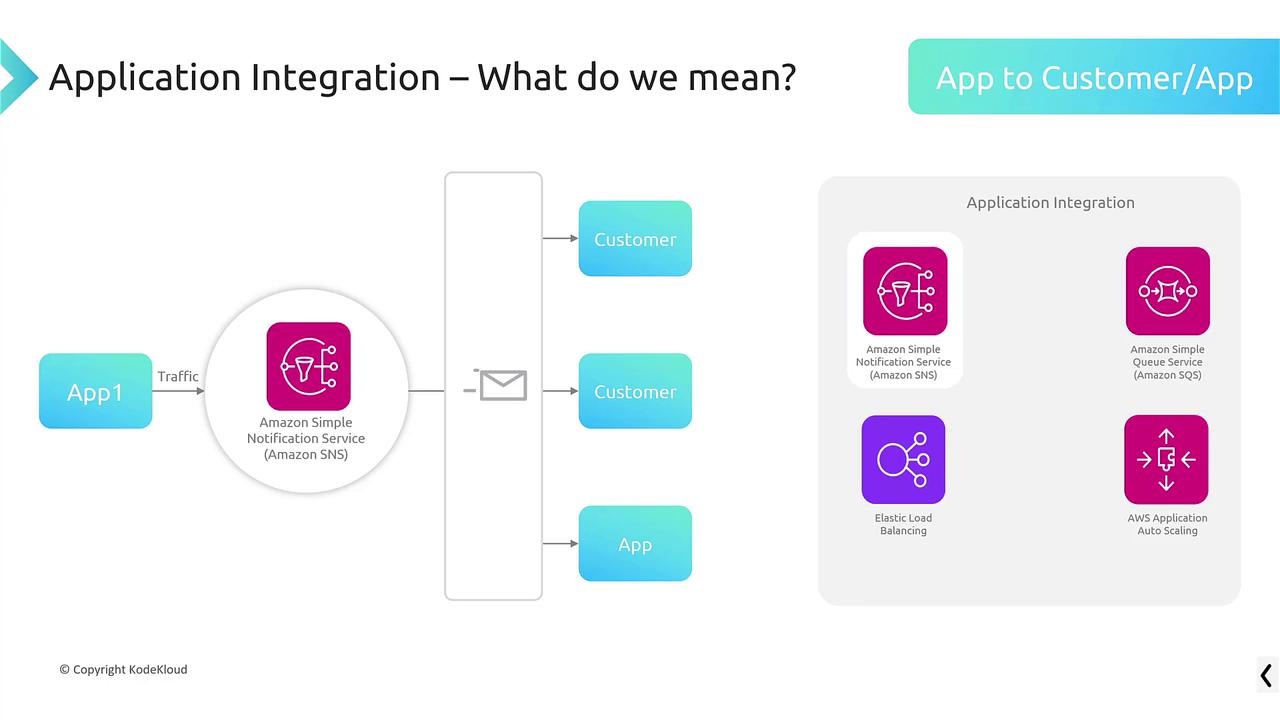
Simple Notification Service (SNS)
We begin with SNS, the duplicator service. When a message is sent to SNS, it replicates the message across all endpoints subscribed to a specific topic. For example, publishing a message on SNS ensures that every device or service subscribed to that topic receives a copy, similar to an email subscription system.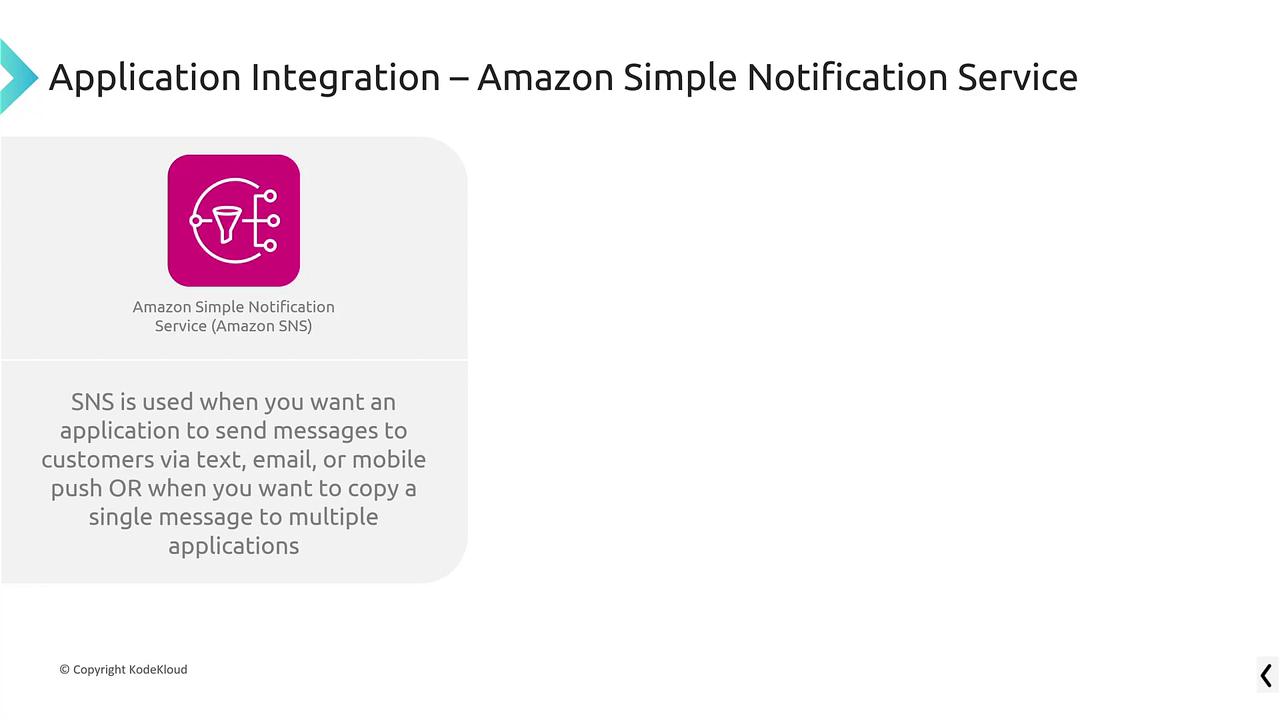
Simple Queue Service (SQS)
SNS pairs naturally with SQS, a service built around the concept of a queue. SQS manages a large influx of messages by storing them until the receiving application is ready to process them. This buffering mechanism prevents backend systems from getting overwhelmed during peak loads. Unlike SNS, which duplicates messages, SQS ensures that messages are held and then processed one-by-one, maintaining system stability.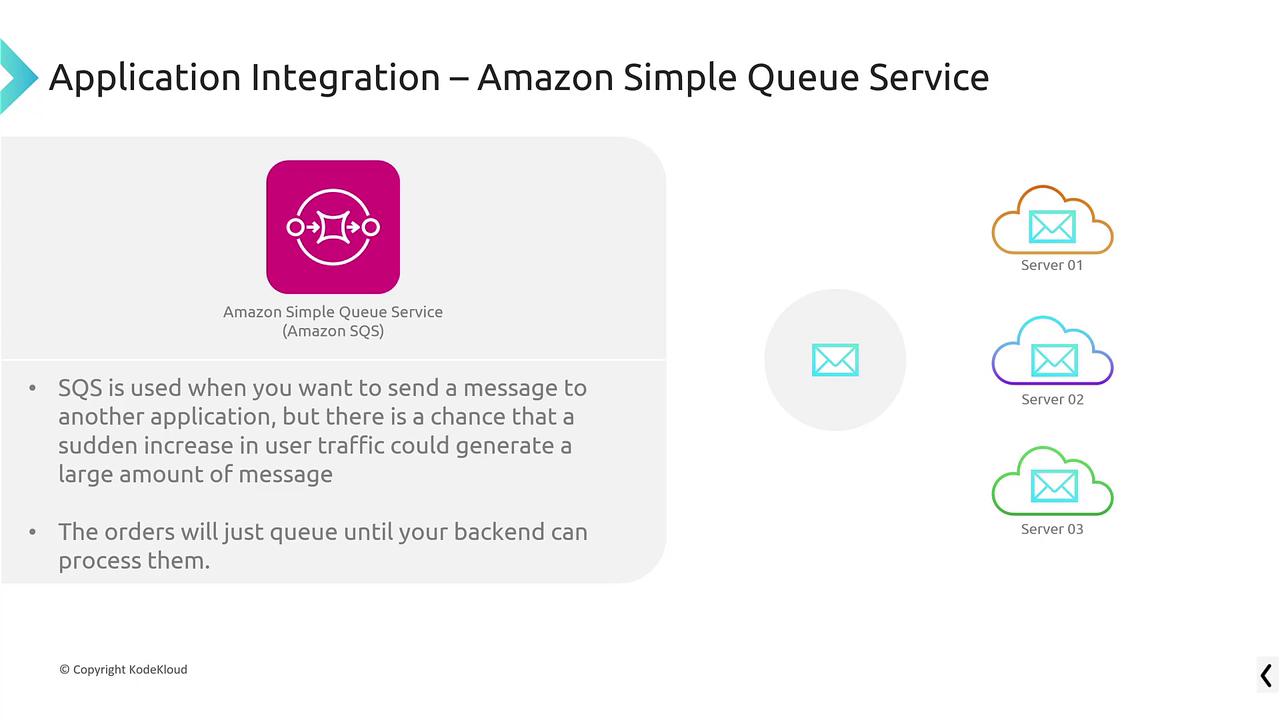
Elastic Load Balancing (ELB)
Next, we examine Elastic Load Balancing. ELB distributes incoming traffic evenly across multiple backend servers. Imagine a busy restaurant where guests are efficiently routed to different service stations—ensuring no single station becomes overloaded. ELB directs traffic to the first available server and automatically reroutes requests if a server fails. This functionality applies to diverse compute environments, including virtual machines, containers, and Lambda functions. The diagram below demonstrates how ELB distributes incoming traffic across multiple availability zones: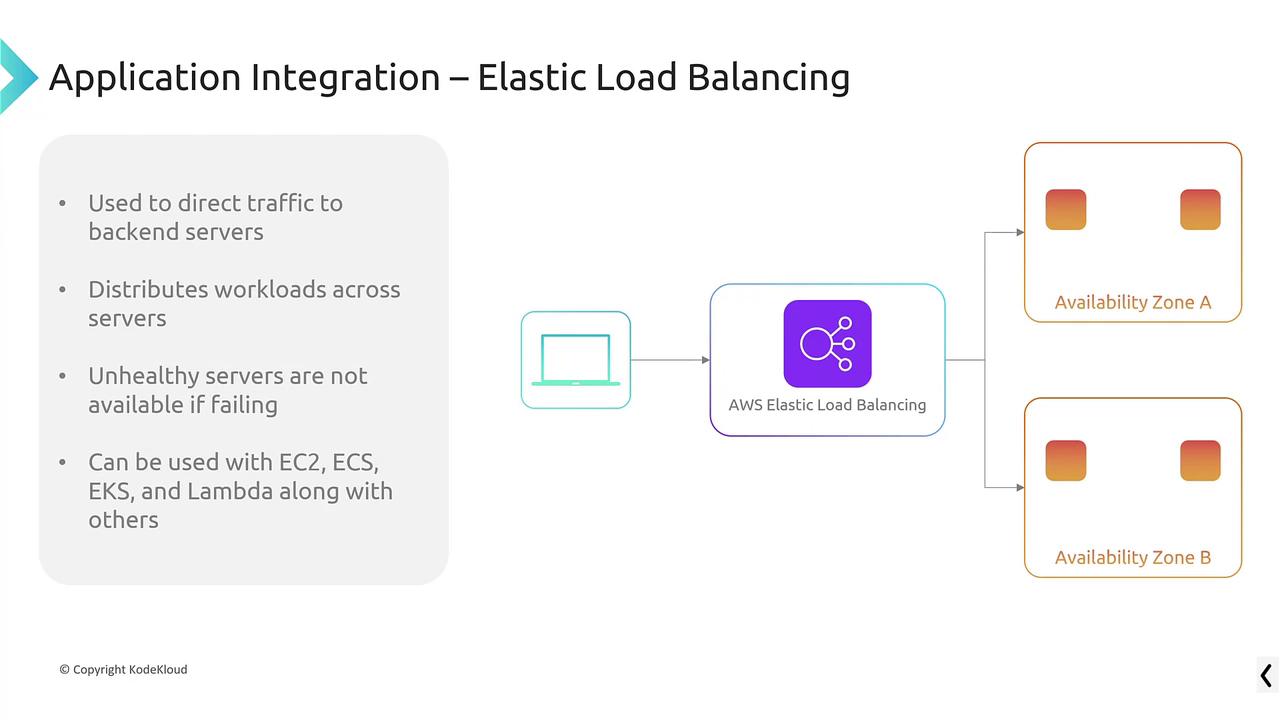
Auto Scaling
Working hand in hand with load balancing is Auto Scaling. This service monitors incoming traffic and other performance metrics, adjusting the capacity of backend servers automatically. For example, if your load balancer detects higher traffic, Auto Scaling adds servers to maintain optimal performance. Conversely, it scales down capacity when demand decreases, optimizing cost efficiency. Below is a diagram showing how increased traffic results in an expanded Auto Scaling group, with the load balancer redistributing requests among all instances: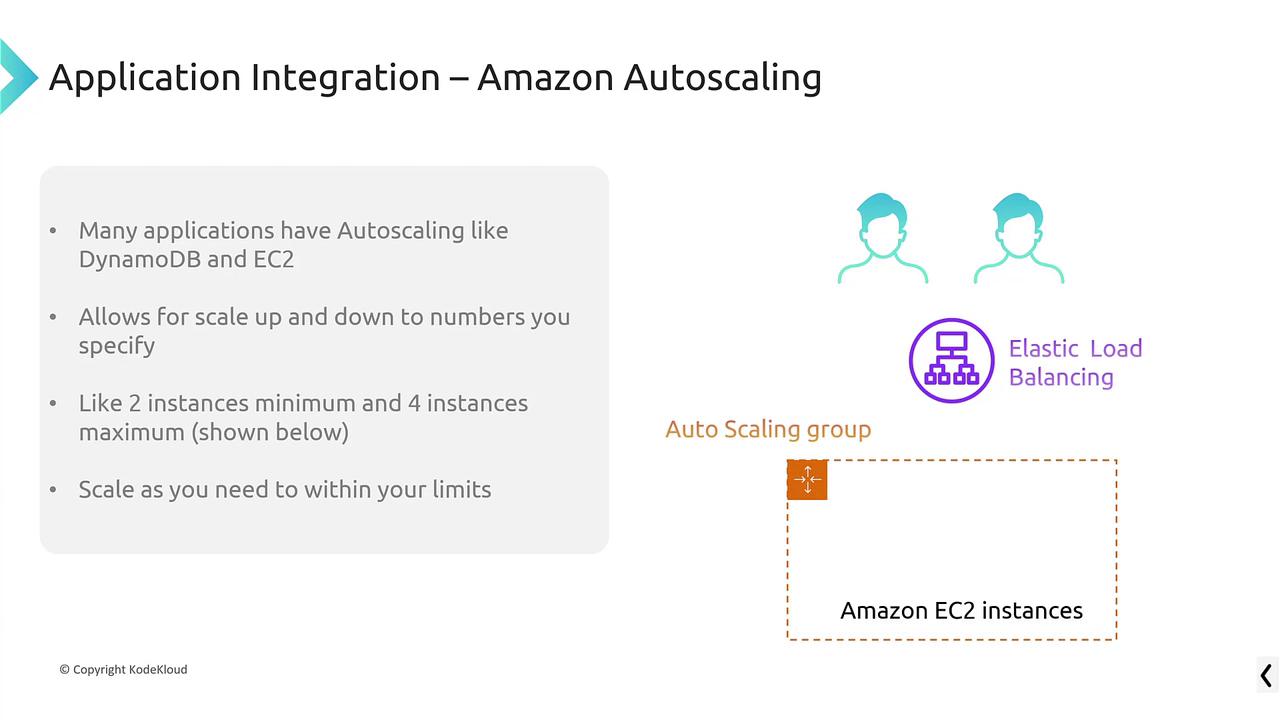
Additional Application Integration Services
Beyond SNS, SQS, ELB, and Auto Scaling, AWS offers several other services tailored for application integration:- AppFlow: Orchestrates data replication from third-party sources, such as Salesforce, into AWS automatically. Think of it as a tool similar to IFTTT, Make, or Zapier for AWS environments.
- EventBridge: Functions like a post office, capturing events from your applications and triggering necessary responses. For example, an application can post an event to EventBridge to schedule a task.
- Amazon MQ: Provides a managed queue service using popular open-source software (such as ActiveMQ or RabbitMQ). While SQS offers a simplified, scalable solution, Amazon MQ is ideal for those already invested in open-source queue systems.
- Step Functions: Orchestrates and chains multiple Lambda functions to execute more complex tasks that exceed individual function limitations (like the 15-minute runtime limit).
Integrating multiple AWS services for application integration not only enhances performance but also improves the scalability and reliability of your cloud architecture.
Summary
- Simple Notification Service (SNS): Duplicates and disseminates messages to multiple endpoints, making it perfect for notifications across applications, text, email, or mobile devices.
- Simple Queue Service (SQS): Buffers incoming messages and processes them sequentially to prevent backend overload.
- Elastic Load Balancing (ELB): Distributes incoming traffic evenly across multiple servers and handles automatic traffic rerouting.
- Auto Scaling: Dynamically adjusts compute capacity based on real-time traffic, ensuring both performance and cost efficiency.
- Additional services like AppFlow, EventBridge, Amazon MQ, and Step Functions cater to specific needs in data integration and orchestration.