

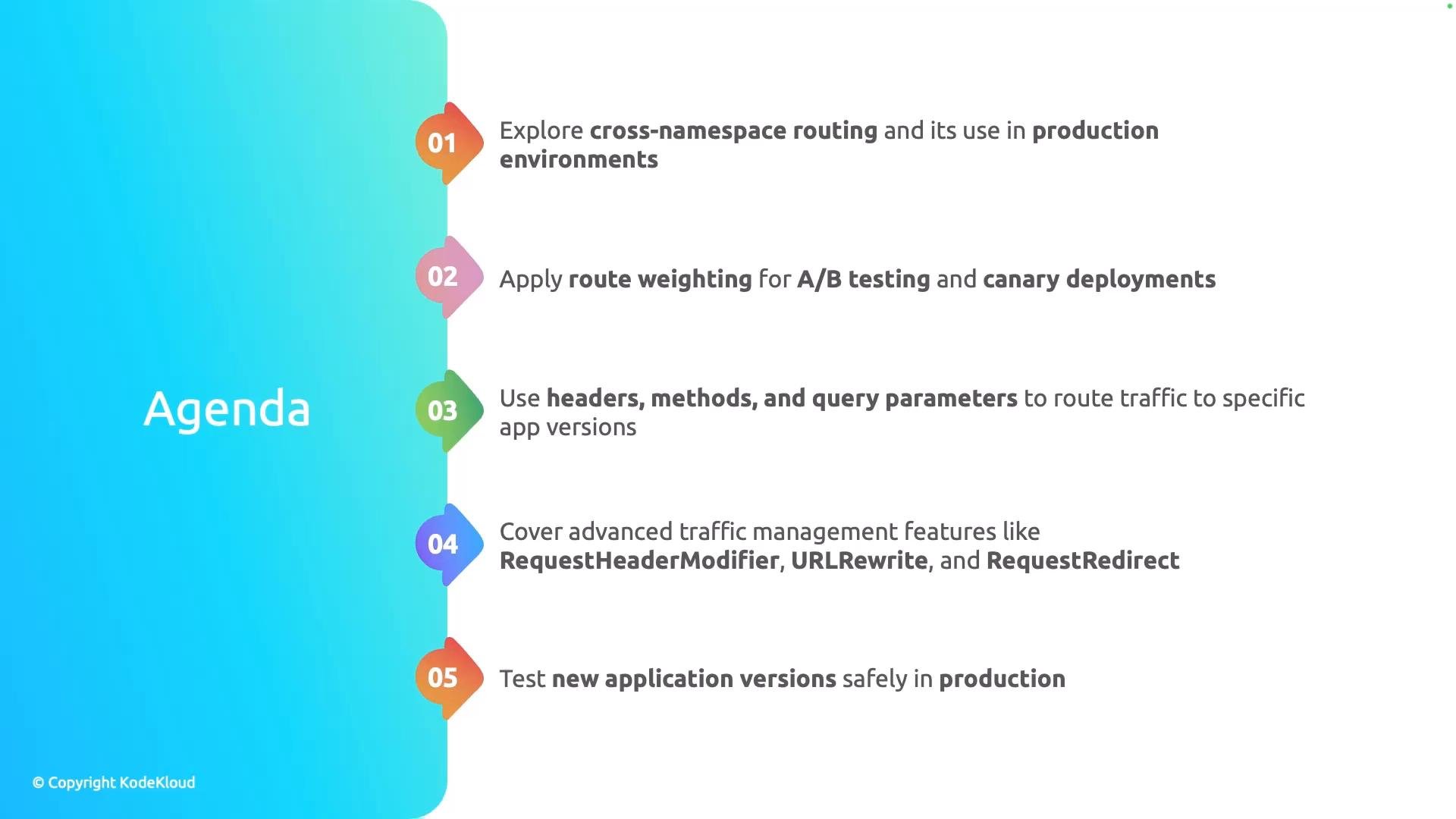
- Cross-namespace routing: route traffic across Kubernetes namespaces to support multi-tenant or split-team deployments.
- Route weighting for A/B testing and canary deployments: gradually shift traffic between versions to validate changes before full rollout.
- Header-, method-, and query-parameter-based routing: target specific requests (for example, by
User-Agent, HTTP method, or feature-flag query) to direct traffic to particular application versions. - Advanced request controls:
RequestHeaderModifier,URLRewrite, andRequestRedirectfor shaping requests or steering clients without changing application code. - Safe production testing: combine these features (weighting, header routing, rewrites) with observability to test new releases with minimal risk.
Before you begin, ensure your cluster has the Gateway API CRDs and NGINX Fabric Gateway installed, and that sample application versions exist in the namespaces you plan to target. These prerequisites make it easy to follow the hands-on examples in this section.
Testing in production carries risk. Use incremental rollouts (weighting/canaries), health checks, monitoring, and automated rollbacks to limit exposure. Never route 100% of critical traffic to an untested release without observability and a rollback plan.
Links and references:
- Gateway API — Kubernetes SIG Gateway
- NGINX Gateway Controller / Fabric Gateway documentation
- Kubernetes Basics