

server.js, routes/auth.js, database.js), with minimal surface area change.
Example interactive prompt used to drive the audit:
- Overall score: 3.5 / 10 — current demo not ready for production.
- Major problems: no centralized error handling, inconsistent response format, unhandled promise rejections, no retry/circuit-breaker patterns, and sensitive info written to logs.
- Immediate priorities: add a centralized error middleware, register process-level handlers for unhandled rejections/uncaught exceptions, and stop logging raw error objects.
During development, verbose stack traces are helpful. In production, never expose stack traces or raw error objects to API responses or unprotected logs—use sanitized, structured logs and environment-based response behavior.
Logging full error objects (which may include DB URIs, SQL, tokens, or user credentials) is a high-risk data-exposure vector. Sanitize or redact sensitive fields before logging.
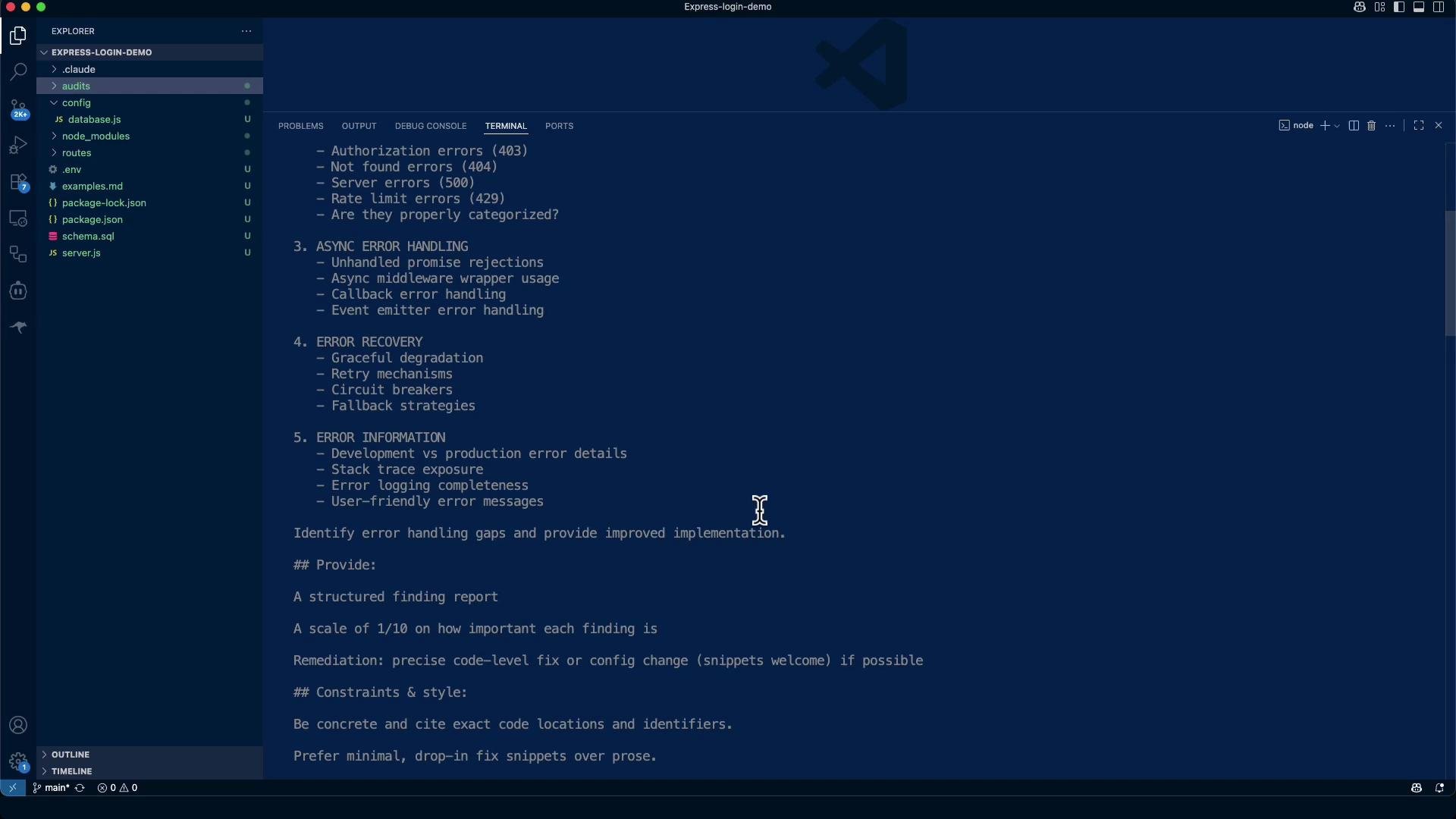
Detailed findings and concrete remediation
Below are prioritized findings with precise remediation snippets suitable for drop-in changes. Where new helper files are recommended, place them underutils/ or middleware/ unless your repo already contains equivalents. If a file does not exist, add it; if you prefer not to add files, the contents can be placed inline in server.js, but separating increases maintainability.
- ERROR HANDLING CONSISTENCY — CRITICAL
- Location:
server.js(top-level Express setup) - Evidence: No centralized error middleware or standardized response format.
utils/errorResponse.js):
middleware/errorHandler.js):
server.js after routes:
- ERROR CATEGORIES — MEDIUM
- Current: routes only use a handful of statuses (400/401/500); missing common HTTP error mappings (403, 404, 409, 429).
- Impact: Clients and monitoring cannot reliably interpret failures.
utils/httpErrors.js:
routes/auth.js:
- ASYNC ERROR HANDLING — CRITICAL
- Issues: no
process.on('unhandledRejection')orprocess.on('uncaughtException')handlers; routes use manual try/catch scattered throughout. - Evidence: missing global handlers in
server.js.
server.js (near top, before app.listen):
middleware/asyncHandler.js):
- ERROR RECOVERY — FAIL
- Issues: no retry logic for transient DB/network errors; no circuit-breaker or fallback strategies.
- Impact: transient errors lead to service outages and potential cascading failures.
config/database.js):
npm i opossum):
- ERROR INFORMATION & LOGGING — CRITICAL / MEDIUM
- Evidence: application uses
console.log/console.errorand logs full error objects (including DB details). - Impact: sensitive data (connection strings, SQL, tokens) may leak to logs.
utils/logger.js):
console.error('Login error:', error) with:
- Never log full request body for authentication endpoints.
- Remove DB URIs, tokens, and passwords from logged objects.
- Consider sampling or PII redaction policies for high-volume endpoints.
- ENVIRONMENT-SPECIFIC BEHAVIOR — HIGH
EnsureNODE_ENVcontrols verbosity:
- Development: include stack traces and verbose logs.
- Production: hide stack traces from API responses; log full details to secure destinations only.
errorHandler above respects NODE_ENV and only includes stack traces when NODE_ENV !== 'production'.
Priority remediation plan
Estimated effort:
- Core fixes: 2–3 days for a small team (error middleware, global handlers, logger replacement).
- Full resilience: 2–3 months to implement retries, breakers, and staged fallbacks.
- Current: NOT READY for production.
- After critical fixes: improved readiness; still require monitoring, alerting, secret management, and secure logging destinations.
- Audit referenced
server.js,routes/auth.js, andconfig/database.js. For an automated verification run, include exact lines whereconsole.erroris used and route handlers are defined so tests can assert replacement by logger and async handlers. - If any suggested file does not exist, create
utils/andmiddleware/files as described. Alternatively, embed minimal logic intoserver.jsfor fast verification, but modular placement is recommended.
- Implement the central error middleware and mount it after routes.
- Register process-level handlers for unhandled rejections and uncaught exceptions.
- Replace ad-hoc
console.*with a structured logger (Winston/Pino) and enforce sanitization rules. - Add
asyncHandlerto wrap async route handlers and standardize error objects viahttpErrors/ErrorResponse. - Add retry logic for DB connections and circuit-breaker wrappers for fragile external services.
- Express error handling recommendations: https://expressjs.com/en/guide/error-handling.html
- Node process
unhandledRejection/uncaughtException: https://nodejs.org/api/process.html#process_event_unhandledrejection - Winston structured logging: https://github.com/winstonjs/winston
- Opossum circuit breaker: https://nodeshift.dev/opossum/