

Note: the audit focused on authentication hardening patterns relevant to most Express-based demos: password hashing, JWT handling, refresh-token rotation, session invalidation, brute-force protection, input validation, and secure cookie/CSRF practices.
Structured audit prompt (representative)
This article focuses on actionable fixes for Express.js authentication flows: secure password storage, robust JWT handling, refresh-token rotation, brute-force defenses, safe cookie/CSRF configuration, and input validation. Use the snippets below as minimal drop-in improvements and adapt them to your project structure.
Executive summary (high level)
- Primary focus: authentication flow hardening for an Express demo with PostgreSQL and JWTs.
- Main risks found (representative):
- Hard-coded or weak JWT secret — Critical
- Plaintext password storage or missing hashing — Critical
- Missing brute-force/rate-limiting on login/reset — High
- Long-lived access tokens / no refresh-token rotation — High
- Insufficient input validation / potential account enumeration — Medium-High
- Recommended priorities:
- Replace weak/hard-coded secrets; use environment or secret manager and rotate keys.
- Ensure passwords are hashed (bcrypt with async salts ≥12) before persistence.
- Implement RT rotation + reuse detection, shorten access TTL.
- Add rate-limiting and consistent, generic error messaging to prevent enumeration.
- Harden cookies, CSRF protections, and input validation.
Key checks — what to inspect and why
Relevant references:
- bcrypt: https://www.npmjs.com/package/bcrypt
- Redis: https://redis.io
- express-rate-limit: https://www.npmjs.com/package/express-rate-limit
Example findings (representative)
-
Weak JWT Secret Management
- Severity: Critical | CWE-798 (Hard-coded Credentials)
- Evidence:
.envincludedJWT_SECRET=your_jwt_secret_key_here. - Remediation: Replace with a cryptographically strong secret stored in environment or secret manager; rotate keys and use asymmetric keys (RS256/ES256) if feasible.
-
No password hashing on registration
- Severity: Critical
- Evidence: Registration flow persisted plaintext password.
- Remediation: Use bcrypt.hash() (async) with salt rounds ≥ 12 before persisting.
-
Missing brute force protection on login
- Severity: High
- Evidence: No rate limiting or lockouts on login/reset endpoints.
- Remediation: Add express-rate-limit with Redis backing; block after threshold and present generic error messages.
-
Excessive token lifetimes / no RT rotation
- Severity: High
- Evidence: Long-lived access tokens; refresh tokens not rotated.
- Remediation: Shorten access TTL, implement RT rotation with reuse detection and per-device tracking.
Concrete remediation snippets
Place these snippets into appropriate files (e.g.,routes/auth.js, middleware/, or a config file). They are minimal and intended to be adapted to your project style and error handling.
1) Register with bcrypt hashing (async)
2) Rate limit login attempts (express-rate-limit + Redis)
3) HTTPS redirect middleware (enforce TLS in production)
4) Generic server-side error logging and client response
5) Strong JWT verification (explicit algorithms and claim checks)
6) Password validation rules (express-validator)
Immediate actions (next 48 hours): replace weak/hard-coded JWT secrets, ensure passwords are hashed before persistence, add login rate-limiting, shorten access token TTL, and implement refresh-token rotation. These address the highest-impact findings.
Test recommendations (examples)
- Refresh token reuse detection (pseudo-test)
- Brute force protection test
- Password reset flow test
- Create a short-TTL reset token, assert it’s hashed at rest, use once, and verify it’s invalid afterwards.
Report generation & operational checklist
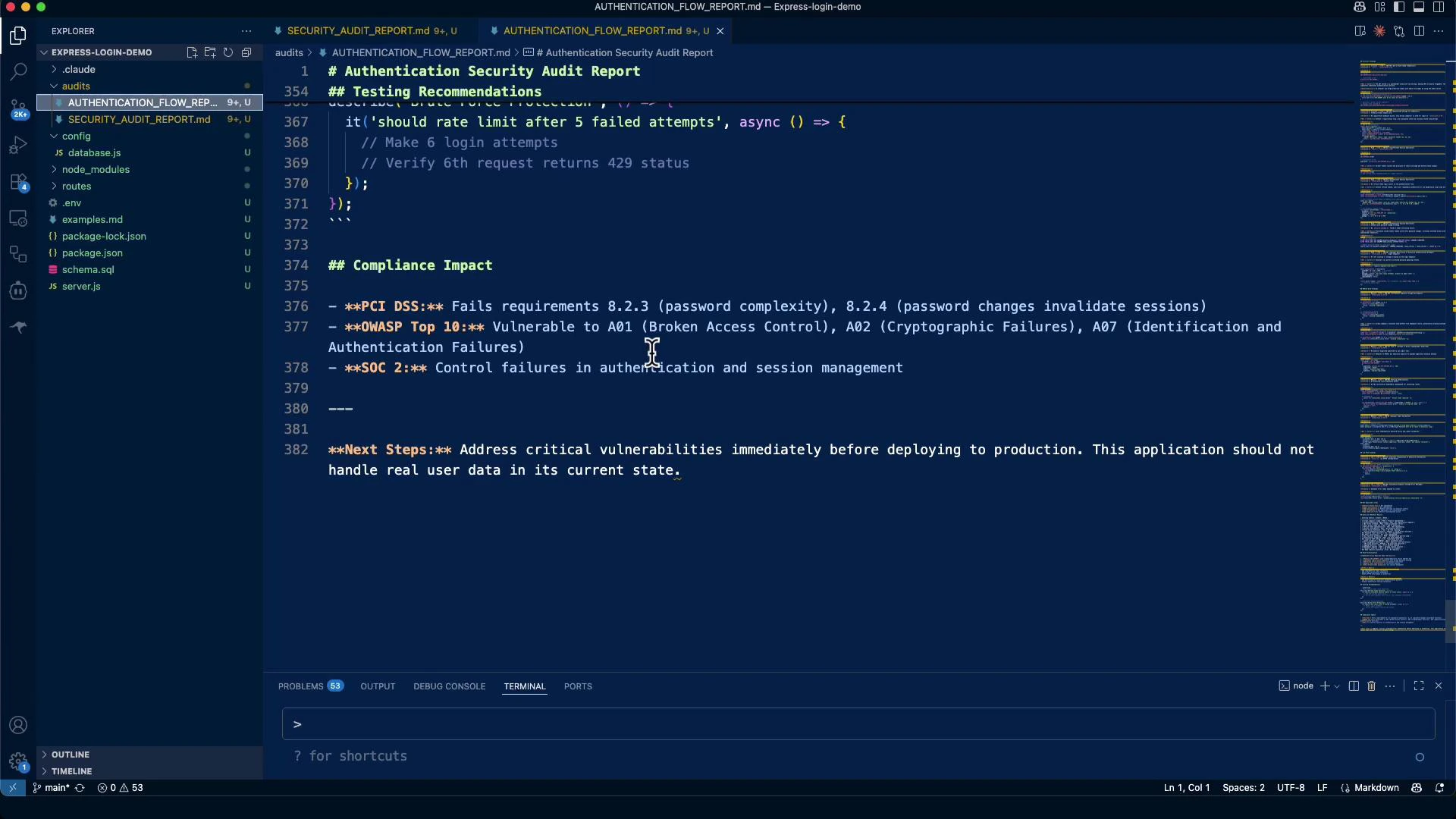
The audit output should be committed as a structured markdown report (example filename:audits/AUTHENTICATION_FLOW_REPORT.md) and include:
- Executive summary and risk score
- Critical & high severity findings with CWE references
- Evidence (file/line references where available)
- Minimal remediation snippets and suggested timelines:
- Immediate (48 hours): replace JWT secret with strong key; add bcrypt hashing on registration and updates; add brute-force protection; shorten access token TTL; add refresh-token rotation.
- Within 1 week: implement session invalidation on password change; comprehensive input validation; JWT middleware and claim verification.
- Within 1 month: logging redaction; monitoring/alerting for RT reuse; penetration testing and key rotation procedures.
- Tests to validate fixes (RT reuse, invalidation after password change, bruteforce detection).
- Checklist diff showing before/after and file-level changes.
Where to find prompts and next steps
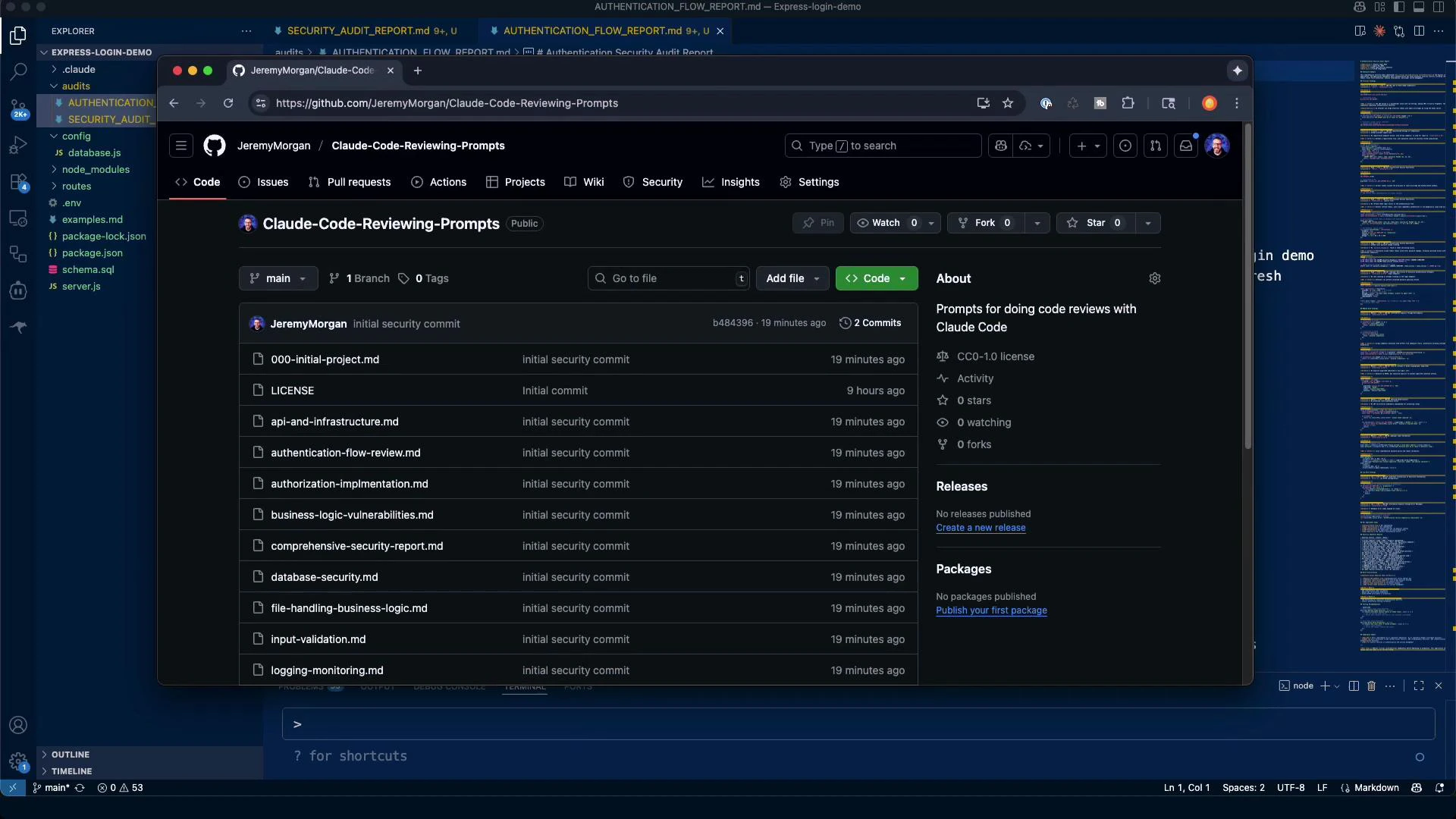
All prompts used for these reviews were kept in the repository for reuse and iteration. Recommended operational next steps:- Replace placeholder secrets with production-grade secrets (secrets manager or KMS).
- Implement the code fixes above and run the tests suggested.
- Add monitoring and alerting for refresh-token reuse and anomalous auth patterns.
- Schedule a secondary audit after fixes are merged and tests pass.
Final notes
- Not every check applies to every application. Mark items “Unable to Verify” where required context or files are missing.
- Prioritize concrete, minimal fixes that can be validated with tests and rolled out progressively.
- Preserve the practice of never exposing secrets or tokens in logs and enable key rotation and monitoring.