You did it β€” a complete, deep dive into LangGraph and the techniques for building robust agentic systems. This guide covered both core concepts and practical patterns you can apply immediately: graph structure and flow design, state and context management, human-in-the-loop integration, debugging with observability, and state persistence and replay. Below is a concise recap of the most important learning points to reinforce what you practiced. Key practical skills you now have:
  • Designing graph topologies that map to real-world workflows and agent responsibilities.
  • Managing state and context consistently to reduce hallucinations and drift.
  • Adding observability hooks to reproduce, debug, and branch executions.
  • Integrating humans into decision loops for safety and quality control.
  • Persisting runs and replaying flows to validate and evolve system behavior.
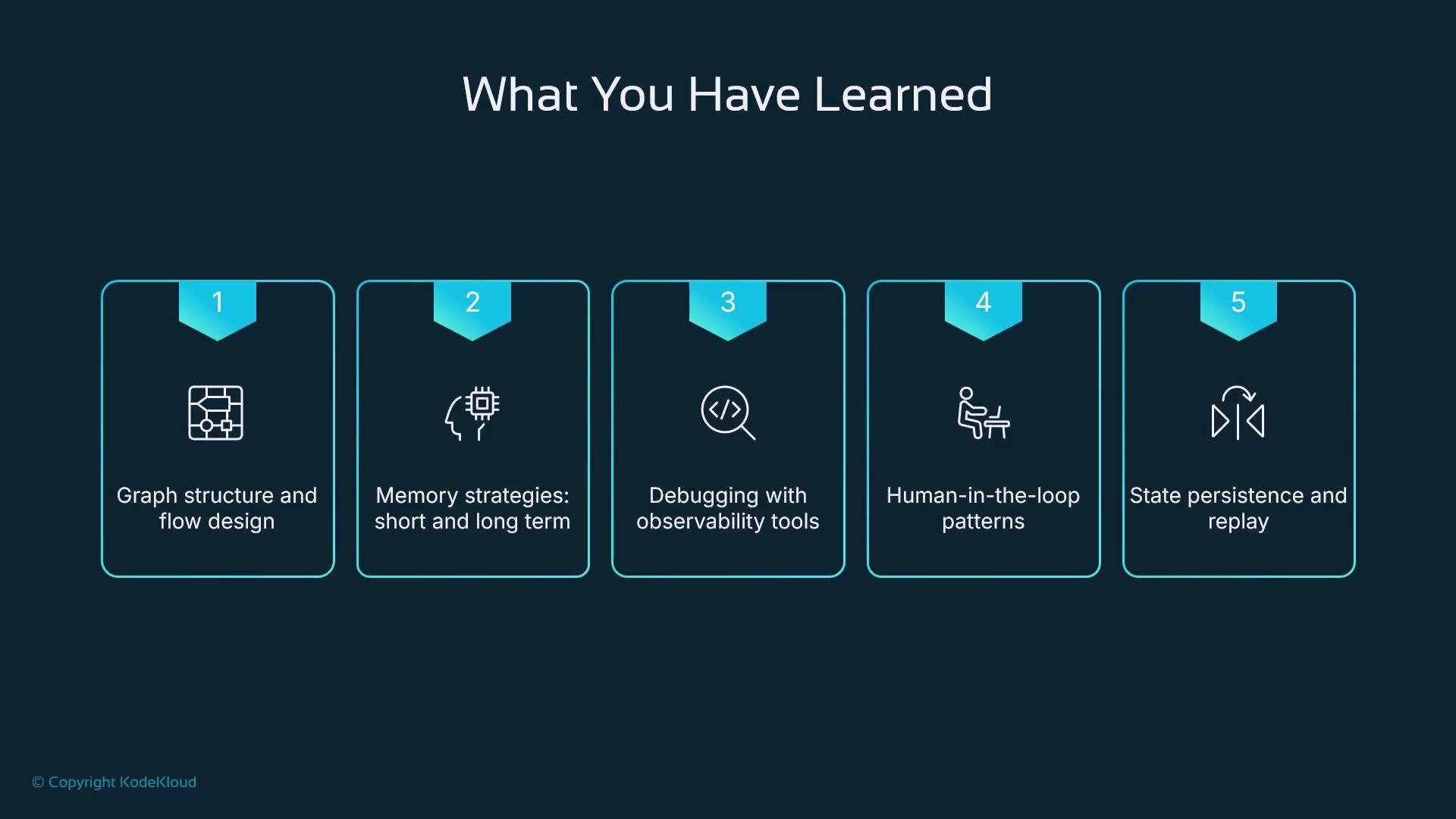
The image outlines five learning points: graph structure and flow design, memory strategies, debugging with observability tools, human-in-the-loop patterns, and state persistence and replay.
LangGraph is more than a library β€” it’s a growing ecosystem and a community shaping the future of agentic applications. Share what you build, contribute to open-source components, document your lessons, and participate in discussions. Collaboration accelerates improvement and helps surface better patterns for the whole community.
Share your work, open-source components, and lessons learned. Community feedback and collaboration accelerate progress for everyone.
The image shows a world map with multiple user icons placed across different continents, indicating a global community presence, alongside the text "You're Part of the LangGraph Community."
Next steps and resources
  • Continue experimenting with different graph patterns and instrument them for observability.
  • Open-source small reusable nodes or flows to accelerate collaboration.
  • Read and contribute to community discussions and repositories on GitHub, and explore complementary frameworks such as LangChain for integration ideas.
  • Useful reading and community hubs:
On behalf of the entire team, thank you. We hope you walk away with a refreshed way of thinking about software, agents, and intelligence. Stay curious, keep building, and we look forward to seeing what you create.

Watch Video