

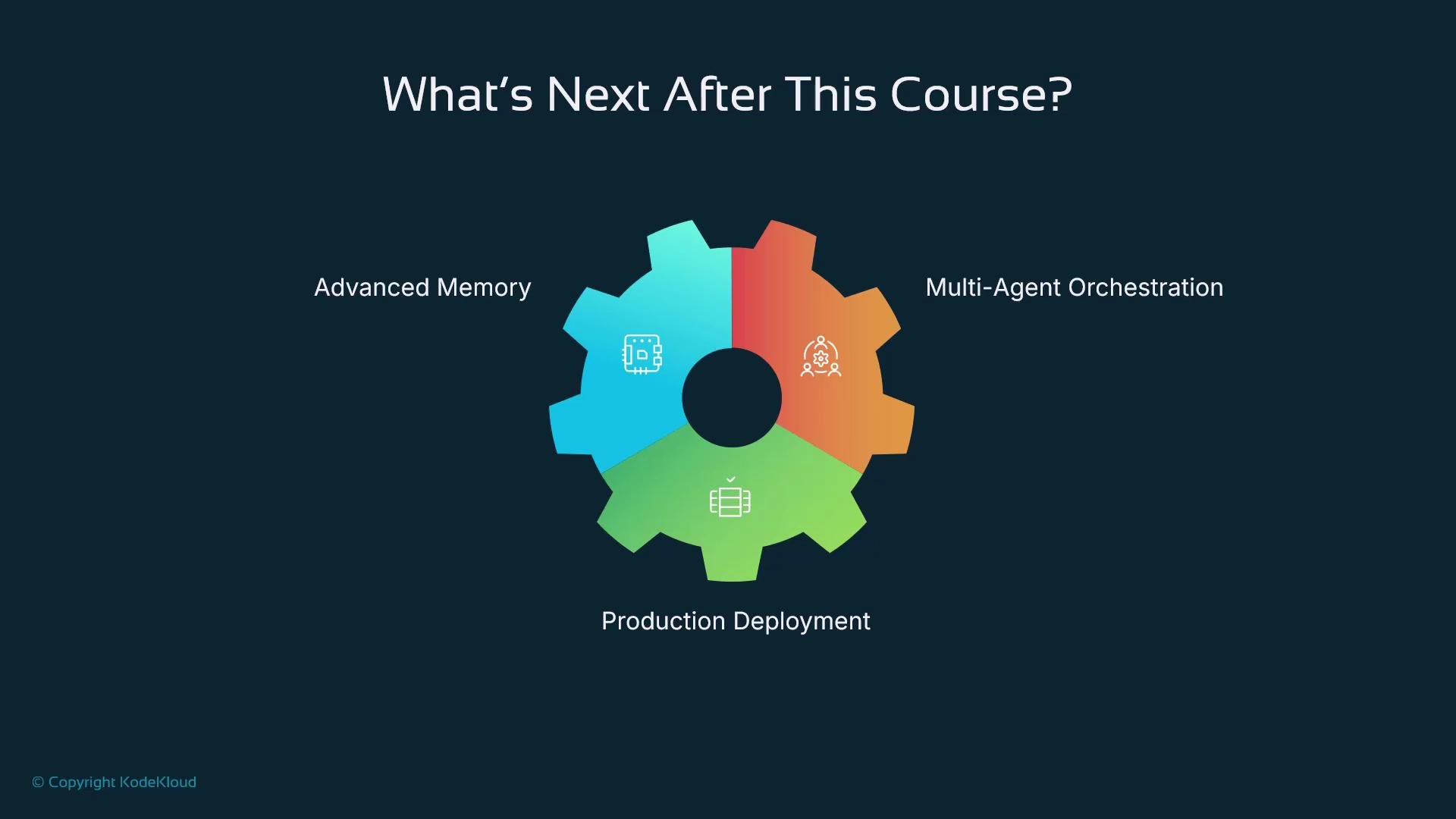
- Design multi-agent workflows where each agent has a clear role and edge logic, reducing tight coupling and improving maintainability.
- Implement long-term memory that persists across sessions, with reliable embedding storage and retrieval.
- Deploy LangGraph in production environments that require concurrency, observability, durability, and security.
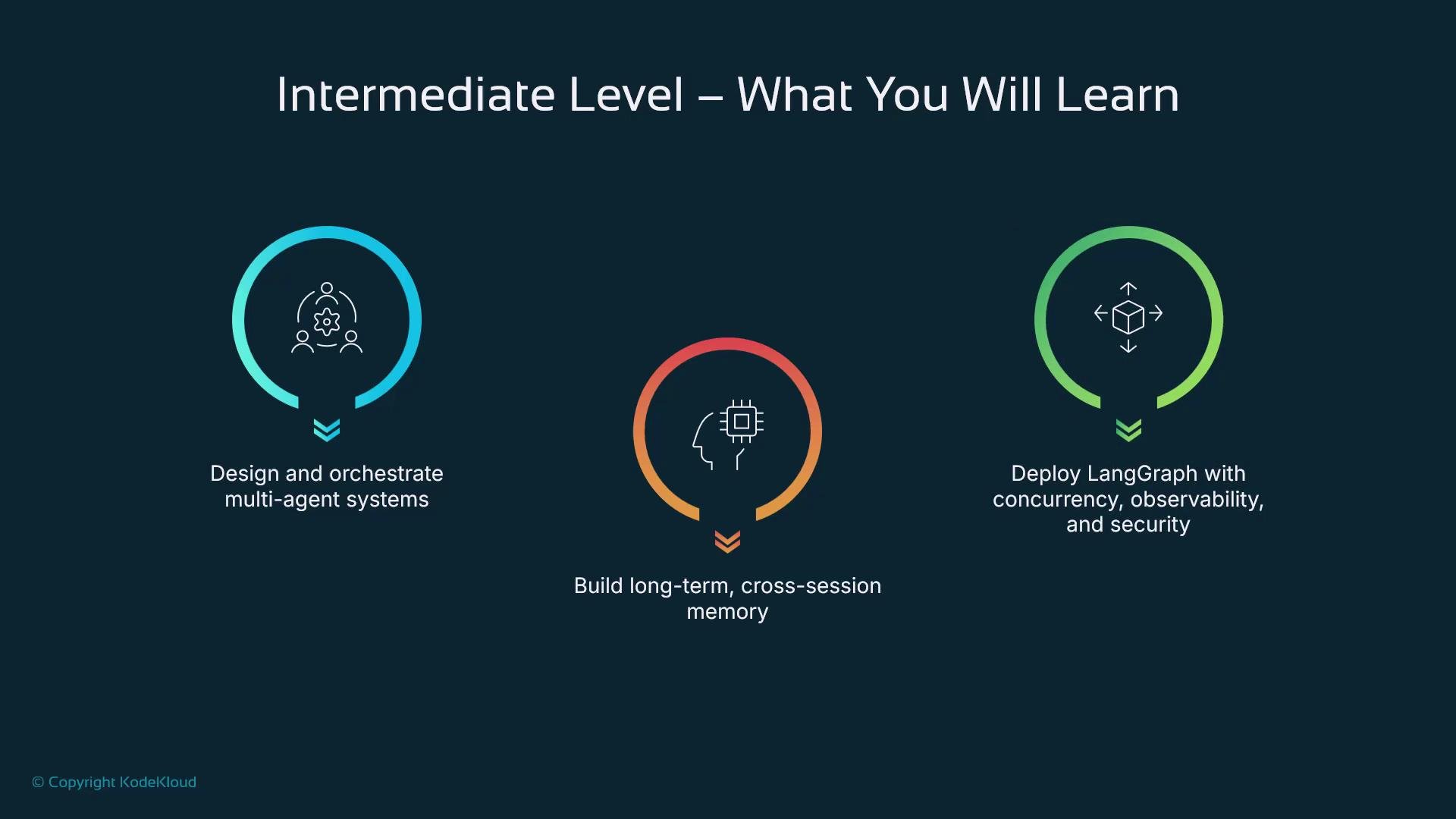
- Architecting multi-agent workflows with separation of concerns and explicit communication channels.
- Syncing memory across sessions and persisting embeddings with resilience to failures.
- Incorporating human-in-the-loop feedback in a way that improves models without creating operational bottlenecks.
- Persistence: store canonical data for recovery and audit.
- Time travel: snapshot and replay state transitions for debugging and compliance.
- Observability: add tracing, metrics, and logs to see agent decisions and state changes in real time.
- Safety: enforce access controls, rate limits, and human review gates where needed.
Prerequisites: familiarity with core LangGraph concepts — Paths, State Reducers, Context, Human-in-the-Loop, and Observability — will help you move faster. Basic Python experience and knowledge of LangChain APIs are helpful but not required; the course emphasizes architecture and production patterns.
- Revisit your existing LangGraph flows and identify single points of failure or tightly coupled components.
- Practice persisting embeddings and recovering state from durable storage.
- Add lightweight observability (tracing spans or structured logs) to at least one flow.
- Prototype a small human-in-the-loop checkpoint for validation or safety review.
- The intermediate path pushes you to think like a systems architect: design for scale, resiliency, and safety.
- Focus on clear role boundaries for agents, reliable memory layers, and production-ready observability to move confidently from prototype to deployed application.
- LangChain Documentation
- Consider resources on distributed systems and observability (tracing, metrics) to complement the course material.