State accumulation is how LangGraph (and similar graph-based systems) remembers what happened during execution. The shared graph state acts as an incremental memory: each node can read from it, modify it, and pass the enriched state forward. Without accumulation, a graph is essentially stateless and cannot reason about prior events or maintain coherent multi-step behavior.
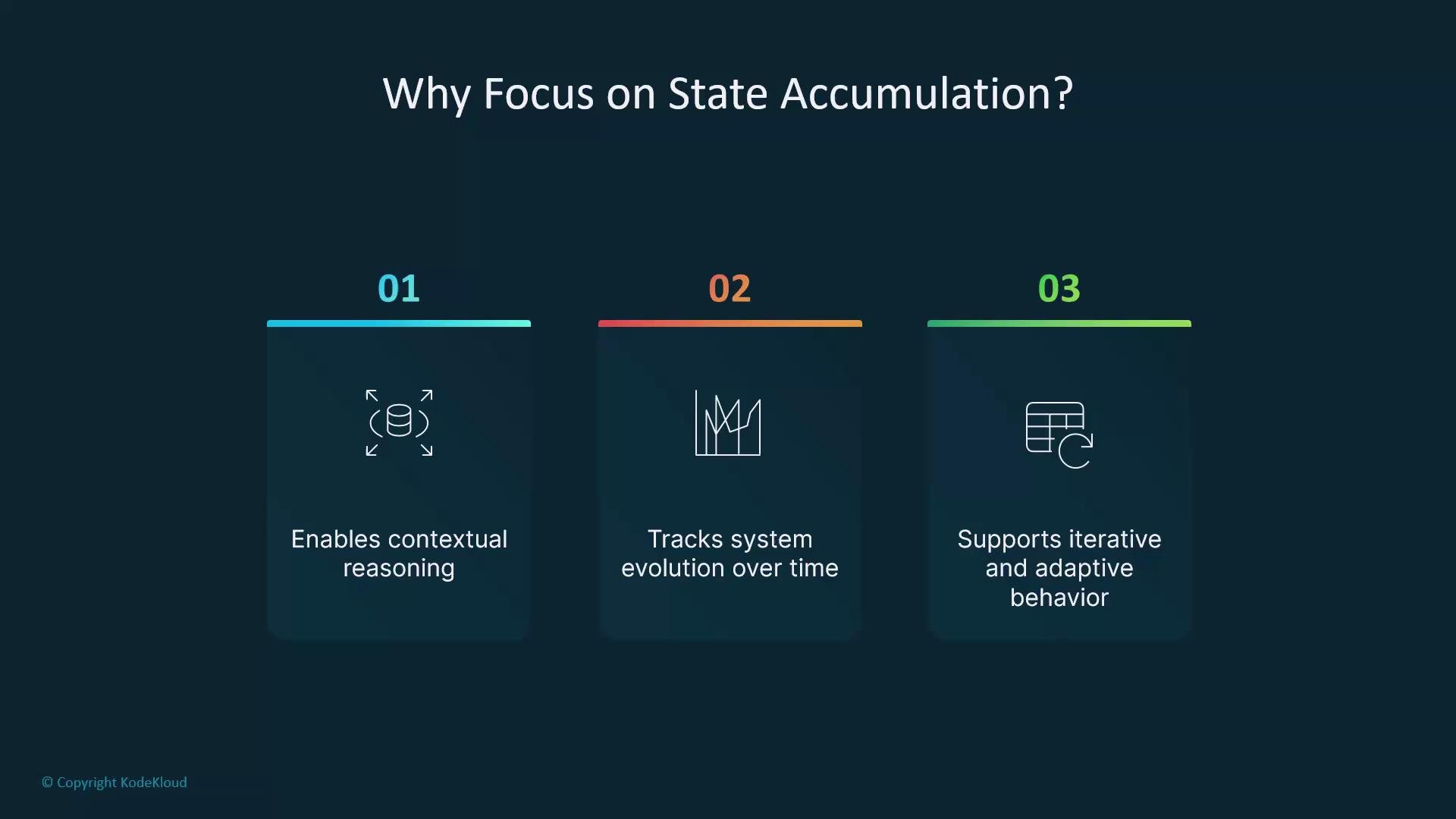
The image presents three reasons to focus on state accumulation: enabling contextual reasoning, tracking system evolution over time, and supporting iterative and adaptive behavior.
Why state accumulation matters
  • Enables contextual reasoning across multiple nodes and turns.
  • Tracks the system’s evolution over time, useful for audits and debugging.
  • Supports iterative and adaptive behavior (e.g., agents refining their plan or tools over multiple passes).
How accumulation works (conceptual)
  • The graph state is a dictionary/object shared between nodes.
  • Each node may add new fields or update existing ones.
  • Over time the state becomes a record of inputs, intermediate decisions, tool invocations, and final output.
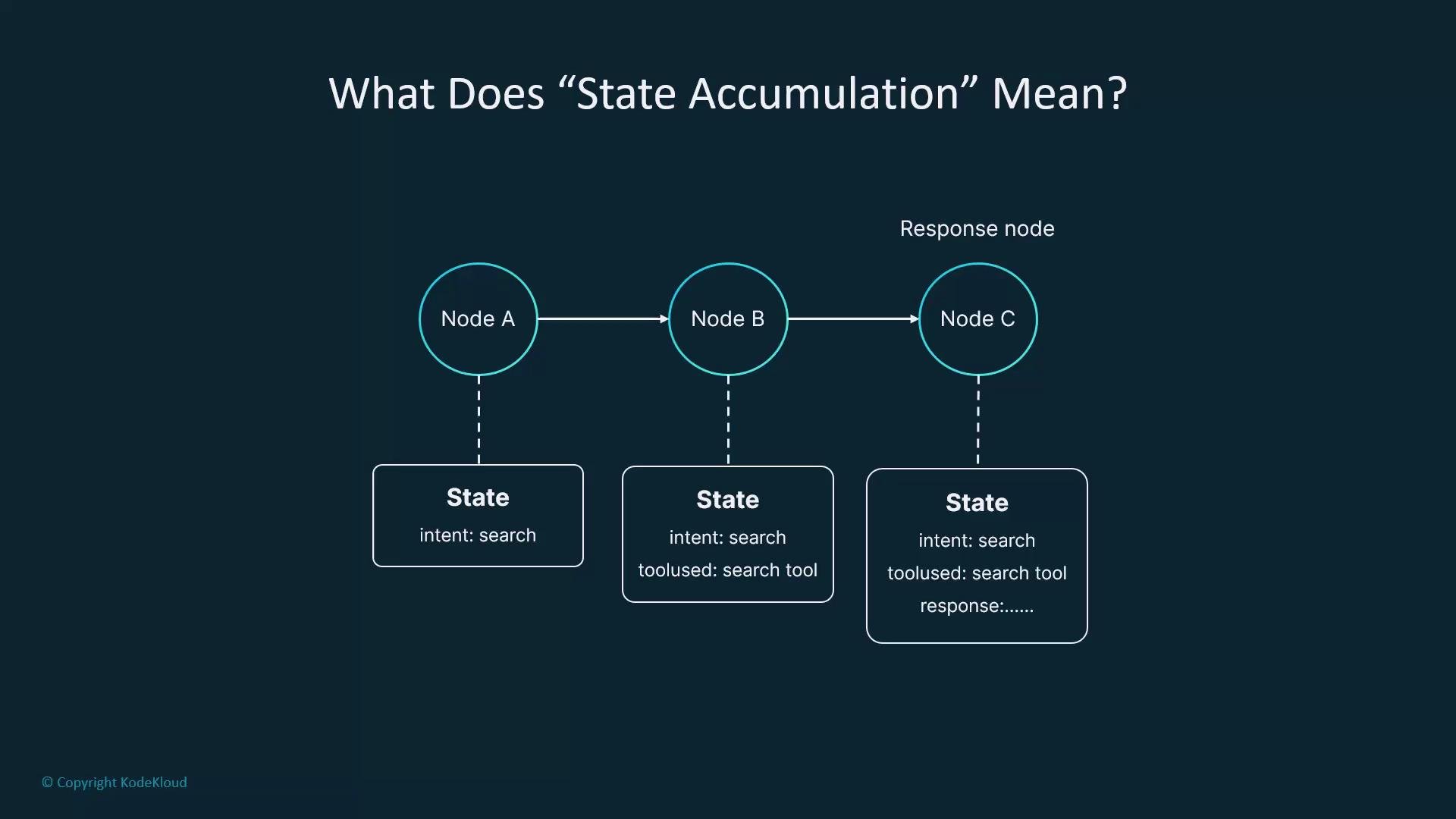
Example: a simple state evolution
The image illustrates a concept of "State Accumulation" using a flowchart with nodes A, B, and C, each accumulating more state information as they progress. It shows the evolution of intent and tools used at each node.
Analogy: delivery journal Think of the state as a delivery journal. At every stop the courier adds notes—what was delivered, which tool was used, or a customer request—and the journal becomes richer over the route. The graph state similarly accumulates actionable context that later nodes can consult. State accumulation in chatbots and agents
  • Follow-up questions only make sense when prior messages are preserved.
  • Tools (search, calculators, external APIs) produce outputs that should be appended to the state so later nodes can reason with them.
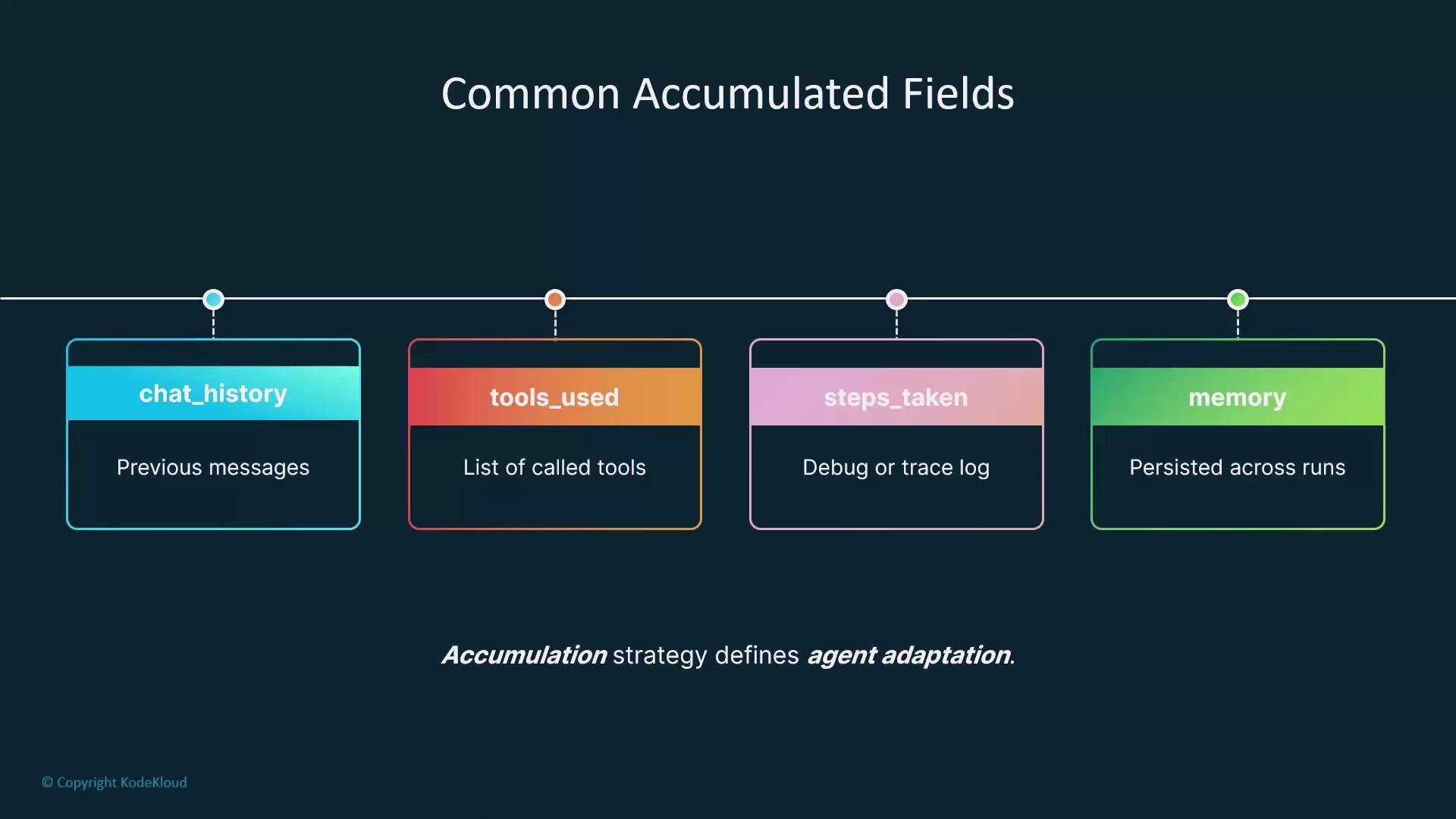
  • Execution traces (steps_taken) help debugging, audit, and reproducibility.
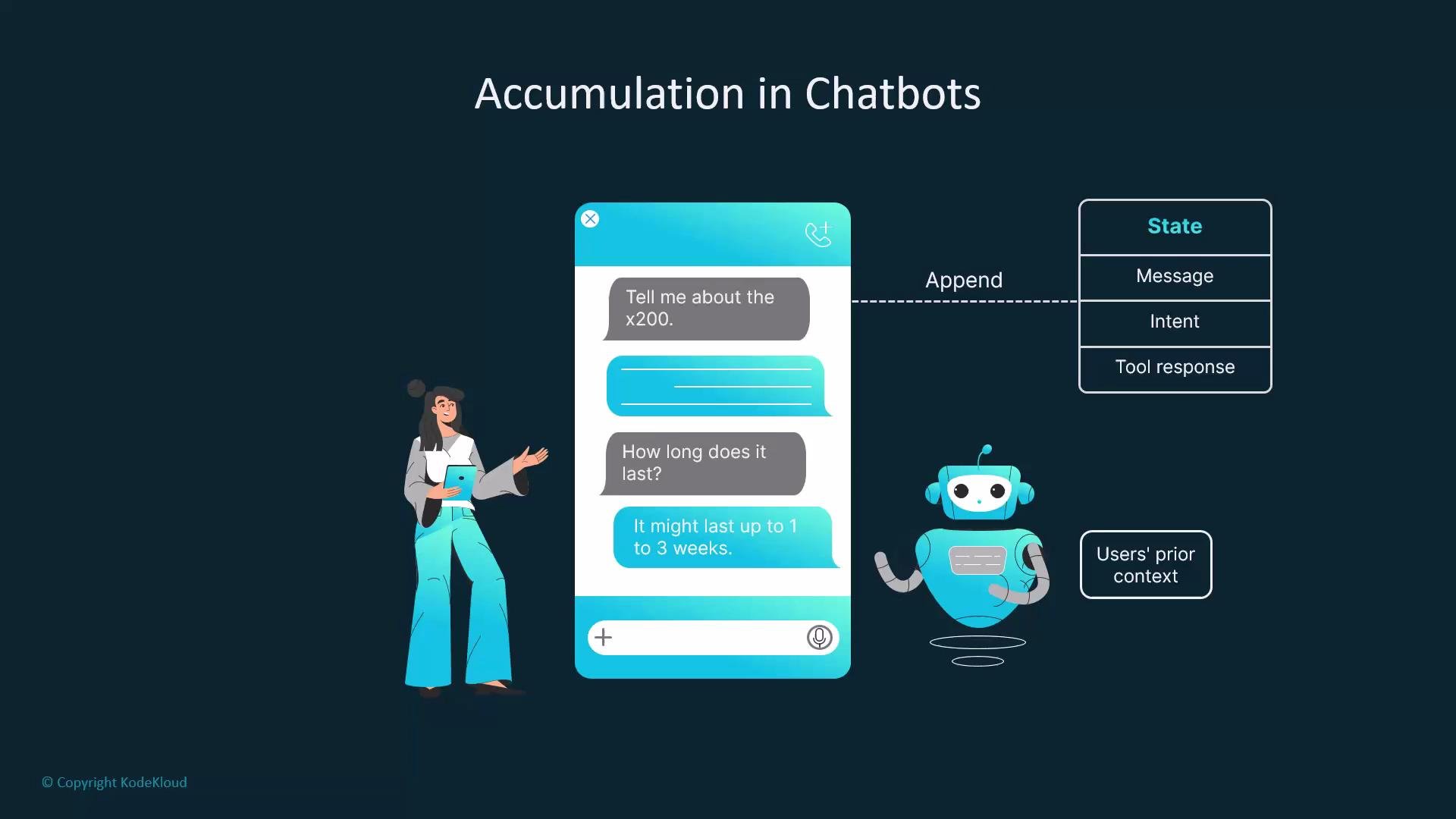
The image illustrates "Accumulation in Chatbots" with a woman holding a tablet, a chatbot discussing how long a product lasts in a chat interface, and a diagram describing the chatbot's state and user context handling.
Common accumulation patterns
The image illustrates four common accumulated fields: chat_history, tools_used, steps_taken, and memory, each with short descriptions. The text emphasizes that accumulation strategy defines agent adaptation.
Trade-offs and mitigation Accumulating everything without control can bloat the state, increase memory use, and slow processing. Common mitigation strategies:
  • Cap chat history length (e.g., keep the last N turns).
  • Expire or summarize older tool logs.
  • Prune or compress steps_taken entries for long-running flows.
  • Persist only what helps behavior or auditing; drop or archive the rest.
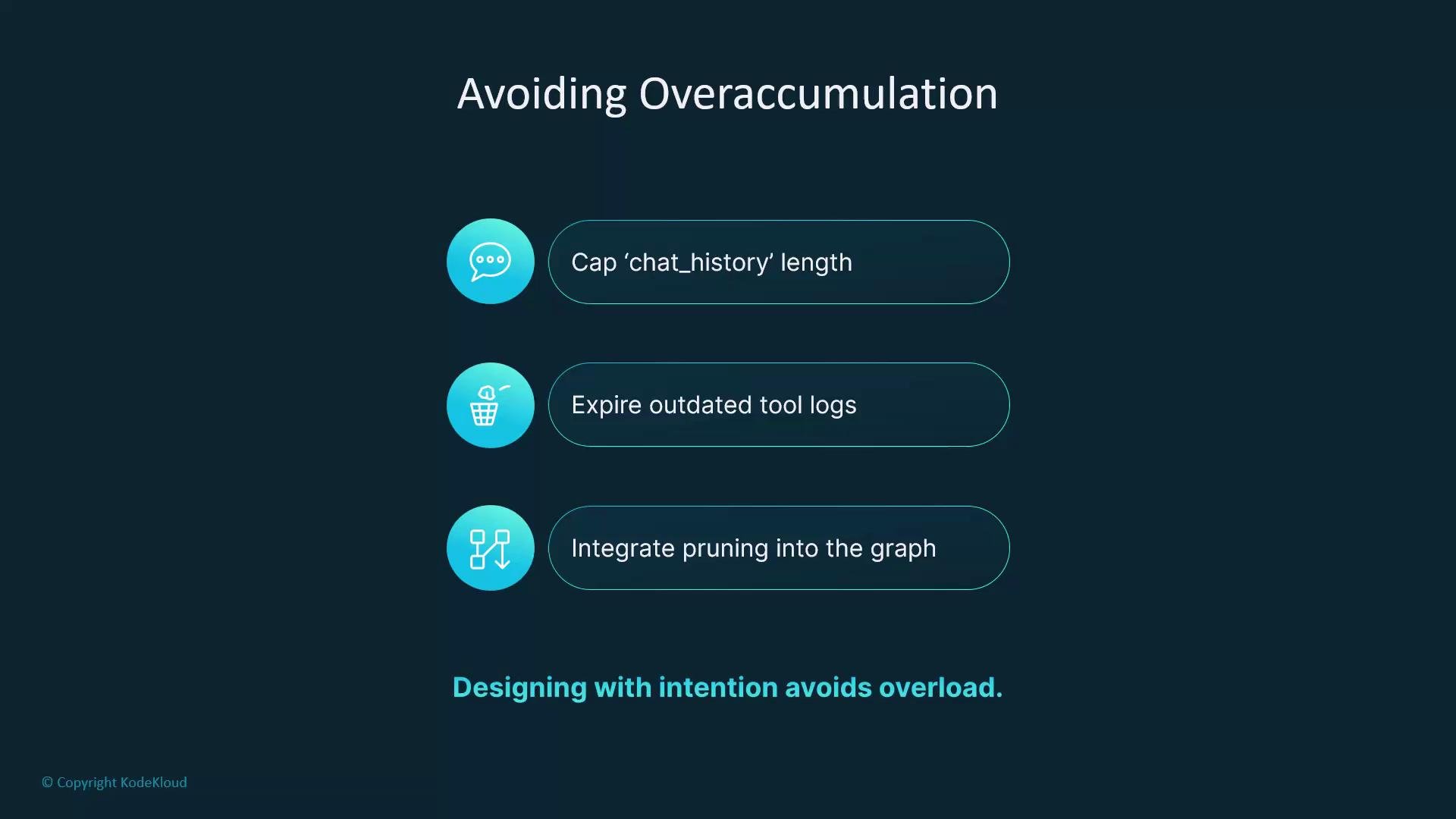
The image lists strategies for avoiding overaccumulation, such as capping chat history length, expiring outdated tool logs, and integrating pruning into graphs, with the reminder that intentional design prevents overload.
Decide what to persist based on the agent’s goals. Keep only the state that improves behavior or is required for auditing; summarize or drop the rest to maintain performance.
Further reading and references
  • State (computer science): https://en.wikipedia.org/wiki/State_(computer_science)
  • For practical designs, search for “conversational memory patterns”, “agent tool logging”, and “execution tracing best practices” to find implementation examples and community patterns.

Watch Video