

This lesson is beginner-friendly: you don’t need prior graph theory or advanced AI knowledge. We’ll use practical analogies and hands-on examples to build intuition.
- Maintain and inspect state across runs
- Support conditional branching and decision logic
- Implement short- and long-term memory strategies
- Orchestrate human-in-the-loop handoffs and interruptions
- Provide instrumentation for debugging and observability
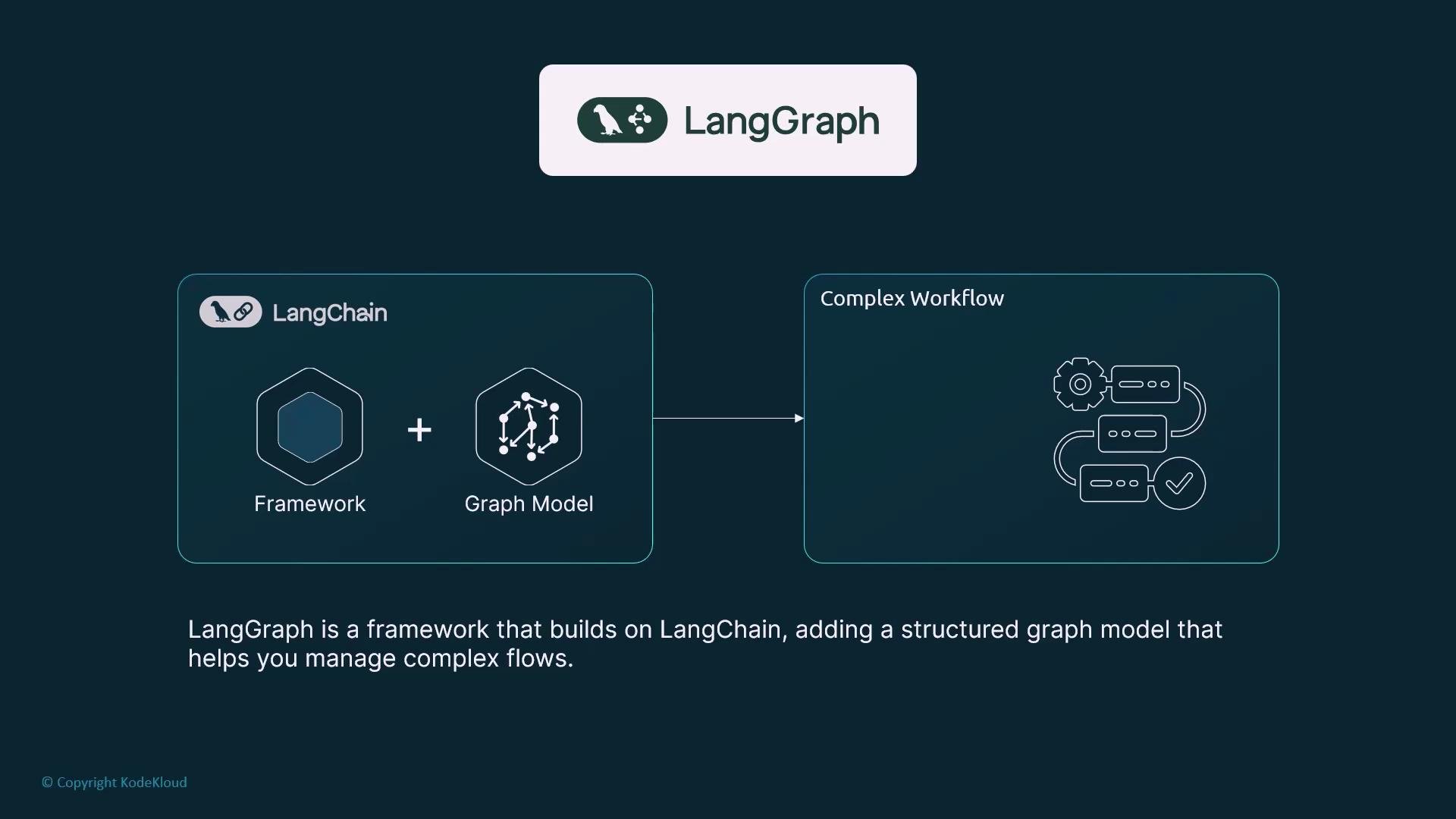
- Understand graph primitives (nodes, edges, execution semantics) and compose them into end-to-end workflows.
- Implement conditional paths and branching logic for robust decision-making.
- Manage transient and persistent state across graph runs.
- Apply short-term (contextual) and long-term memory strategies using datastores and retrieval mechanisms.
- Design human-in-the-loop patterns like approvals, handoffs, and interruptions.
- Instrument graphs for observability, traceability, and reliable debugging.
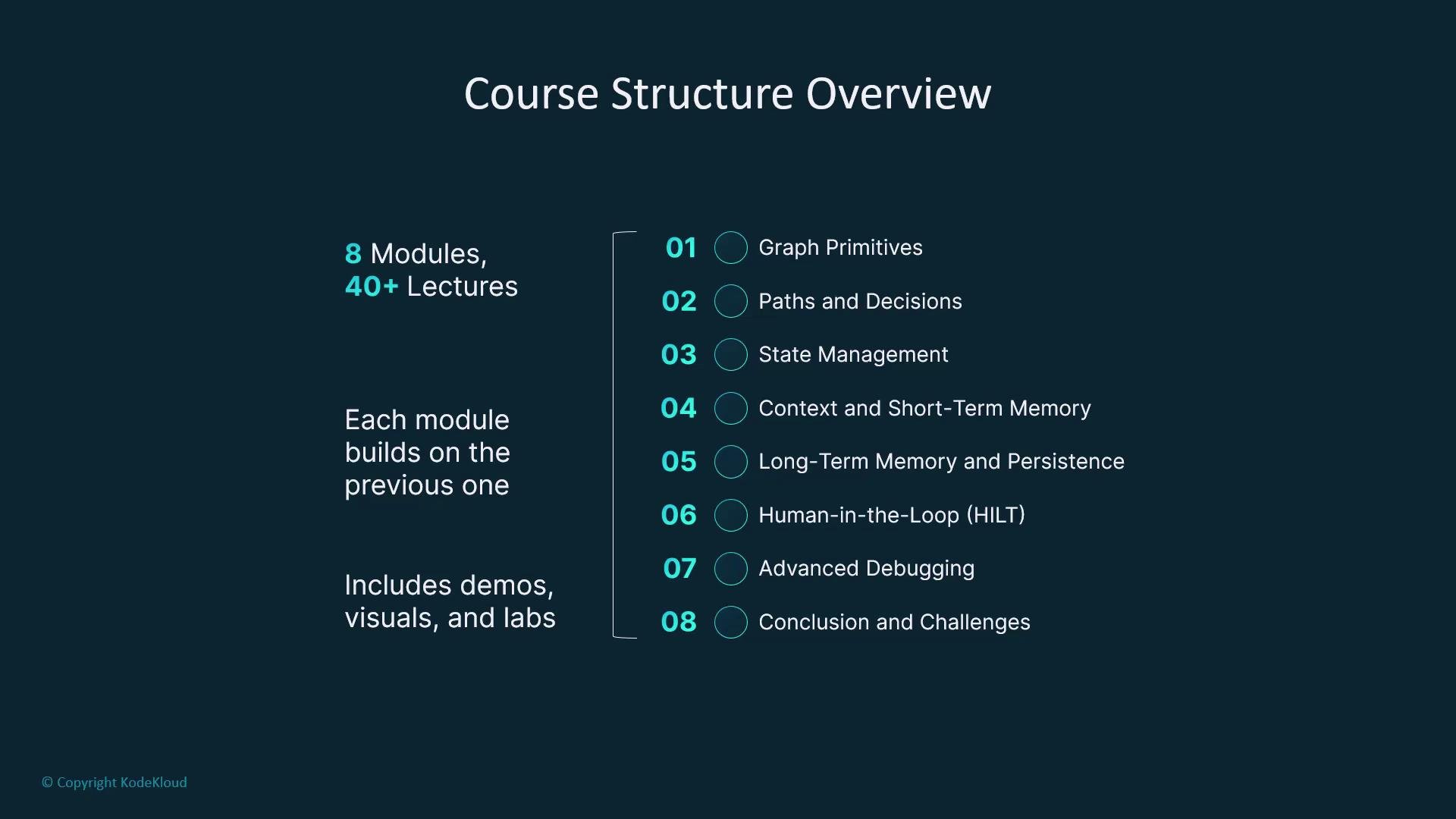
- Module 1 — Graph primitives (nodes, edges, execution semantics)
- Module 2 — Paths and decisions (conditional routing, branching)
- Module 3 — State management (local and runtime state)
- Module 4 — Context and short-term memory (session-level memory)
- Module 5 — Long-term memory and persistence (datastores, retrieval)
- Module 6 — Human-in-the-loop patterns (interruptions, approvals, handoffs)
- Module 7 — Advanced debugging and observability (tracing, logging, replay)
- Module 8 — Wrap-up, self-challenges, and next steps (projects and further learning)
- Beginners to LangGraph or LangChain who want a structured introduction.
- Developers familiar with prompts and chains who want to move to modular, conditional, and persistent agentic systems.
- Practitioners who need practical patterns for memory, control, and human-in-the-loop interactions.
- Follow modules sequentially — each lesson builds on previous concepts.
- Reproduce demos locally and experiment with node/edge variations.
- Use the labs to apply patterns to domain problems (e.g., planning, customer support, scheduling).
- Instrument and replay flows to learn debugging and observability techniques.
- LangChain (course) — Related foundational material.
- Official LangChain docs — refer to LangChain’s documentation for integrations and models.