

High Availability Models in SQL Database
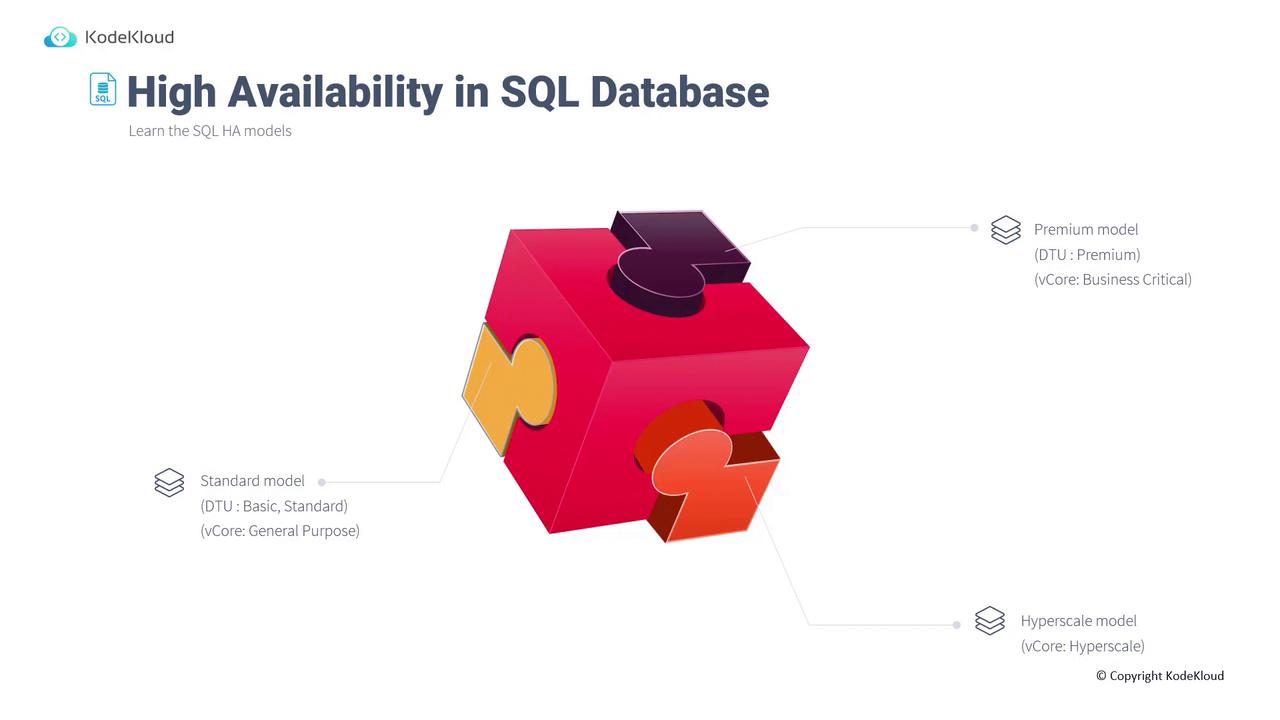
SQL Database provides three tiers of availability based on the selected performance model:- Standard Availability Model: Activated when you select the basic/standard tier (DTU model) or the general-purpose option from the vCore model.
- Premium Availability Model: Utilized when opting for the premium tier in the DTU model or the business-critical tier in the vCore model.
- Hyperscale Model: Chosen when using the hyperscale tier.
Standard Availability Model
In the Standard Model, the compute and storage layers are decoupled:- Compute Layer: Hosts the SQL Server executable along with TempDB and cache data.
- Storage Layer: Houses the database files on Azure Premium Storage, leveraging replication options like GRS, LRS, or ZRS to maintain backup redundancy.
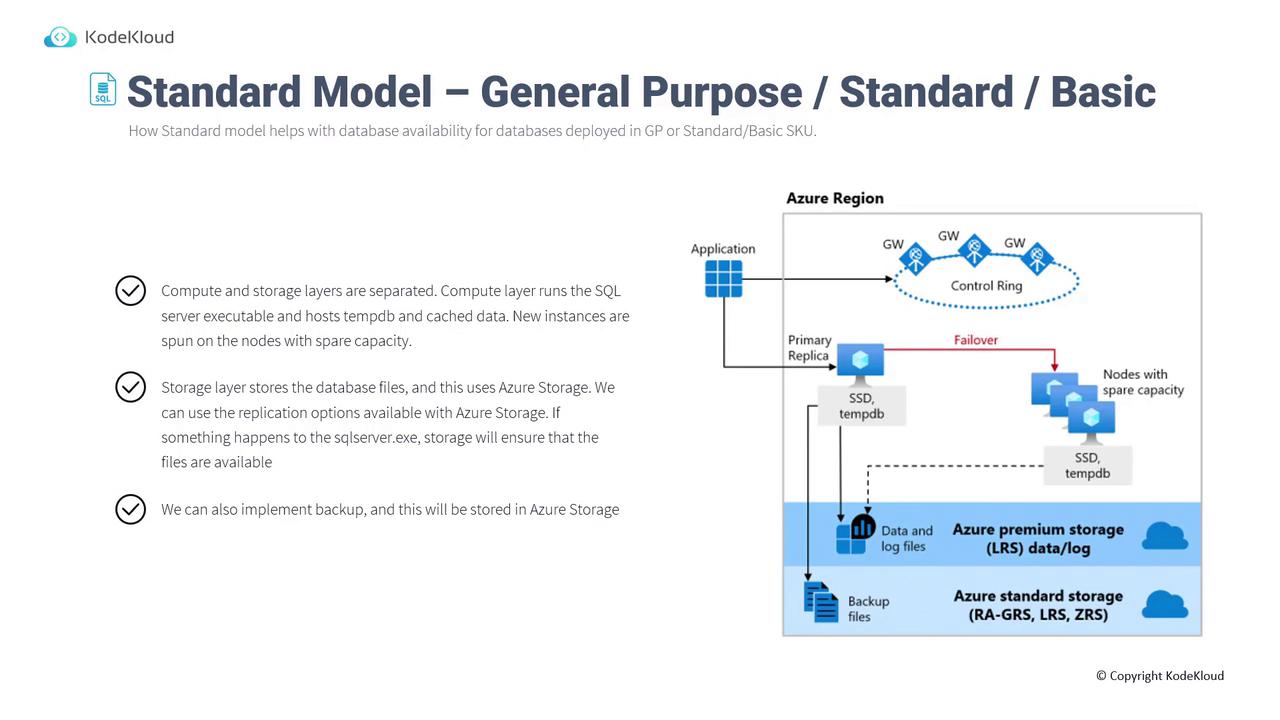
- The architecture shows a primary replica with secondary replicas across different nodes.
- The compute layer is dedicated to running SQL Server.exe, whereas the storage layer secures database files.
- Azure Storage is employed for backup operations, ensuring redundancy in case of compute layer issues.
Premium Availability Model
The Premium Model integrates both compute and storage within a single node. Key characteristics include:- Integrated Architecture: SQL Server executable and directly attached SSD storage co-exist on the same server.
- Multi-Node Cluster: Typically deployed in clusters of three or four nodes for high availability.
- Designed for OLTP Applications: Ensures high transaction rates and ultra-low I/O latency.
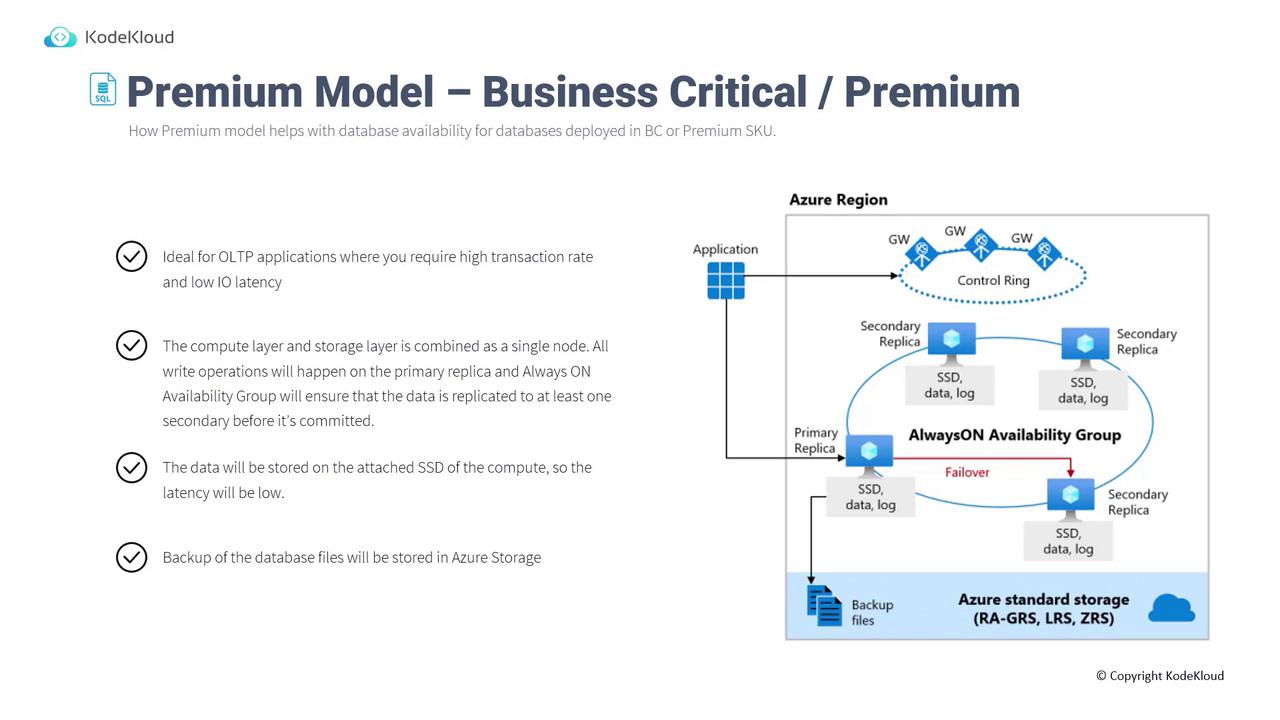
- Primary replica leverages directly attached SSD storage to minimize latency.
- All write operations occur on the primary replica. An Always On Availability Group ensures data is replicated to secondary nodes before commit.
- Backup processes continue to use Azure Storage.
- Managed entirely by Microsoft when deploying a business-critical or premium tier.
Hyperscale Model
The Hyperscale Model is designed for complex and high business-critical workloads. Its multi-layered approach includes:- Stateless Compute Layer: Runs SQL Server.exe, manages transient data, cache, and operates in a primary/secondary configuration.
- Stateless Storage Layer: A distributed storage engine, featuring page servers that cache transient and processed data.
- Stateful Transaction Log Layer: Captures all transactions from the primary compute and replicates log and cache data to secondary compute nodes.
- Stateful Storage Layer: Preserves the definitive database files, ensuring data integrity even if compute nodes encounter failures.
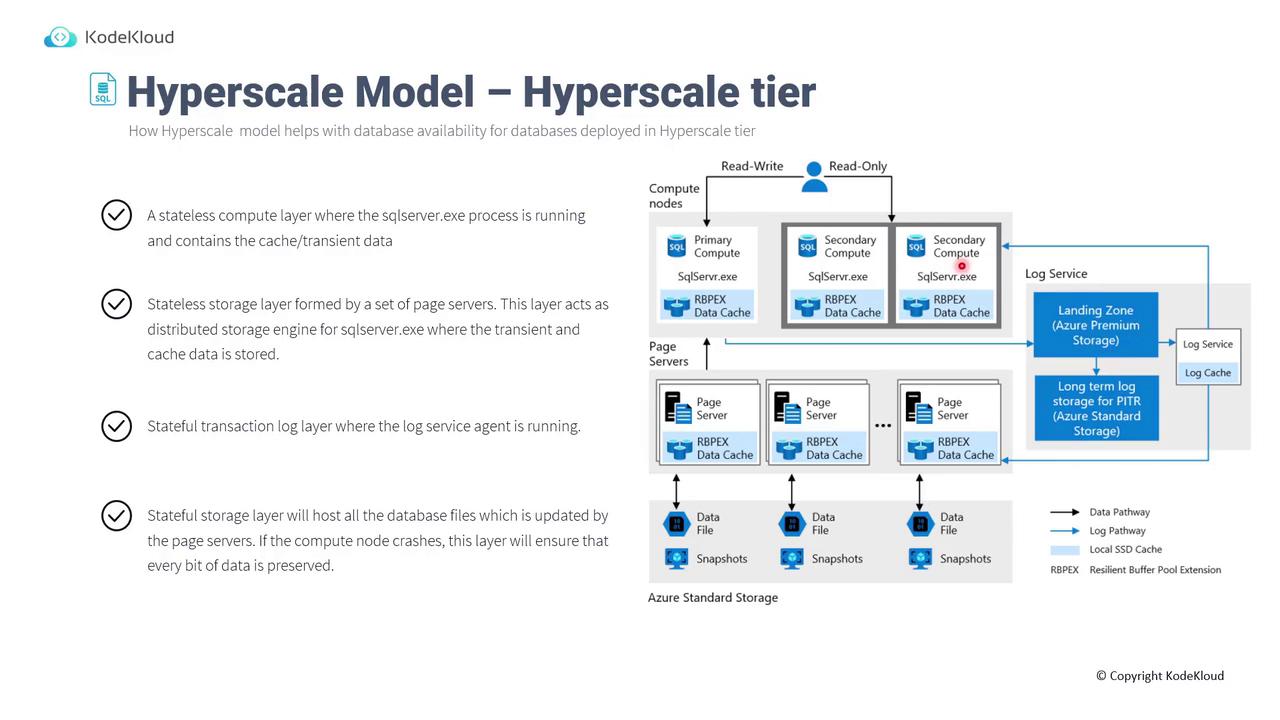
- The compute layer directly handles read/write operations along with running the SQL Server process.
- Page servers (stateless storage) manage transient and cached data.
- A dedicated log service layer ensures all transactions and cache data are replicated.
- This model is ideal for workloads that demand extremely low latency and high data integrity.
Failover Strategies
While these models are generally deployed within a single data center, additional strategies are essential to mitigate complete data center or regional failures:- Availability Zones: Within the premium tier, distributing compute nodes across multiple availability zones protects against data center-level failures. If one zone fails, the remaining zones ensure continuous operation.
- Geo-Replication: For regional failures, geo-replication involves duplicating the SQL Database to a secondary logical server in a different region. The primary server handles read/write operations while redirecting read-only requests to the secondary. In the event of a primary region failure, the secondary region assumes full operations.
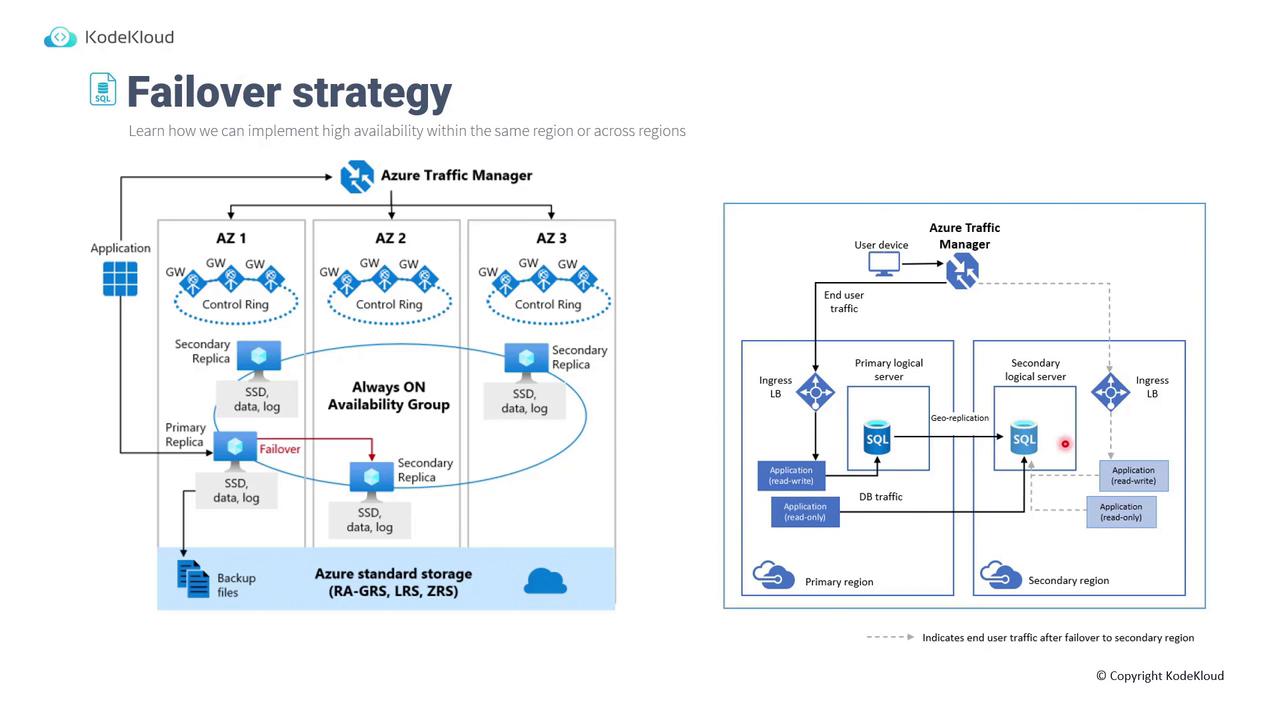
- Availability Zones: Ensure continuity within the same region.
- Geo-Replication: Provides robust protection across different regions with automatic failover capabilities.
Summary
To summarize, SQL Database availability can be achieved through different architectural models tailored for specific business needs:
This concludes our discussion on SQL Database availability models. In the next section, we will explore advanced data security strategies to further safeguard your SQL Database deployments.
For more detailed technical guidance, refer to the Microsoft Azure Documentation and SQL Database best practices.