

When to Use a Message
Messages are ideal when your distributed application requires guaranteed, specific processing of the communication. Consider the following scenario: Imagine a user uploads a new picture to your photo-sharing application. The mobile app sends the picture data to a web API hosted in Azure. The web API is expected to store this picture in a database for later access by other users. In this case, messaging is essential. The mobile app sends a message containing the picture data to the web API, which then processes and stores the picture in the database. This ensures the picture data is handled correctly with a clear guarantee on its processing.When to Use an Event
On the other hand, events provide a lightweight communication mechanism, ideal for broadcast purposes. In an event-driven architecture, a publisher sends events that subscribers can receive. If no subscriber is active, the event may simply be dropped without further processing. A helpful analogy is subscribing to marketing emails. When you subscribe, you expect to receive notifications whenever new content is available. However, if no subscribers are present at the time of the event, no email is sent. Although the analogy is not a perfect match, it illustrates that events are broadcast to all potential receivers without ensuring that each event is processed.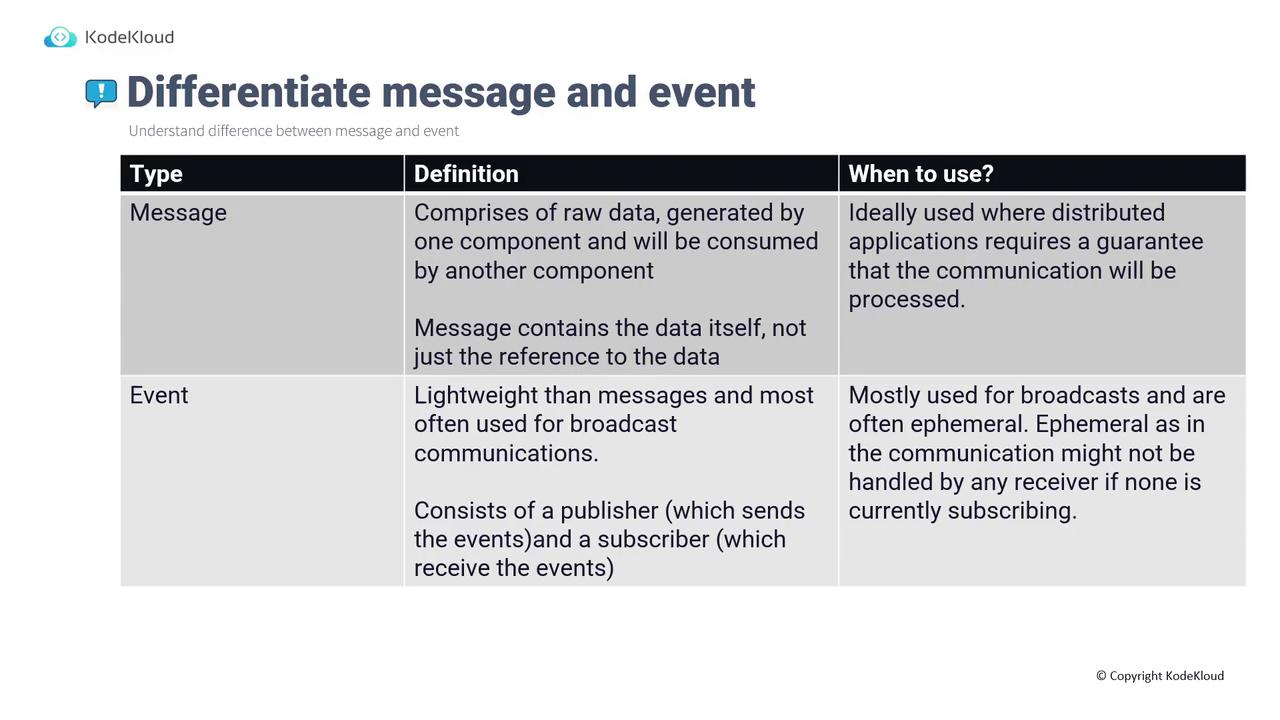
Deciding Between Message and Event
A straightforward question can help you choose the correct communication approach:- Does the sender expect the communication to be processed in a guaranteed manner by the receiver?
- If yes, use a message.
- If no, an event is more suitable as it broadcasts information without enforcing specific processing behavior.
For systems requiring strict reliability and order in processing, messages are the preferred choice over events.
Designing a Messaging Solution
When designing a messaging solution, it is crucial to assess the specific requirements of your application components. Consider whether your use case calls for guaranteed data processing or a lightweight, broadcast mechanism. By clearly defining these requirements, you can select the solution that best fits your architectural needs.Ensure you meticulously evaluate your system’s needs before deciding on a messaging strategy. Choosing the wrong model can affect both performance and data integrity.