

- Model size and inference speed
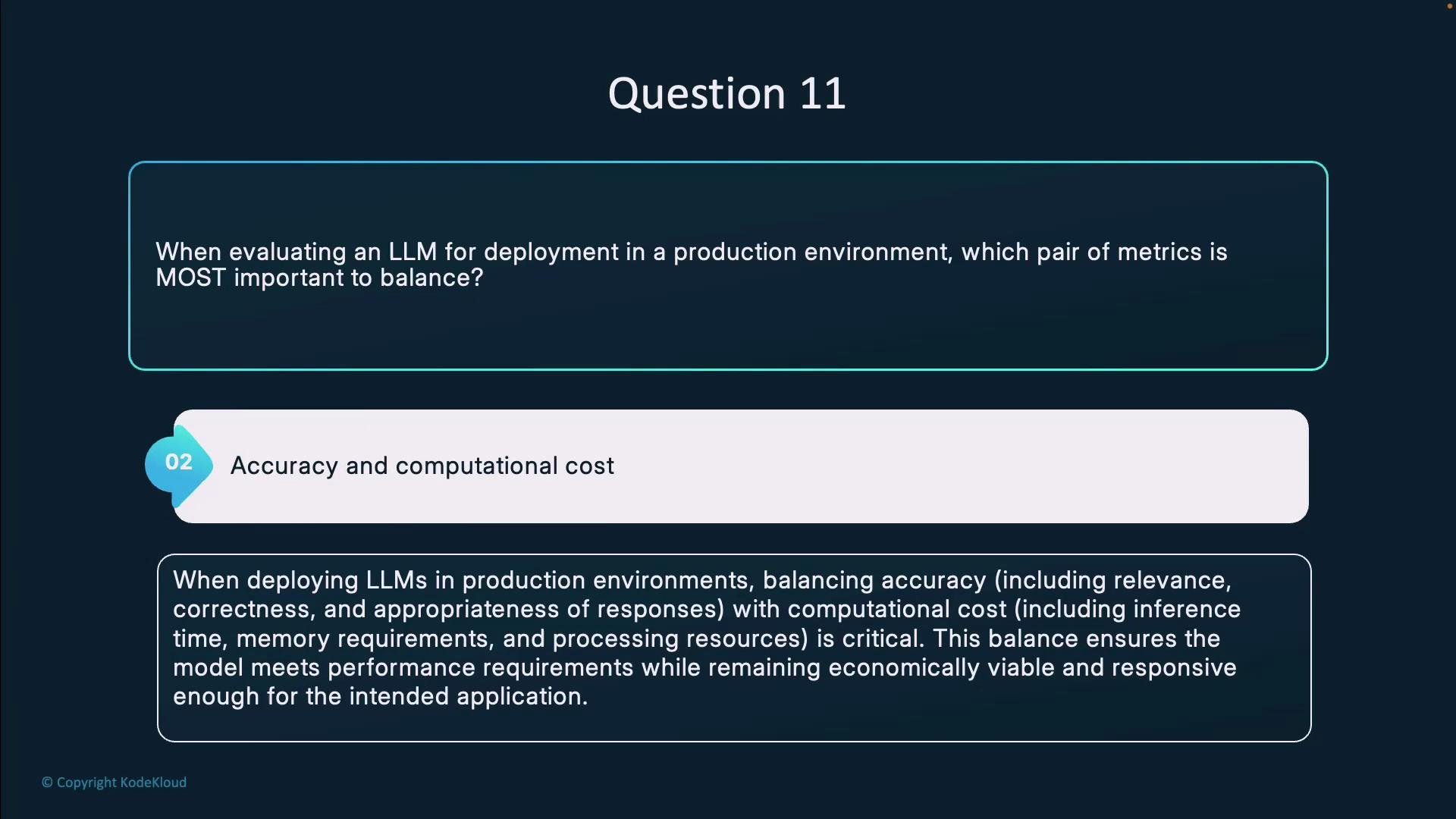
- Accuracy and computational cost
- Training time and memory usage
- Vocabulary size and context length
When deploying LLMs, weigh the quality of responses (relevance, correctness, and appropriateness) against the computational resources required (inference latency, memory footprint, and processing costs). This trade-off determines whether the model meets performance targets while remaining economically viable.
- Accuracy: The model’s ability to generate relevant, correct, and context-appropriate outputs for the target use case. This includes factuality, fluency, and adherence to safety or policy constraints.
- Computational cost: The resources required to run the model in production — primarily inference latency, memory footprint (RAM/VRAM), and CPU/GPU utilization that drive infrastructure and operational costs.
- A very accurate model that requires excessive compute may be impractical for interactive or cost-sensitive applications.
- A low-cost model that performs poorly in quality can damage user trust, reduce conversion, and harm downstream tasks.
How to balance accuracy vs computational cost (deployment checklist)
- Benchmark candidate models on realistic workloads: measure latency, memory, and throughput with representative prompts and batch sizes.
- Set quantitative SLAs and quality targets (e.g., 95th percentile latency < 200 ms, human eval >= X).
- Optimize models as needed:
- Quantization (e.g., int8) to reduce memory and improve speed.
- Pruning and structured sparsity to lower compute without large accuracy loss.
- Knowledge distillation to create smaller models that retain quality.
- Offloading and model partitioning for long-context scenarios.
- Use caching, prompt engineering, and retrieval augmentation to reduce expensive generation while preserving quality.
- Perform A/B tests with real users to validate trade-offs in production.
- NVIDIA Model Optimization (GPU-focused optimizations and inference runtimes)
- Hugging Face — Model Distillation & Quantization
- ONNX Runtime Performance Tuning