

- Using the same model with different prompting techniques?
- Comparing against human performance on the same task?
- Comparing against state-of-the-art published results for the task?
- Or comparing against a random baseline of possible answers?
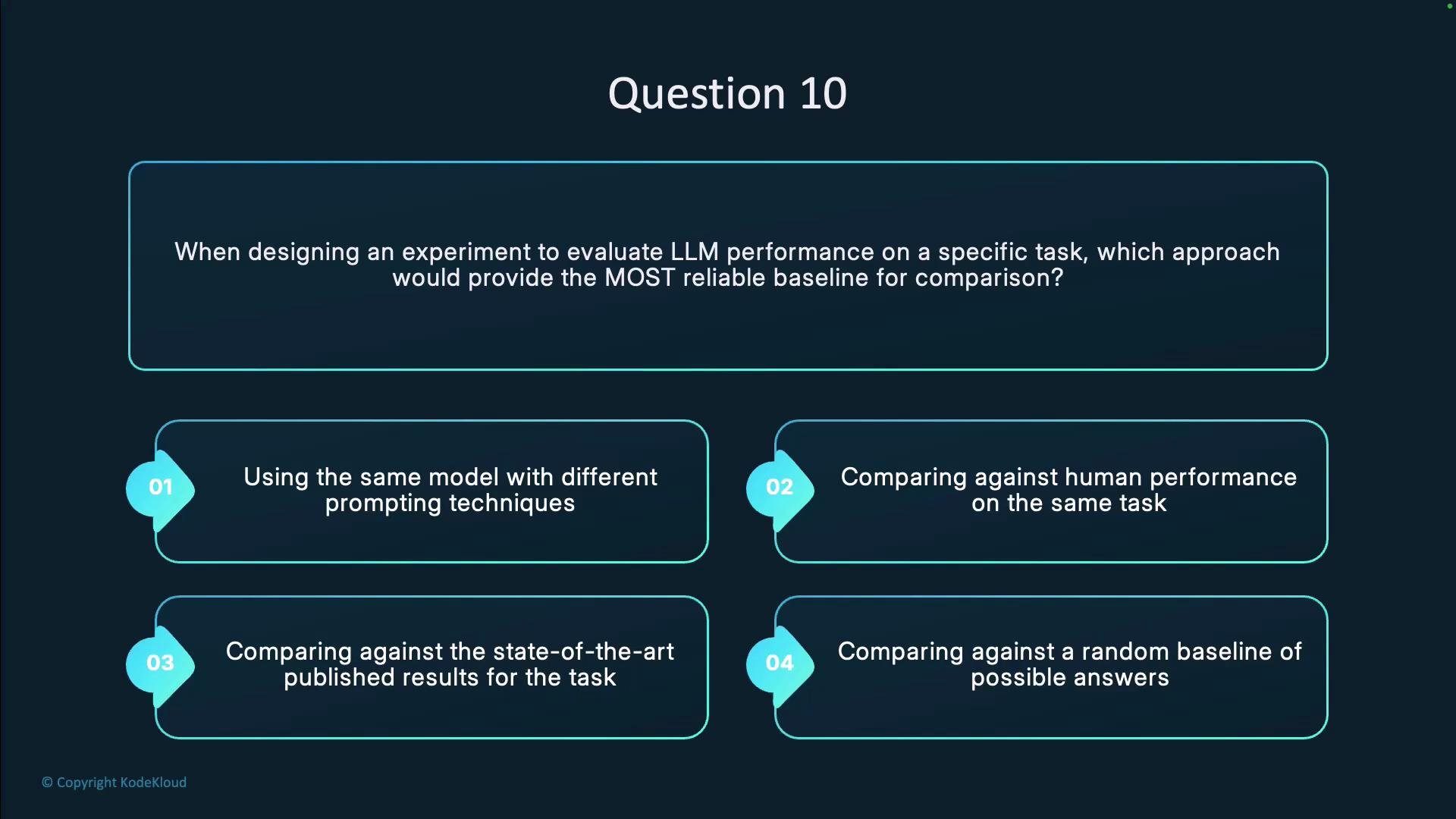
- Real-world reference: Human performance sets a practical target for many applications (e.g., summarization, question answering, content moderation, creative writing).
- Task nuance and ambiguity: Human judgments expose acceptable answer variation, common failure modes, and trade-offs (accuracy vs. fluency vs. style).
- Metric validation: Comparing models to humans helps you choose evaluation metrics that align with end-user expectations and perceived quality.
- Interpretability: A human baseline grounds model performance in observable behavior rather than purely statistical improvement.
Best practices for robust baselines
- Combine baselines: include a human baseline for real-world relevance, SOTA for research context, controlled model variants for ablation/prompting insights, and a random/trivial baseline as a sanity check.
- Match conditions: collect human annotations under the same instructions, time limits, and evaluation metrics as the model outputs.
- Report variability: provide inter-annotator agreement (e.g., Cohen’s kappa, Fleiss’ kappa) and confidence intervals so differences are interpretable.
- Use appropriate metrics: align automatic metrics (BLEU, ROUGE, METEOR, BERTScore, or task-specific measures) with human judgments; validate metric choice by correlating with human evaluations when possible.
- Statistical testing: apply significance tests (e.g., bootstrap resampling, paired t-test, or permutation tests) for robust claims about improvements.
- Document everything: include dataset splits, prompt templates, model versions, evaluation scripts, and the exact annotation protocol for reproducibility.
- Hugging Face Evaluate documentation: https://huggingface.co/docs/evaluate
- PapersWithCode (for SOTA comparisons): https://paperswithcode.com/
- Human evaluation guidelines and best practices: search for “human evaluation in NLP” and review ACL/NAACL workshop resources for annotation protocols and agreement metrics.
Collect the human baseline under the same conditions and using the same evaluation metrics as the model. Document inter-annotator agreement and variability so comparisons are fair and interpretable.