

- A. Testing on a dataset that was partially included in the model’s training data
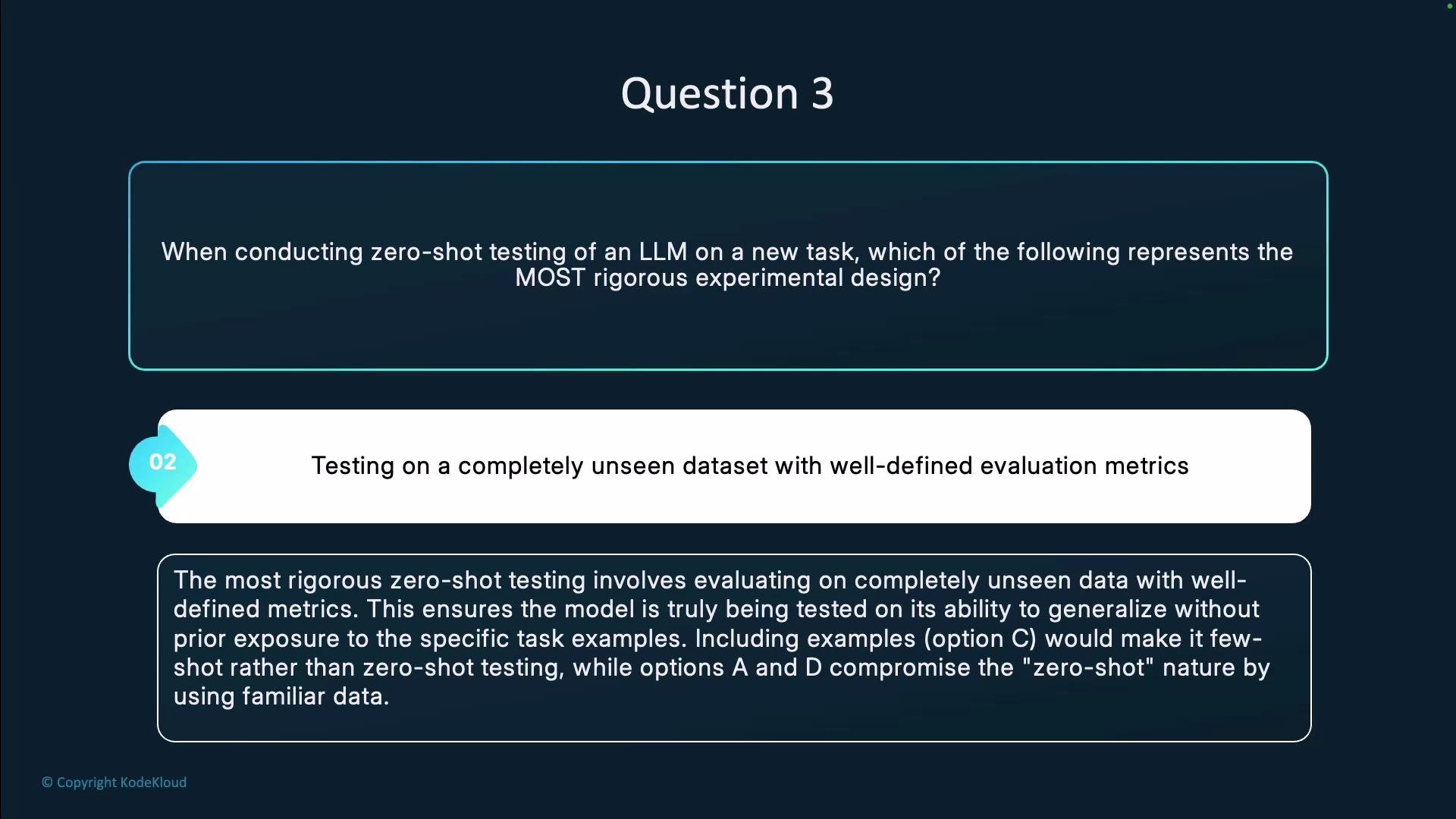
- B. Testing on a completely unseen dataset with well-defined evaluation metrics
- C. Testing with prompts that include examples of expected outputs
- D. Testing on tasks that are similar to those in the training data
- True zero-shot evaluation requires strictly held-out data that the model has never seen during training to avoid data leakage and inflated performance estimates.
- Clear, objective evaluation metrics (accuracy, F1, exact match, BLEU/ROUGE for generation, etc.) are essential for reproducibility and meaningful comparison across models.
- This combination isolates the model’s ability to generalize rather than its memorization or familiarity with task-specific examples.
- Option C: Including example outputs in the prompt converts the setup to few-shot evaluation, which is a different experimental condition and no longer zero-shot.
- Option A: Using datasets that overlap with training data introduces data leakage and can artificially boost performance.
- Option D: Testing on tasks similar to training tasks risks overestimating generalization because the model may rely on pattern reuse rather than genuine transfer.
Practical checklist for rigorous zero-shot evaluation
- Ensure dataset provenance: document sources, timestamps, and any possible overlap with model training corpora.
- Hold out a strict unseen test set: never use it during prompt development, hyperparameter tuning, or any model selection.
- Define metrics before running experiments: choose task-appropriate metrics (e.g., accuracy/F1 for classification, EM/F1 for QA, BLEU/ROUGE for generation).
- Standardize preprocessing and tokenization: report these steps so others can reproduce results.
- Control prompts: keep prompts consistent across models and document exact wording and temperature/top-p settings.
- Run statistical tests and report variance: include confidence intervals or bootstrap estimates to show result stability.
- Compare to baselines: rule-based or simple heuristics help contextualize model performance.
- Publish artifacts when possible: test set (or a reproducible sampling procedure), prompts, and evaluation scripts.
- Classification: accuracy, precision, recall, F1
- Question answering (extractive): exact match (EM), F1
- Generation/summarization: BLEU, ROUGE, METEOR (and human evaluation)
- Ranking/retrieval: MRR, MAP, NDCG
- Papers With Code — Evaluation: benchmarks and metrics across NLP tasks
- Practical recommendations for evaluating generative models (example research on best practices)
- Checklist for Reproducible NLP Experiments — guidelines for experimental rigor
For rigorous zero-shot testing: use strictly held-out datasets, define evaluation metrics up front, and document any pre-processing or prompt engineering to ensure reproducibility.