

- Comparing models with different architectures trained on the same dataset.
- Comparing models with identical architectures trained on progressively larger subsets of the same dataset.
- Comparing a single model before and after fine-tuning.
- Comparing models trained on completely different datasets of the same size.
Compare models with identical architectures trained on progressively larger subsets of the same dataset.
- Controls for architecture: Using the same model architecture removes architectural differences as a confounder, so observed performance changes can be attributed to dataset size.
- Keeps distribution consistent: Drawing progressively larger subsets from the same dataset preserves the underlying data distribution, isolating dataset size as the primary variable.
- Produces clear learning curves: With fixed hyperparameters and evaluation protocols, you can build a reliable performance vs. dataset-size curve that reveals scaling behavior.
Recommended experimental best practices
- Fix the model architecture, optimizer, learning rate schedule, batch size, and all other hyperparameters across runs.
- Use random, reproducible subsets by setting a seed so results are repeatable and comparable.
- Reserve a single, held-out evaluation set that is never used for training across any subset.
- Plot performance vs. dataset size (learning curve) using both mean estimates and confidence intervals or standard errors.
- Run multiple seeds per subset size to measure variance and compute statistical significance.
- Where practical, report compute used (GPU-hours, FLOPs) in addition to dataset size to contextualize results.
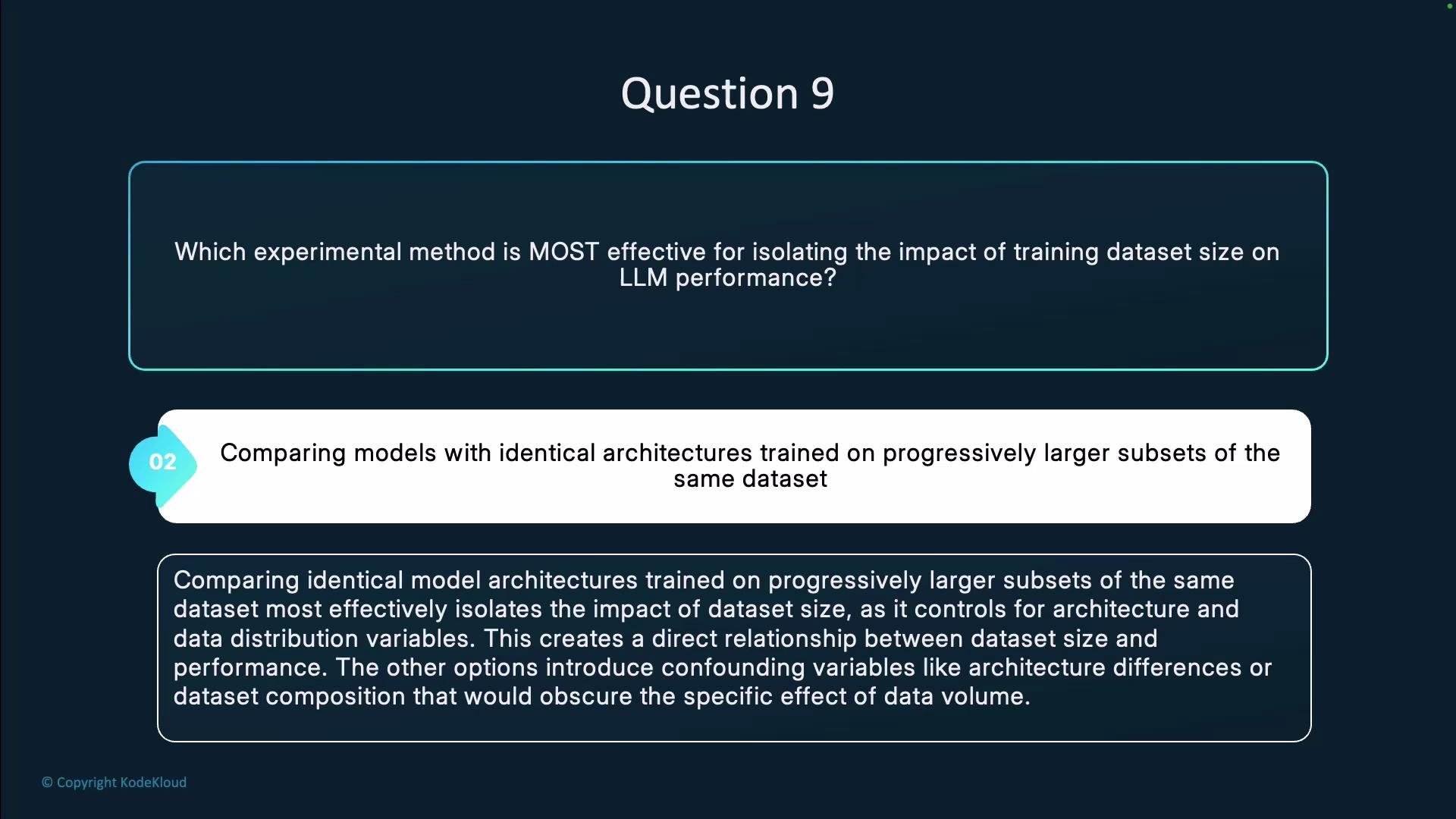
Avoid confounding variables: architecture changes, dataset composition shifts, or fine-tuning procedures will obscure the effect of dataset size. Always document dataset sampling method and training conditions.
- Kaplan et al., “Scaling Laws for Neural Language Models” — https://arxiv.org/abs/2001.08361
- Practical guidance on experimental design for ML: https://www.microsoft.com/en-us/research/publication/rigorous-evaluation-machine-learning/
- For learning-curve visualization and statistical tests, see common resources on model evaluation and reproducibility.