

- Translating all content to multiple languages.
- Chunking documents into appropriately sized segments.
- Filtering out all numeric data.
- Converting all text to lowercase.
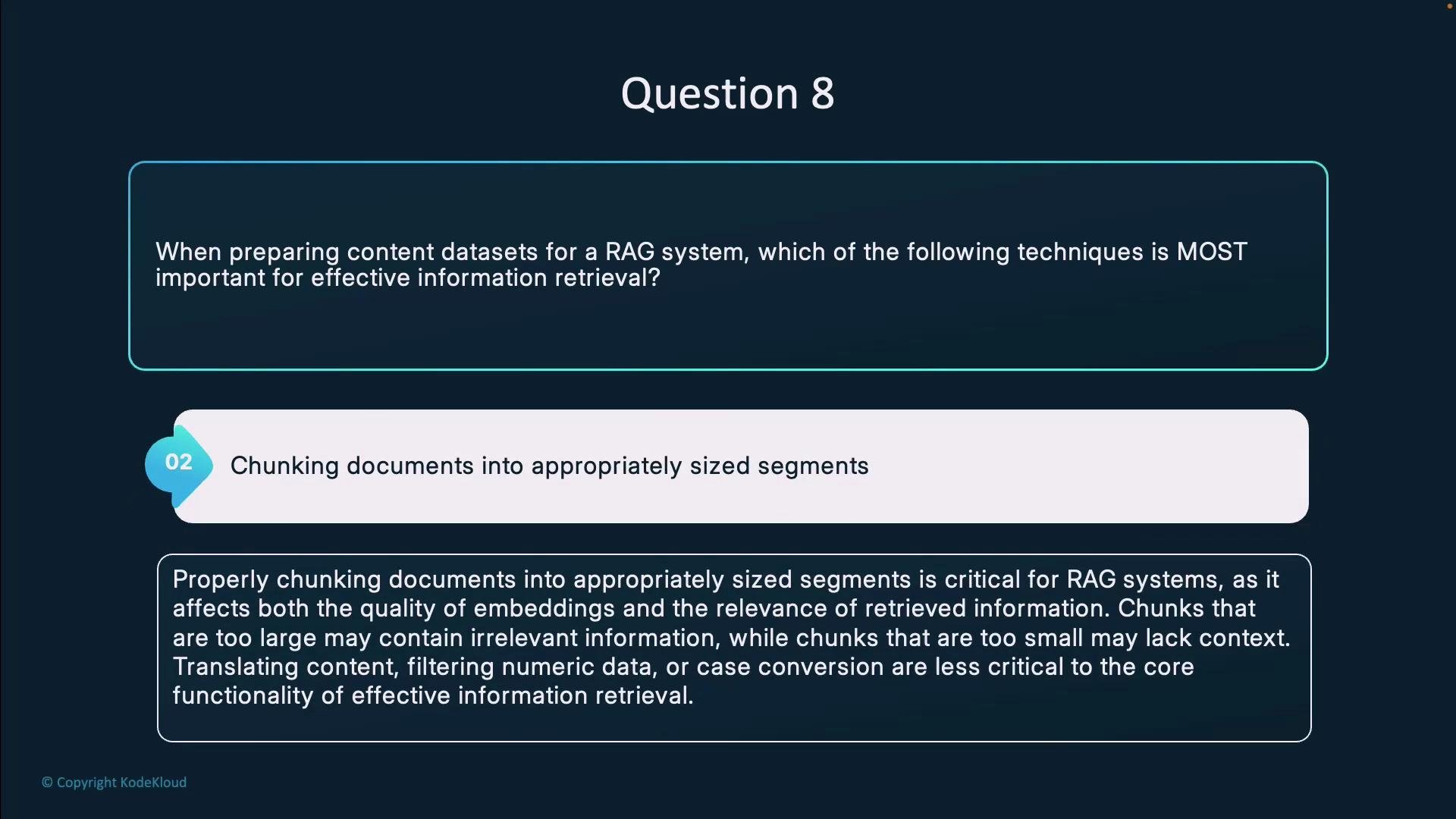
- Embedding quality: Embedding models encode the semantic meaning of a chunk. Appropriately sized, topically coherent chunks produce focused embeddings that match user queries more reliably.
- Retrieval relevance: Indexing granular chunks increases the chance that a retrieved passage contains a concise, relevant answer rather than unrelated material.
- Context trade-offs: Very large chunks can mix topics and dilute embeddings; very small chunks can strip necessary context, harming the LLM’s reasoning.
- Efficiency and scalability: Smaller, well-formed chunks reduce search latency for nearest-neighbor (k-NN) lookups in vector databases and lower memory overhead.
- Target chunk sizes that match your embedding model and the downstream LLM’s context window — commonly
~200–1000tokens depending on model choice. - Use semantic boundaries (sentences, paragraphs, section headings) instead of arbitrary byte/character splits to preserve coherence.
- Include modest overlap between adjacent chunks (e.g.,
10–30%) to preserve continuity across boundaries. - Attach rich metadata to each chunk:
source,document_id,position,section_title, and any domain tags for reranking and provenance. - Deduplicate near-duplicate chunks, normalize whitespace/formatting, and preserve numeric data unless you have a domain-specific reason to remove it.
Notes on the other options
- Translating all content may be useful for a multilingual deployment, but it is not the primary factor for retrieval quality. Consider translation when user languages require it.
- Filtering out numeric data is usually detrimental: numbers are frequently essential for accurate answers in technical, financial, scientific, and date-sensitive domains.
Do not remove numeric data indiscriminately. Numbers often carry crucial semantic meaning and can be necessary for correct retrieval and factual responses.
- Converting all text to lowercase is a minor normalization step; many modern tokenizers and embedding models handle case in a way that preserves useful signals, so lowercasing is not a substitute for proper chunking.
- Start by profiling your documents: average paragraph length, common section sizes, and domain-specific indicators (tables, code blocks, numeric-heavy sections).
- Experiment with chunk sizes and retrieval metrics (recall@k, MRR) to find the sweet spot for your pipeline.
- Consider hybrid approaches: combine semantic chunking with structured extraction for tables or code, and use specialized embeddings for tables or numeric data when needed.