- Having a single expert evaluate all outputs?
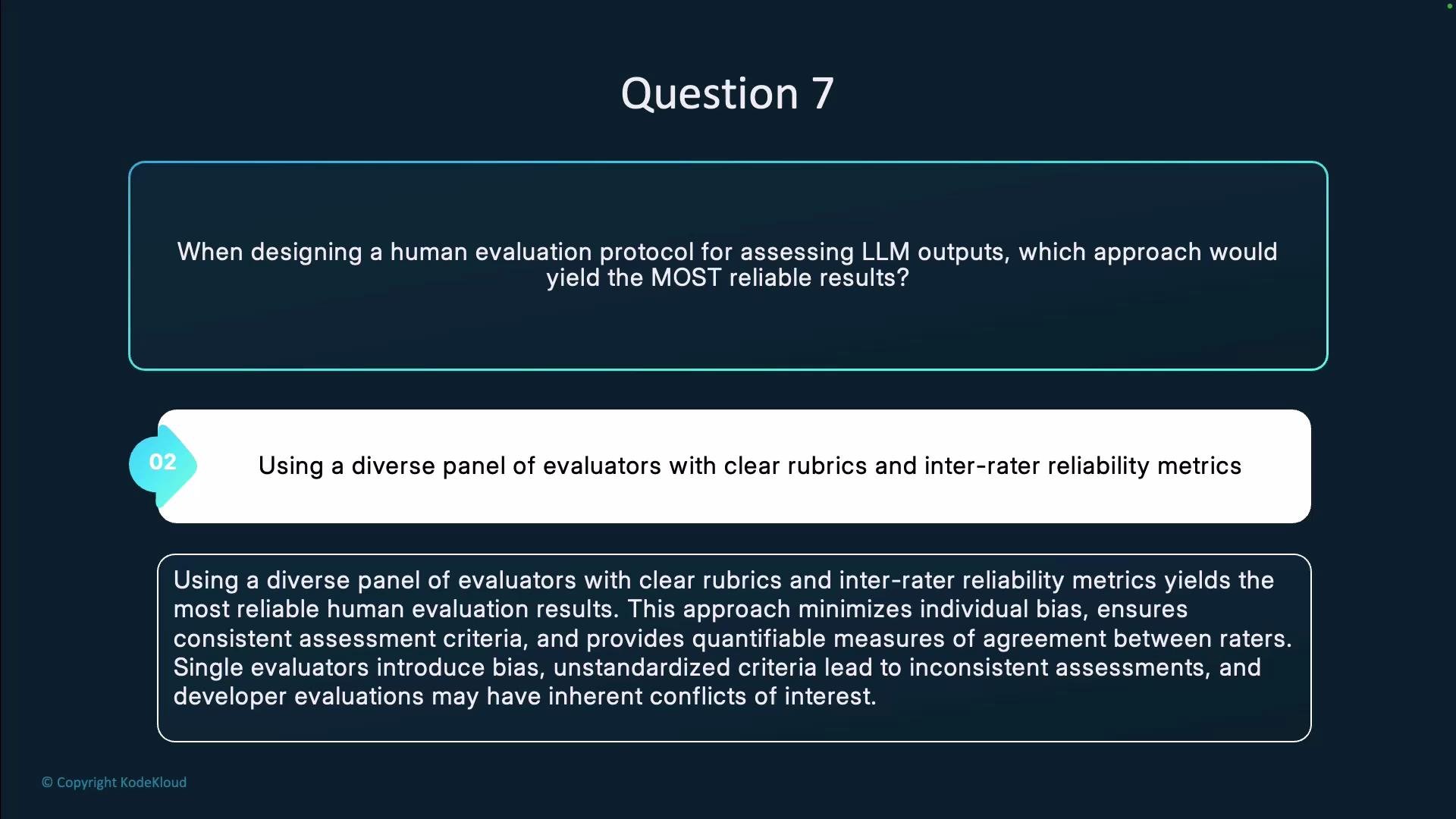
- Using a diverse panel of evaluators with clear rubrics and inter-rater reliability metrics?
- Collecting as many ratings as possible without standardized criteria?
- Having developers who train the model evaluate its outputs?
- Reduces individual bias by aggregating multiple perspectives.
- Enforces consistent assessment through explicit rubrics and example-driven guidance.
- Produces quantitative agreement measures (e.g., Cohen’s kappa, Fleiss’ kappa, Krippendorff’s alpha) to monitor annotation quality.
- Supports reproducibility and defensible comparisons across model versions and datasets.
Recommended human-evaluation protocol (concise)
-
Define clear rubrics
- Specify criteria and scoring scales (e.g., 1–5) with positive and negative examples for each level.
- Include edge-case guidance and a short decision tree to resolve ambiguous cases.
-
Recruit a diverse evaluator panel
- Combine domain experts, representative end users, and trained annotators.
- Avoid relying solely on model developers to reduce confirmation bias.
-
Annotator training and calibration
- Conduct calibration sessions using a shared seed set of examples.
- Discuss disagreements and iteratively refine the rubric.
-
Use multiple independent ratings per item
- Aim for at least three independent ratings per example; increase for subjective tasks.
- Use adjudication or consensus only for persistently conflicting items.
-
Measure inter-rater reliability (IRR)
- Calculate appropriate IRR metrics and track them over time (see Cohen’s kappa, Fleiss’ kappa, Krippendorff’s alpha).
- If IRR is low, revisit rubric clarity and retrain annotators.
-
Sampling and experimental design
- Use stratified sampling to capture edge cases, rare inputs, and typical use cases.
- Blind evaluators to model identity and version when possible to prevent anchoring effects.
-
Metadata, auditability, and reproducibility
- Record annotator IDs, timestamps, rubric version, instructions shown, and random seeds.
- Store raw annotations, adjudication notes, and any calibration artifacts for audits and longitudinal analysis.
- Single expert: introduces a narrow viewpoint and a single point of failure. Results are less generalizable.
- Many ratings without standards: generates noisy, inconsistent annotations that are difficult to interpret or replicate.
- Developers as evaluators: invites bias toward the model’s strengths and can mask real-world failure modes.
- Include example-driven rubrics with borderline cases to reduce interpretation variance.
- Pilot the protocol on a representative validation set, then scale after fixing rubric issues.
- Track IRR and annotation drift over time; schedule periodic recalibration sessions.
- Consider mixed-methods evaluation: pair quantitative ratings with qualitative feedback to surface unexpected failure modes.
- Kruskal, Fleiss, and Krippendorff reliability measures
- Designing effective annotation guidelines — practical tips and templates (replace with your internal guide)
For reliable, actionable human evaluation of LLM outputs, combine a diverse evaluator panel with a clear rubric, annotator calibration, multiple independent ratings per item, and explicit inter-rater reliability metrics.