

- Removing components randomly and measuring performance?
- Systematically removing one component at a time and measuring the impact on performance?
- Replacing components with more advanced alternatives?
- Adding new components and measuring performance improvements?
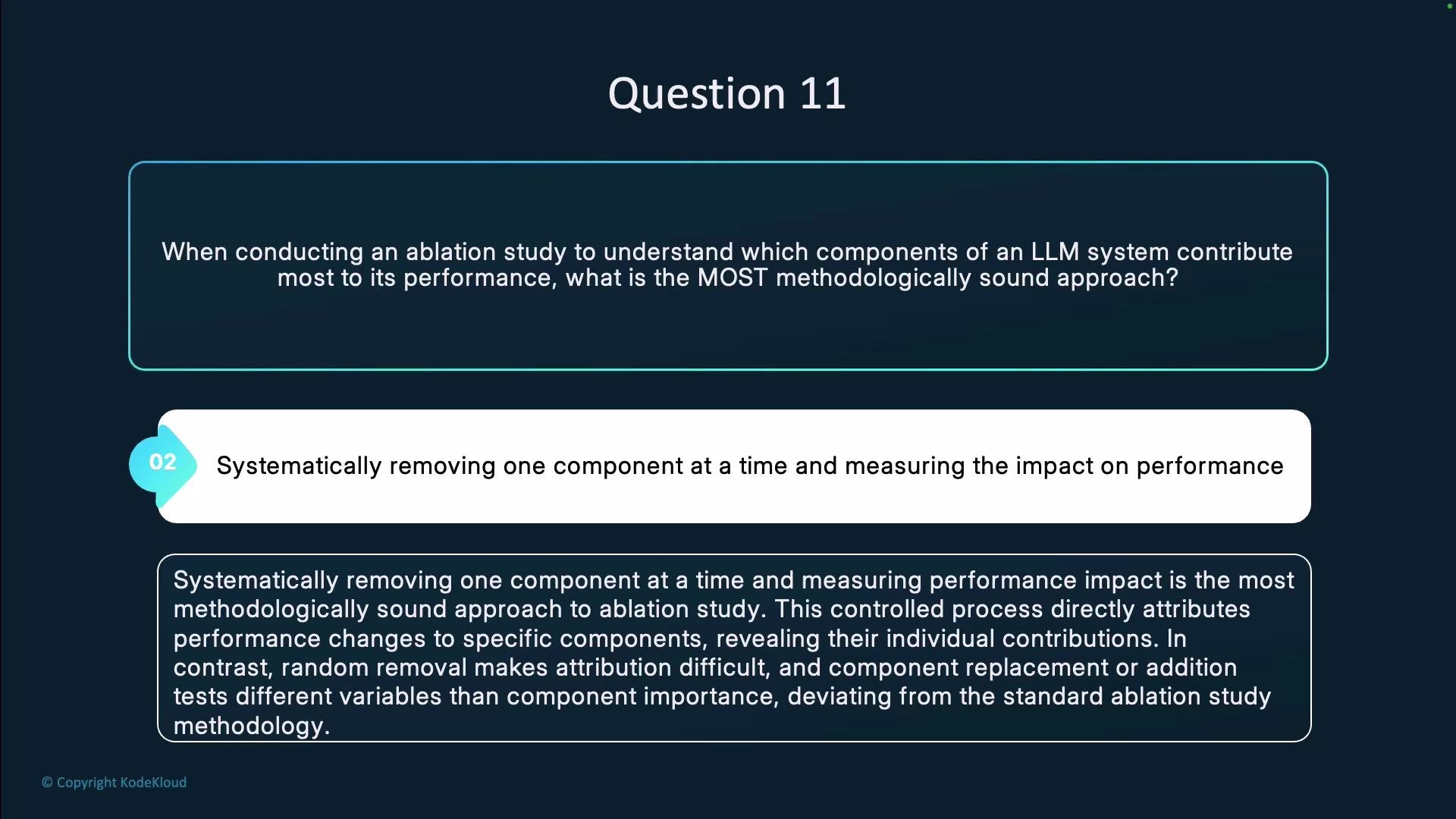
Best practices for rigorous ablation studies
Follow these practices to make ablation results reliable and actionable:
- Change only one factor per experiment (controlled ablation).
- Keep datasets, evaluation metrics, random seeds, and training/optimization regimes constant across runs.
- Run multiple trials and report variance, confidence intervals, or statistical significance.
- Log full configurations, checkpoints, and artifacts to ensure reproducibility.
- If components are likely to interact, supplement single-factor ablations with factorial designs or pairwise ablations to detect interaction effects.
Avoid drawing conclusions from single runs or from experiments where multiple variables change simultaneously. Interaction effects can hide or exaggerate a component’s true contribution—design experiments (and report them) to surface and quantify these interactions.
- Define a clear baseline system and evaluation metric(s).
- Enumerate components to ablate and prioritize them.
- For each component:
- Remove or disable it while keeping all other settings identical.
- Run N independent trials (N chosen to estimate variance reliably).
- Compute mean performance, standard error, and statistical tests vs. baseline.
- Summarize effect sizes and report any observed interactions.
- Ablation study (general guidance)
- Design of Experiments (DOE) overview
- Articles on reproducibility and reporting in machine learning research