

- Model A: accuracy = 87%, F1 = 0.83
- Model B: accuracy = 85%, F1 = 0.86
- Model A, because it has higher accuracy.
- Model B, because it has a higher F1 score.
- Both models perform equally well, or neither model is suitable for imbalanced datasets.
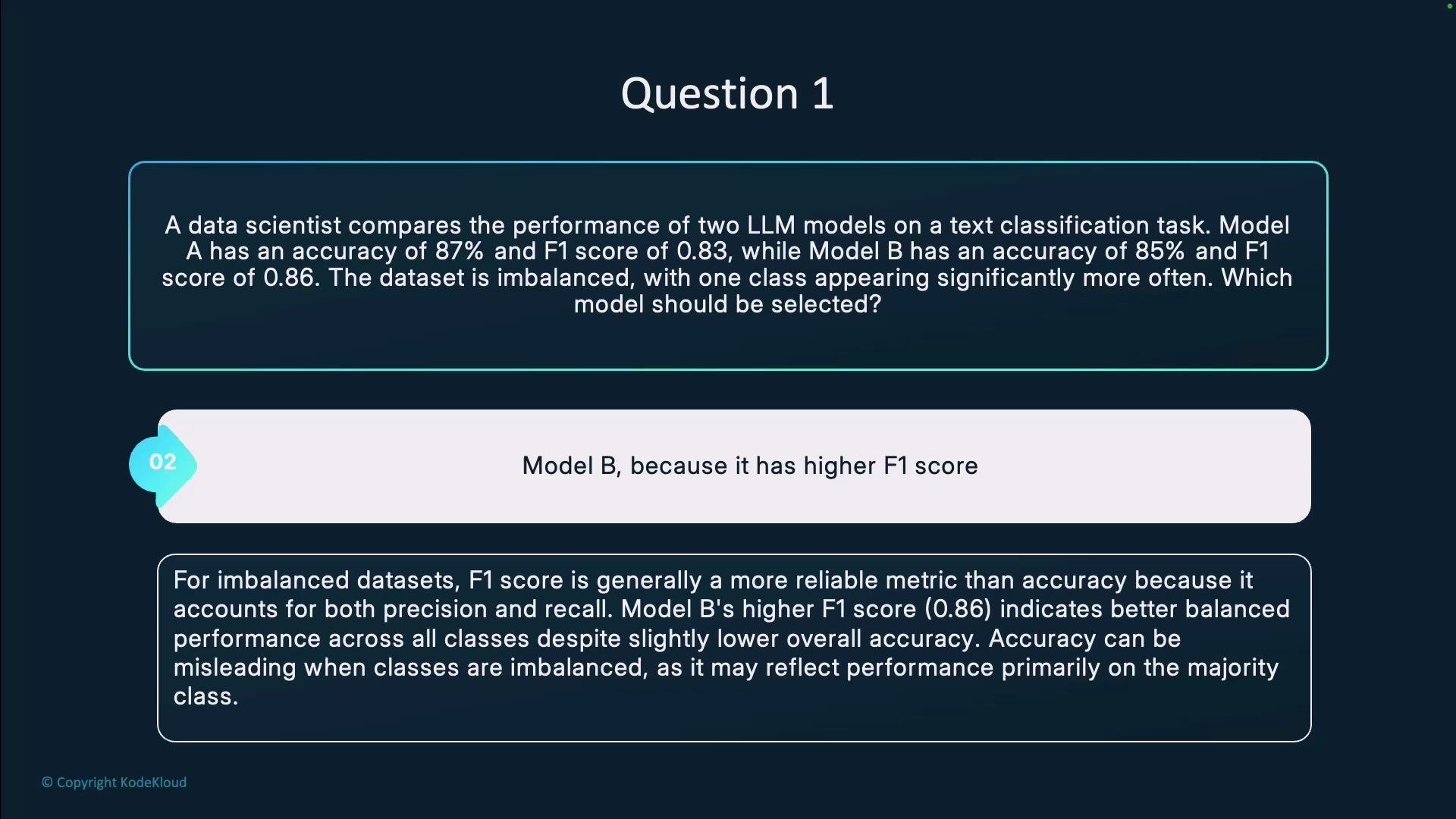
- Although Model A shows higher overall accuracy, Model B is the better choice for imbalanced datasets because its higher F1 score (0.86) indicates a healthier balance between precision and recall on the minority class.
- Accuracy can be misleading when class distribution is skewed: a trivial classifier that always predicts the majority class can still yield high accuracy while failing to identify the minority class.
Why F1 is preferable for imbalanced classes
- F1 combines precision and recall, so it penalizes models that achieve high accuracy by only predicting the majority class.
- When the minority class is important (e.g., fraud detection, disease diagnosis), missing positives (low recall) or producing many false positives (low precision) are both costly — F1 captures both types of errors.
- Use macro-F1 to treat classes equally, and weighted-F1 to account for class frequency while still exposing poor minority-class performance.
- Prefer F1 / macro-F1 / weighted-F1: imbalanced datasets, minority-class importance, or class-wise performance matters.
- Use PR-AUC (precision-recall AUC) for rare positive classes — PR curves emphasize performance on the positive class.
- Use ROC-AUC only when classes are reasonably balanced or when you want a threshold-agnostic measure and false positive/negative costs are similar. In extreme imbalance, ROC-AUC can be overly optimistic.
- Accuracy is acceptable when classes are balanced and the costs of different error types are similar.
- Inspect the confusion matrix and per-class precision/recall — don’t rely solely on a single scalar like accuracy.
- Report multiple metrics:
precision,recall,F1,macro-F1,weighted-F1, andPR-AUCwhere applicable. - Consider business impact: define whether false positives or false negatives are more costly and tune thresholds accordingly.
- Improve minority-class performance if needed:
- Class weighting in the loss function.
- Resampling: oversample minority class (SMOTE, ADASYN) or undersample majority class.
- Use ensemble methods or specialized algorithms for imbalanced data.
- Calibrate classification thresholds based on precision/recall trade-offs.
- If 90% of the data is class A and 10% is class B, a model that always predicts class A gets 90% accuracy but zero recall on class B. F1 for class B will be 0 — clearly showing the model is useless for the minority class despite high accuracy.
- Choose Model B because its higher F1 (0.86) signals better balance between precision and recall for the minority class, which is the key concern in imbalanced datasets.
- Report per-class metrics and include macro-F1 / weighted-F1 in any model comparison to make decisions transparent.
When classes are imbalanced, favor F1-based metrics and per-class evaluation (precision, recall, confusion matrix). Model B is the better choice here because its higher F1 indicates more balanced performance across classes despite slightly lower accuracy.
- Precision and Recall — Wikipedia
- Understanding the ROC Curve — Towards Data Science
- Scikit-learn metrics — Precision, Recall, F1