- Testing a single, extremely large context window?
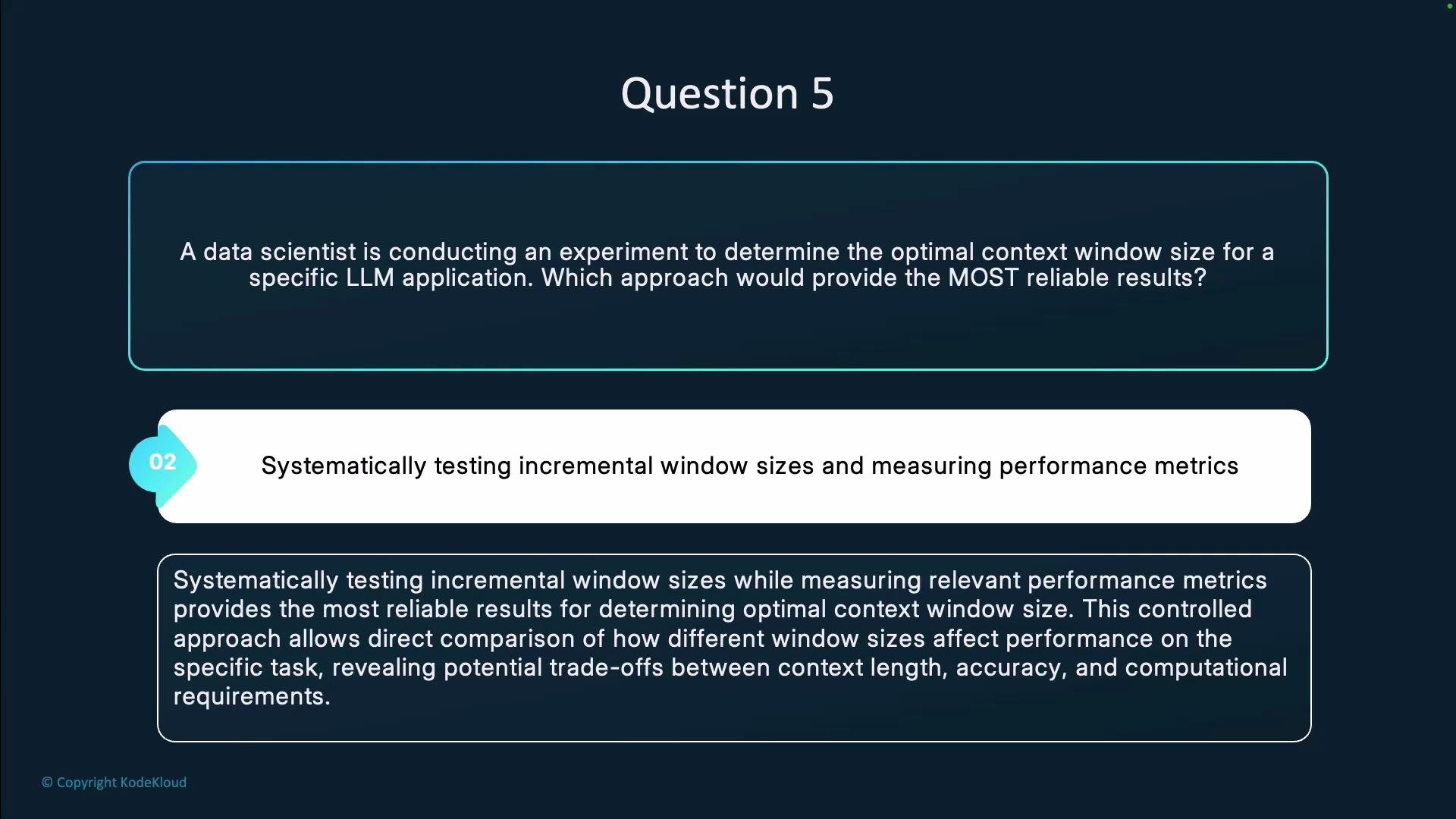
- Systematically testing incremental window sizes and measuring performance metrics?
- Using the default context window recommended by the model documentation.
- Asking users which context window they prefer?
The most reliable method is a controlled, systematic experiment across multiple context window sizes, measuring both model performance and system/resource metrics. This reveals performance trends and practical trade-offs (accuracy, latency, memory, cost), rather than relying on a single data point or subjective preference.
- Direct comparison: Changing only the context window isolates its effect on the task.
- Quantitative trade-offs: You can observe where performance gains plateau while resource costs keep rising.
- Reproducibility: Using consistent prompts, tokenization, and seeds reduces variance and supports statistically valid conclusions.
- Practicality: Allows you to combine model capability with operational constraints (latency, memory, and cost) to select the best real-world configuration.
-
Define scope
- Specify task(s): e.g., summarization, question answering, code generation.
- Select datasets and clear evaluation splits (train/validation/test).
- Choose metrics: accuracy, F1, exact match, perplexity, latency, peak GPU/CPU memory, and inference cost.
-
Select window sizes to test
- Pick a range that covers typical and extreme cases (e.g., 512, 1,024, 2,048, 4,096 tokens), up to the model’s supported limit.
-
Ensure experimental consistency
- Use identical prompt templates, preprocessing, tokenization, and random seeds across runs.
- Repeat runs to quantify variance.
-
Measure and record both model and system metrics
- Model metrics: accuracy, F1, BLEU, ROUGE, perplexity, recall for long-range dependencies.
- System metrics: latency (p99/p95), throughput (tokens/sec), peak and average memory usage, and cost per inference.
-
Analyze results
- Plot performance vs. window size and resource usage vs. window size to identify inflection points and diminishing returns.
- Use statistical tests or confidence intervals to validate observed differences.
-
Consider hybrid or alternative approaches
- Retrieval-augmented prompting (store and fetch relevant context).
- Chunking + summarization (divide long context and compress).
- Streaming/recurrence mechanisms or stateful architectures.
- Compare any hybrid method against single-window baselines.
Practical tips and pitfalls
- Don’t assume “bigger is always better.” Large windows can improve recall but often increase latency, memory usage, and cost disproportionately.
- Use validation splits and repeated trials to mitigate noisy measurements.
- If long contexts are necessary but expensive, evaluate hybrid solutions (retrieval, summarization, chunking) as first-class options.
Avoid making decisions based on a single run, purely model-documented defaults, or user preference alone. Those approaches miss the trade-offs that matter in production (latency, memory, and cost). Always validate experimentally for your specific task and deployment constraints.