- Using only data from a single demographic group
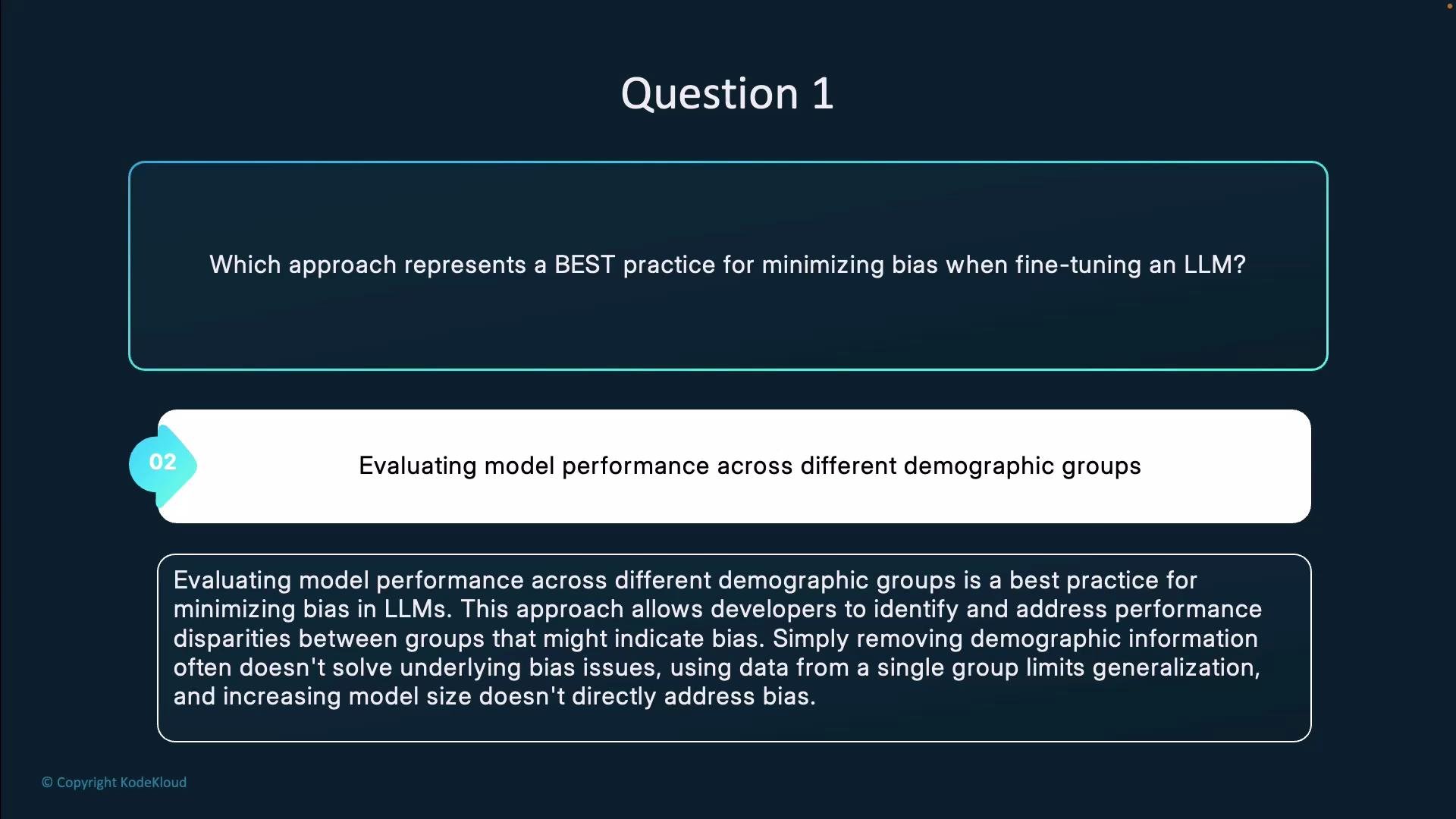
- Evaluating model performance across different demographic groups
- Iterator pattern
- Builder pattern
- Measuring performance across demographic groups reveals disparities that indicate bias and point to where mitigation is needed.
- Removing explicit demographic attributes from training data rarely removes bias entirely; models can learn proxies for those attributes.
- Training on a single demographic group reduces generalization and can amplify harm for underrepresented groups.
- Software design patterns like iterator or builder are unrelated to bias mitigation in model fine-tuning.
Assessing model performance across diverse demographic groups is the starting point for detecting and fixing bias—measure first, then apply targeted mitigation.
Additional implementation notes
- Define and document demographic groups, metrics, and acceptable thresholds before optimization to avoid ad hoc changes.
- Balance fairness objectives with overall utility and safety; trade-offs should be explicit and tracked.
- Engage stakeholders (domain experts, impacted communities, legal/compliance) when defining fairness goals and validating mitigations.
Avoid trusting a single mitigation (like removing demographic fields) as a silver bullet. Models can infer protected attributes from correlated features; mitigation should be measured empirically and iterated.
- NVIDIA Generative AI LLMs Associate Certification
- AI fairness toolkits and resources: IBM AI Fairness 360 (https://aif360.mybluemix.net/), Google ML fairness guides (https://developers.google.com/machine-learning/fairness-overview)
- Research and best practices on fairness metrics and mitigation: Barocas, Hardt, Narayanan — Fairness and Machine Learning